
On Earth as It Is in Heaven, Part 2 – Daniel 10

Daniel 10 introduces the book’s fourth and final vision, which includes Chapters 10, 11, and 12. It is set in about 537 BC, the third year of Cyrus and approximately two years after the vision of Chapter 9. Daniel’s Babylonian name, Beltshazzar, is used to remind us he is still in Babylonian exile.

Two years earlier the first group of Jewish exiles had returned to Jerusalem in response to Cyrus’s decree to rebuild the Jerusalem Temple (see Ezra 1-2). But we know from Daniel 9 that although some of the captives were returning, the end of the Babylonian exhile was not the end of conflict for the Jewish people.

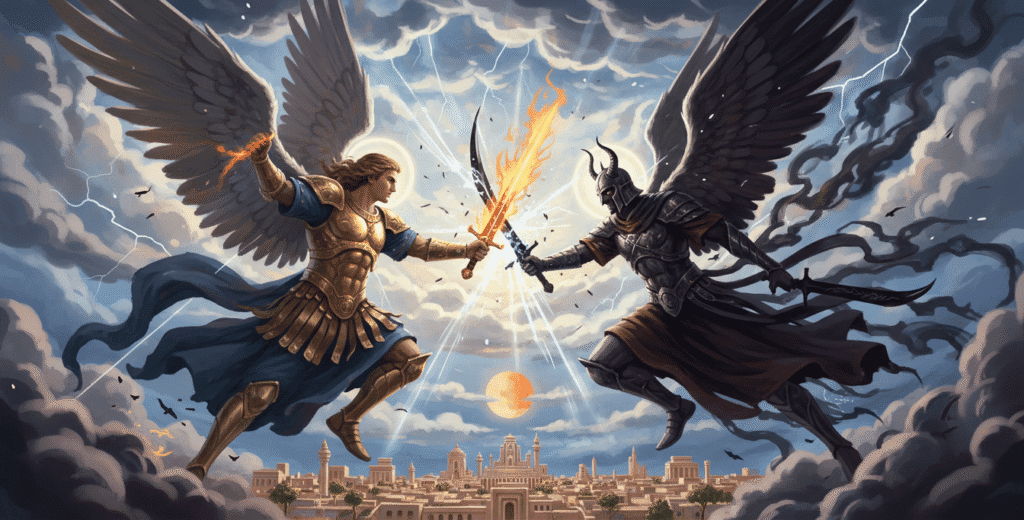
Daniel 10 momentarily pulls back the curtain separating the visible and invisible realms–the earthly and heavenly, the temporal and eternal–to reveal the divine realities behind human conflicts. This prologue to Daniel’s vision in Chapters 10-12 explained that the historical struggles of the Jews, Persia, and Greece (and all nations by extension) have a supernatural dimension.

Daniel 10:4-7 described a glorious being wearing linen, with eyes like flaming torches and a face like lightning that appeared to him in a vision. Possibly that figure was a manifestation of God Almighty (a theophany). If so, then the figure introduced in verses 5–6 need not be the same being as the messenger who later described needing Michael’s assistance to get his message through to Daniel. But, it seems improbable that God Himself could be held up in the spiritual realm for 21 days and would need assistance from another spiritual being (vs. 13).

While other supernatural beings appeared to Daniel later in the vision (vs. 12:5), the glorious figure described in vs. 10:5-6 was a heavenly attendant of God who reflected God’s glory and thereby demonstrated his credentials to bring the message. Without reading more into the story, he was also the one talking to Daniel in the vision.

The divine figure or angel told Daniel that the prince of Persia resisted him for 21 days until one of the chief princes, the archangel Michael, came to assist him. Some may argue that the “prince” mentioned here was a human ruler, but certainly it was a supernatural being who exercised authority over the Persian nation: “When the Most High gave to the nations their inheritance, when he divided mankind, he fixed the borders of the peoples according to the number of the sons of God” (Deuteronomy 32:8, ESV).

The 21-day delay (Daniel had spent three weeks in prayer and mourning – vs. 2-3) was because of the resistance of the (demonic) supernatural being that had spiritual dominion over the Persian territory attempting to prevent God’s message from being brought to Daniel (see vs. 1). To bring God’s message to Daniel, the heavenly messenger required the assistance from another spiritual being of greater authority.

While God rules over all creation, the biblical narrative includes real heavenly beings who exercise delegated authority. Some of these heavenly beings have rebelled against God’s plans and purposes. The struggles of earthly empires are connected to this supernatural reality. Yet neither rebellious spiritual powers nor oppressive earthly rulers can prevent God’s ultimate victory. His people will always be vindicated and God’s Kingdom will prevail.

We live in a world of dual realities and God’s will is exercised on earth as it is in heaven. But we must not forget that there are evil spiritual powers exercising spiritual authority over the nations of the earth and attempting to subvert God’s will (in heaven and on earth).

The Apostle Paul declares that Christians must not underestimate the demonic powers that are at work in this world nor try to fight against them in their own power: “Finally, be strong in the Lord and in the strength of his might. Put on the whole armor of God, that you may be able to stand against the schemes of the devil. For we do not wrestle against flesh and blood, but against the rulers, against the authorities, against the cosmic powers over this present darkness, against the spiritual forces of evil in the heavenly places (Ephesians 6:10-12, ESV).
God’s Grand Plan – Daniel 9:16-27

“While I was speaking and praying, confessing my sin and the sin of my people Israel, and presenting my plea before the Lord my God for the holy hill of my God, while I was speaking in prayer, the man Gabriel, whom I had seen in the vision at the first, came to me in swift flight at the time of the evening sacrifice. He made me understand, speaking with me and saying, ‘O Daniel, I have now come out to give you insight and understanding. At the beginning of your pleas for mercy a word went out, and I have come to tell it to you, for you are greatly loved. Therefore consider the word and understand the vision. Seventy weeks are decreed about your people and your holy city, to finish the transgression, to put an end to sin, and to atone for iniquity, to bring in everlasting righteousness, to seal both vision and prophet, and to anoint a most holy place'” (Daniel 9, 20-24, ESV).

In the first year of the rule of Darius the Mede Daniel was reading the book of Jeremiah the prophet and realized that the time of Babylonian exile was almost completed (see Jeremiah 25:11-14; 29:10-14). Within the traditional chronology that places Darius the Mede immediately after Babylon was conquered by Persia, Daniel’s reference to his first year likely points to approximately 538 BC. Since the first captives had been taken from Jerusalem around 605 BC, Daniel recognized that Jeremiah’s 70-year period was nearing completion.

So Daniel began to pray to God pleading for the return of the Jews to the promised land in vs. 3-19. Daniel’s impassioned prayer contained expressions of humility worship, confession, and petition. In the prayer Daniel acknowledged that the destruction of Jerusalem and the exile of Judah were not acts of an arbitrary God, but the consequences of the sinful actions of God’s people, about which they were repeatedly warned.

Daniel concluded that if there was any hope for them, it would be because of God’s mercy and in His righteousness, not their own.

Then, the angel Gabriel appeared to Daniel and communicated the heavenly answer to Daniel’s prayer by reinterpreting the seventy years as seventy weeks (seventy sevens) that are at hand for God’s people (vs. 24). These seventy weeks are understood to refer to seventy seven-year periods of time or 490 years (70 x 7 years).

So, Gabriel informed Daniel that the period of time Daniel was concerned with, the Babylonian exile, was only one part of a more extensive plan of God that would “bring in everlasting righteousness” (vs. 24, cf. Ephesians 1:7-10).

There are several interpretations of the 490-year era that Gabriel revealed. Some view the 490 years figuratively or as approximate and some views interpret the time period literally. Because Gabriel breaks the seventy sevens into three parts, 7 + 62 + 1 (see vs. 25-27), some views even place a gap or period of time between the 69th and 70th weeks so that the last seven-year period of time is at the time leading up to the second coming of Christ.

While there has been much speculation by biblical scholars stipulating when the 70 weeks begins and/or ends, what’s significant to me is that God through the angel Gabriel notified Daniel that the 70 years Daniel is concerned about is but one week of a 70-week comprehensive plan.

God has a grand plan. It’s a plan for our redemption. But, the scope of God’s plan is always immensely greater that what we can know or even understand.

And, you have a role to play in God’s grand plan of redemption. Your job is to hope and trust in Him and make His Will your own will so that you become both a participant and a facilitator of the cosmic plan of God!

In him we have redemption through his blood…. making known to us the mystery of his will, according to his purpose, which he set forth in Christ as a plan for the fullness of time, to unite all things in Christ, things in heaven and things on earth in him. (Ephesians 1:7-10 , ESV)

Role Player – Genesis 20-21:6

“The Lord came to Sarah as he had said, and the Lord did for Sarah what he had promised. Sarah became pregnant and bore a son to Abraham in his old age, at the appointed time God had told him” (Genesis 21:1-2, CSB).

In basketball not every great player is a starter. You have players who come off the bench who are great defensive players, great rebounders, great ball-handlers or great 3-point shooters. These players may not be the stars of the team but you can’t be a championship team without great role players.

After the destruction of Sodom and Gomorrah, Genesis returned to the story of Abraham. Genesis 20 is devoted to God’s rescue of Abraham’s wife, Sarah, from the harem of King Abimilech.

Abraham had continued his travels around the Promised Land and settled for a while in the region of the Negev. The Negev is a desert region in southern Israel. Abraham obviously had a large entourage and a large number of flocks so when he entered the region he likely requested permission from the king to encamp there.

In making his request Abraham told King Abimelech that Sarah was his sister, not his wife. While it was true that Sarah was Abraham’s half-sister (Genesis 20:12), Abraham omitted the part that she was also his wife. Abimilech took Sarah into his household (or harem) as one of his wives, possibly to seal the deal.

Continue reading →

God’s Power of Attorney – John 14:8-17

“Truly I tell you, the one who believes in me will also do the works that I do. And he will do even greater works than these, because I am going to the Father. Whatever you ask in my name, I will do it so that the Father may be glorified in the Son. If you ask me anything in my name, I will do it…. And I will ask the Father, and he will give you another Counselor to be with you forever. He is the Spirit of truth” (John 14:12-17, CSB).

As Jesus and His disciples shared a last meal together, Judas Iscariot’s impending betrayal was revealed by Jesus to His disciples. Once Judas left the dinner to carry out his unscrupulous scheme, Jesus spoke openly and intimately with His remaining disciples about the events that were about to unfold and what they meant. John 13:31 – 17:26 replays the conversation Jesus had with His disciples.

As Jesus was explaining to His disciples that the only way to know God the Father was through Him, Philip asked Him to show them the Father and that’s all they would need to believe. Jesus reminded the disciples that the Father was in Him and the words He spoke and miracles He performed were by the power of God the Father.

Then, Jesus added that not only did He have the power to do God’s works, He also had the power to enable those who believed in Him, His disciples, to perform the miracles He performed and even greater ones than He did! When Jesus said to ask in His name and He will do it, He was granting His power of attorney.

Continue reading →

What’s Really Important – Matthew 6:19-21

“For where your treasure is, there your heart will be also” (Matthew 6:21, NIV).

In this one concise statement Jesus reveals a fundamental attribute of human behavior: People do what’s important to them!

In other words, your priorities dictate your behavior.

Your life in this world is not so much a matter of what you get out of it as what you put into it.

All of us have plans for the future and goals we want to achieve in life. These could be plans for success in your career, a six or seven figure salary, a new home or maybe an exotic vacation.

Whatever the plans or goals are, we strive for those things that are important to us. And, Jesus makes it clear in this pronouncement that the things that we personally value are the things that control our lives.

Continue reading →

Good Trouble – 2 Samuel 19:1-8

“‘Now get up! Go out and encourage your soldiers, for I swear by the Lord that if you don’t go out, not a man will remain with you tonight. This will be worse for you than all the trouble that has come to you from your youth until now!’ So the king got up and sat in the gate, and all the people were told: ‘Look, the king is sitting in the gate.’ Then they all came into the king’s presence” (2 Samuel 19:7-8, HCSB).

Sometimes we let our own personal problems and feelings overshadow what God is doing all around us. Such is the case with King David upon hearing of the death of his son and heir apparent, Absalom.

David’s army of Judah had just defeated an army of the other tribes of Israel in a civil war that Absalom led against David. David’s army prevailed and Absalom was killed in the fighting. When David heard the news of the victory and of Absalom’s death, he immediately went into mourning for his son: “So the victory that day was turned into mourning for all the people, for the people heard that day, ‘The king is grieving for his son.’” (vs. 2).

David let his own grief overcome not just his kingly responsibilities but even his gratitude to God for saving the nation.

Continue reading →

Why? – John 12:27

“Now my soul is deeply troubled. Should I pray, ‘Father, save me from this hour’? But this is the very reason I came!” (John 12:27, NLT).

Recently, I’ve been reading Simon Sinek’s book, Start With Why. The premise of the book is that successful leaders influence loyalty to a product, movement or idea because they communicate why their organizations exist. According to Sinek, knowing your why is more important than  knowing what you do or how you do it. And, knowing your why will help you know what to do and how to do it.

So, apply this on a personal level. What’s your why? Why do you exist? Why do you do what you do?

In a conversation in John 12 that Jesus had with some of His disciples concerning His impending death, He seemed to be very aware of His Why. He knew exactly why He existed and why He did what He did.

Continue reading →

Folding – Romans 12:1-2

sheet_of_paper“So, brothers and sisters, because of God’s mercies, I encourage you to present your bodies as a living sacrifice that is holy and pleasing to God. This is your appropriate priestly service. Don’t be conformed to the patterns of this world, but be transformed by the renewing of your minds so that you can figure out what God’s will is—what is good and pleasing and mature.” (Romans 12:1-2, CEB).

This meditation is a hands-on lesson in how God works in our lives. Give it a try.

  1. Take a blank sheet of paper and in the middle of the sheet of paper write in large letters:

MY WILL

  1. Then in the top left-hand corner write in smaller letters:

GOD’S
PERFECT
WILL

  1. Fold the paper in half folding the bottom half behind and to the top so that the words are still showing.
  2. Then fold the paper in half folding the right half behind and to the left so that the words are still showing.
  3. Again, fold the paper in half folding the bottom half behind and to the top so that the words are still showing.
  4. And, again fold the paper in half folding the right half behind and to the left so that the words are still showing.
  5. You should  now have a small square of paper in your hands that is 1/16th of the original paper size with the words printed on it: GOD’S PLAN FOR MY LIFE. These words probably fill or almost fill the small square of paper in your hand.

Here’s the point of this exercise:

We like to think of God’s will as something that is being revealed a little at a time. It’s like something we discover as if it is unfolding before us.

Actually, finding God’s will is more like folding than unfolding. It’s more like the displacement of our own will in favor of God’s will. It’s a place God leads us, not a place we discover.

Continue reading →

God Is With You. No, God Is In You. – Haggai 1-2

indwelling-holy-spirit“Then Haggai, the Lord’s messenger, gave the Lord’s message to the people: I am with you, says the Lord… be strong, all you people of the land, says the Lord… Work, for I am with you, says the Lord” (Haggai 1:13, 2:4, CEB).

The Lord told Haggai to encourage the people to get to work to rebuild the Temple. God encouraged them to get started and reminded them that they were able to do it because He was with them.  God reminded them in both chapters of this two-chapter Old Testament book.

Now, God is with us by the indwelling presence of the Holy Spirit. And He has an assignment for each of us that accomplishes His purposes.  So, we should be bold and get to work doing His will because “I am with you, says the Lord!”

Here’s the problem: Instead of being bold, we are reticent about doing God’s will. We hesitate because we don’t know what His assignment is for us.

Or we think we don’t know. Or we think we can’t accomplish His assignment for us because it’s so overwhelming.

Continue reading →

God’s Will? Go Figure… – Romans 12:1-2

God's Will-Go Figure“So, brothers and sisters, because of God’s mercies, I encourage you to present your bodies as a living sacrifice that is holy and pleasing to God. This is your appropriate priestly service. Don’t be conformed to the patterns of this world, but be transformed by the renewing of your minds so that you can figure out what God’s will is—what is good and pleasing and mature” (Romans 12:1-2, CEB).

In this life the only right you truly possess is your right to your self–that is, your will. Your will is the the unique quality of self or being that God has created to make you distinctively human: “The Lord God said, ‘The human being has now become like one of us, knowing good and evil'” (Genesis 3:22, CEB).

In other words, human beings have free will. And, they are free to use their wills to choose good or evil.

You are free to choose how you live your life. You can choose to live according to your own will or you can choose to live according to God’s will.

Continue reading →