On Earth as It Is in Heaven, Part 2 – Daniel 10

Daniel 10 introduces the book’s fourth and final vision, which includes Chapters 10, 11, and 12. It is set in about 537 BC, the third year of Cyrus and approximately two years after the vision of Chapter 9. Daniel’s Babylonian name, Beltshazzar, is used to remind us he is still in Babylonian exile.

Two years earlier the first group of Jewish exiles had returned to Jerusalem in response to Cyrus’s decree to rebuild the Jerusalem Temple (see Ezra 1-2). But we know from Daniel 9 that although some of the captives were returning, the end of the Babylonian exhile was not the end of conflict for the Jewish people.

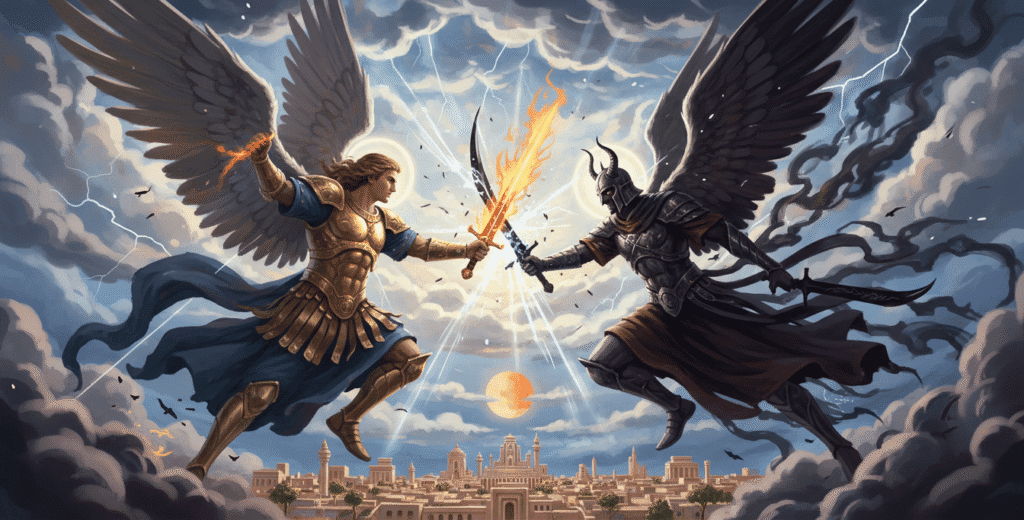
Daniel 10 momentarily pulls back the curtain separating the visible and invisible realms–the earthly and heavenly, the temporal and eternal–to reveal the divine realities behind human conflicts. This prologue to Daniel’s vision in Chapters 10-12 explained that the historical struggles of the Jews, Persia, and Greece (and all nations by extension) have a supernatural dimension.

Daniel 10:4-7 described a glorious being wearing linen, with eyes like flaming torches and a face like lightning that appeared to him in a vision. Possibly that figure was a manifestation of God Almighty (a theophany). If so, then the figure introduced in verses 5–6 need not be the same being as the messenger who later described needing Michael’s assistance to get his message through to Daniel. But, it seems improbable that God Himself could be held up in the spiritual realm for 21 days and would need assistance from another spiritual being (vs. 13).

While other supernatural beings appeared to Daniel later in the vision (vs. 12:5), the glorious figure described in vs. 10:5-6 was a heavenly attendant of God who reflected God’s glory and thereby demonstrated his credentials to bring the message. Without reading more into the story, he was also the one talking to Daniel in the vision.

The divine figure or angel told Daniel that the prince of Persia resisted him for 21 days until one of the chief princes, the archangel Michael, came to assist him. Some may argue that the “prince” mentioned here was a human ruler, but certainly it was a supernatural being who exercised authority over the Persian nation: “When the Most High gave to the nations their inheritance, when he divided mankind, he fixed the borders of the peoples according to the number of the sons of God” (Deuteronomy 32:8, ESV).

The 21-day delay (Daniel had spent three weeks in prayer and mourning – vs. 2-3) was because of the resistance of the (demonic) supernatural being that had spiritual dominion over the Persian territory attempting to prevent God’s message from being brought to Daniel (see vs. 1). To bring God’s message to Daniel, the heavenly messenger required the assistance from another spiritual being of greater authority.

While God rules over all creation, the biblical narrative includes real heavenly beings who exercise delegated authority. Some of these heavenly beings have rebelled against God’s plans and purposes. The struggles of earthly empires are connected to this supernatural reality. Yet neither rebellious spiritual powers nor oppressive earthly rulers can prevent God’s ultimate victory. His people will always be vindicated and God’s Kingdom will prevail.

We live in a world of dual realities and God’s will is exercised on earth as it is in heaven. But we must not forget that there are evil spiritual powers exercising spiritual authority over the nations of the earth and attempting to subvert God’s will (in heaven and on earth).

The Apostle Paul declares that Christians must not underestimate the demonic powers that are at work in this world nor try to fight against them in their own power: “Finally, be strong in the Lord and in the strength of his might. Put on the whole armor of God, that you may be able to stand against the schemes of the devil. For we do not wrestle against flesh and blood, but against the rulers, against the authorities, against the cosmic powers over this present darkness, against the spiritual forces of evil in the heavenly places (Ephesians 6:10-12, ESV).

On Earth as It Is in Heaven – Daniel 8

“And at the latter end of their kingdom, when the transgressors have reached their limit, a king of bold face, one who understands riddles, shall arise. His power shall be great—but not by his own power; and he shall cause fearful destruction and shall succeed in what he does, and destroy mighty men and the people who are the saints. By his cunning he shall make deceit prosper under his hand, and in his own mind he shall become great. Without warning he shall destroy many. And he shall even rise up against the Prince of princes, and he shall be broken—but by no human hand” (Daniel 8:23-25, ESV).

In the Lord’s Prayer we recite the words: “Your Kingdom come, your will be done on earth as it is in heaven.” (Matthew 6:10, ESV). Most of us who recite this prayer probably believe its supplication but don’t really think about the Old Testament theology behind our petition.

When we entreat God to accomplish His will on earth as in heaven, we are acknowledging that heaven and earth are two interconnected realms that God created and rules. And, the biblical pattern is that what happens in heaven impacts what happens on earth–and vice versa.

At a fundamental level the Bible is the story of God’s rule over those two realms through His created image-bearers. While the Bible primarily relates the story of humanity’s struggle with God, God’s created beings are both human and supernatural. The biblical story of God’s will unfolds simultaneously in the earthly and heavenly realms. But, sometimes the Bible provides us a glimpse into the corresponding events unfolding in the heavenly realm.

Daniel 8 is one such place in the Bible that reveals these parallel universes. The narrative of Daniel’s vision seems to allude to the activity of both heavenly beings and humans–the Israelites. Israel is being attacked on earth while a corresponding conflict is occurring in the unseen heavenly realm. Daniel described these earthly events using supernatural imagery because the earthly conflict reflected a corresponding heavenly conflict. So, Daniel 8 is an example of the biblical pattern of “on earth as it is in heaven.”

Continue reading →

Spiritual Sustainability – Judges

The book of Judges chronicles the reigns of twelve leaders (judges) whose temporary leadership over the confederation of Israelite tribes was both civil and military.

The book of Judges covers the approximate 400-year historical period from Joshua’s death (end of book of Joshua) to the establishment of a king over the Israelite tribes (book of 1 Samuel).

During this time Israel’s national and spiritual life descended into chaos and apostasy. As a result the Israelite tribes fought with their neighboring nations to retain control over the promised land that they had conquered and possessed as described in the book of Joshua.

The leaders in Judges demonstrated a variety of leadership strategies. In spite of the unique and sometimes questionable approaches to leadership of these judges, there is an underlying theme in the book of Judges that has relevance for our individual and collective spiritual lives.

The lesson to be gained from the book of Judges is that like the Israelite tribes possessing the promised land, we have to fight to maintain any spiritual victories we have achieved in our lives.

Continue reading →

Armed and Dangerous – Numbers 32

“And the people of Gad and the people of Reuben answered, ‘What the Lord has said to your servants, we will do. We will pass over armed before the Lord into the land of Canaan, and the possession of our inheritance shall remain with us beyond the Jordan'” (Numbers 32:31-32, ESV).

In Numbers 32 the Israelites are preparing for the conquest of the promised land. The people of the tribes of Reuben and Gad requested that Moses allow them to settle in lands on the east side of the Jordan River, which was not within the boundaries of the promised land. They wanted to settle east of the Jordan because they owned large herds of livestock and there was good grazing land there.

At first Moses resisted their request pointing out that they were disobeying God just like their fathers who died during their forty-year wandering in the wilderness because they rebelled against the plan to possess the land God had promised.

So, the tribes of Reuben and Gad struck a deal with Moses that they would settle their families and livestock on the east side of the Jordan but their fighting men would take up arms and lead in the battles against the inhabitants of the land until all the people groups in the land of Canaan were subdued. If they stayed until the war in Canaan was over, then the lands on the east side of the Jordan would be their inheritance.

Continue reading →

Passing Muster – Exodus 30:11-14

“Then the Lord said to Moses, ‘When you take a census of the Israelites to count them, each one must pay the Lord a ransom for his life at the time he is counted. Then no plague will come on them when you number them. Each one who crosses over to those already counted is to give a half shekel… This half shekel is an offering to the Lord. All who cross over, those twenty years old or more, are to give an offering to the Lord'” (Exodus 30:13-14, NIV).

The census was actually a way to determine a record of military manpower. But, when Moses enlisted men for military service, he was also to take a ransom from each twenty-year-old or more male and use it for the construction and ministry of the Tabernacle.

“Crossing over to those already counted” literally meant passing over to those who are mustered. It meant joining the ranks of the enlisted men. By passing muster the Israelite male effectively became a soldier in the Israeli militia–the Lord’s army.

Continue reading →

Resident Evil, Part 1 – Genesis 3:15

good_evil“I will put contempt between you and the woman, between your offspring and hers. They will strike your head, but you will strike at their heels.”” (Genesis 3:15, CEB).

Evil in the Old Testament is not personified as it is in the New Testament. Depending on your interpretation of the Hebrew word for Satan, meaning adversary, the term is more often a designation than a proper name in the Old Testament.

The Apostle Paul associates the serpent in Genesis 3 with a personified devil: “But I’m afraid that your minds might be seduced in the same way as the snake deceived Eve with his devious tricks. You might be unable to focus completely on a genuine and innocent commitment to Christ” (2 Corinthians 11:3, CEB).

The Apostle John clearly delineates the Tempter in the Garden of Eden as Satan or the devil: “So the great dragon was thrown down. The old snake, who is called the devil and Satan, the deceiver of the whole world, was thrown down to the earth; and his angels were thrown down with him” (Revelation 12:9, CEB). The word “old” here refers to the fact that Satan’s appearance on Earth was at an early stage of the world’s history and has long been occupied with the task of deceiving and opposing God’s elect.

Continue reading →

Be Strong and Courageous – Joshua 1:1-9

strong_and_courageous“Be strong and courageous! Do not tremble or be dismayed, for the Lord your God is with you wherever you go!” (Joshua 1:9, NASB).

After Moses died, God commissioned Joshua to take leadership and military command over Israel and lead Israel into the promised land. But there were many evil and unfriendly people inhabiting the land that God promised to Israel. So, God assured Joshua of success in conquering the land for Israel because He would be with Joshua wherever he went.

It’s almost like God was giving Joshua a pep talk before the battle started because three times in this passage God tells Joshua to “be strong and courageous” (vs. 6, 7, 9). And then God’s admonition to Joshua is repeated by the officers of Israel’s army to reinforce God’s command (vs. 18).

Continue reading →

Battle Before Blessing – Numbers 32

spiritual_warfare“So Moses said to them, “If you will do this, if you will arm yourselves before the Lord for the war, and all of you armed men cross over the Jordan before the Lord until He has driven His enemies out from before Him, and the land is subdued before the Lord, then afterward you shall return and be free of obligation toward the Lord and toward Israel, and this land shall be yours for a possession before the Lord” (Numbers 32:20-22, NASB).

After the forty years of wandering in the desert came to an end and the conquest of Canaan was about to begin, two of the Israelite tribes (Reuben and Gad) requested that they be allowed to settle in the fertile grazing land in Transjordan on the east side of the Jordan River: “If we have found favor in your sight, let this land be given to your servants as a possession; do not take us across the Jordan” (vs 5).

Continue reading →

God’s Battlefield – 2 Chronicles 20:15

soldier_prayer“For the battle is not yours, but God’s” (2 Chronicles 20:15, NLT).

When a vast army from Edom marched against Judah, King Jehoshaphat was frantic and pleaded with God for guidance. Jehoshaphat ordered the people of Judah to fast and pray.

People from all the towns of Judah gathered at the Temple in Jerusalem and Jehoshaphat led them in public prayer. The Spirit of God came upon one of the Levites in the gathering and these are the words he proclaimed to King Jehoshaphat and all the people of Judah.

Continue reading →

The Lost Art of Spiritual Warfare – II Corinthians 10:3-6

PullingDownStrongholds“For though we walk in the flesh, we are not waging war according to the flesh. For the weapons of our warfare are not of the flesh but have divine power to destroy strongholds. We destroy arguments and every lofty opinion raised against the knowledge of God, and take every thought captive to obey Christ, being ready to punish every disobedience, when your obedience is complete.” (2 Corinthians 10:3-6, ESV).

In these verses Paul defends his apostolic ministry to the Corinthians. Paul indicates that there is a world war being waged for the souls of men and women. But, it’s a spiritual war not a physical one.

Continue reading →