Fatal Faith – Daniel 3

 “If this be so, our God whom we serve is able to deliver us from the burning fiery furnace, and he will deliver us out of your hand, O king. But if not, be it known to you, O king, that we will not serve your gods or worship the golden image that you have set up” (Daniel 3:17-18, ESV).

Daniel 2 tells the story of King Nebuchadnezzar of Babylon having a troubling dream that none of his wise men could explain. He demanded they not only interpret his dream but also describe the dream itself–otherwise they would be executed! Daniel, a Hebrew exile to Babylon, prayed to God who revealed to Daniel both the dream and its meaning. Daniel then explained the dream and its interpretation to King Nebuchadnezzar and prevented the execution of the Babylonian wise men including himself and his three fellow exiles.

At the end of Chapter 2 King Nebuchadnezzar proclaimed: “Truly, your God is God of gods and Lord of kings, and a revealer of mysteries, for you have been able to reveal this mystery” (vs. 47). Nevertheless, by the beginning of Daniel 3, some eight years later, Nebuchadnezzar’s acclaim for the sovereignty of Israel’s God seemed to have dissipated. In Daniel 3 Nebuchadnezzar made a 90-foot high golden image, presumably of himself, for all the Babylonians to worship!

Though not explicitly stated, there seems to be a literary connection between the stories in Daniel 2 and 3. In Daniel 2 Nebuchadnezzar dreams of a statue with a head of gold, which represented Nebuchadnezzar’s empire: “You are the head of gold” (Daniel 2:38, ESV). The body of the statue was made of several substances representing the rise and fall of multiple historical empires after the Babylonian empire. But, in Daniel 3 Nebuchadnezzar made an entire image of gold.

Although Daniel told Nebuchadnezzar that only God’s kingdom will stand forever (Daniel 2:44), the symbolism of an image constructed completely of gold presumed the permanence and supremacy of Nebuchadnezzar’s rule. The creation of the image was an act of religious defiance and self-exaltation. The story’s symbolism also recalls the events of Exodus 32 when the Israelites fashioned a golden calf at the foot of Mt. Sinai while Moses was on the mountain receiving the Law from God. Like Nebuchadnezzar, the Israelites were substituting human invention (idolatry) for divine revelation (God’s covenant) when God had miraculously demonstrated otherwise to both.

While the statue may not have been a straightforward image of Nebuchadnezzar, it likely represented his authority, his kingdom, and the allegiance he demanded. What it almost certainly was not, was Nebuchadnezzar’s attempt to honor or depict the God of Israel as he understood Him. So, the ulterior motives of Nebuchadnezzar became the context for the well-known account of the fatal faith demonstrated by Daniel’s three friends: Shadrach, Meshach, and Abednego.

King Nebuchadnezzar decreed that all people (of the Babylonian empire) should fall down and worship the giant golden statue he had constructed with the penalty of execution by being burned alive for those who didn’t comply. Nebuchadnezzar’s advisors informed him that Shadrach, Meshach, and Abednego, who were promoted to official positions in the province of Babylon after the dream interpretation episode (see Daniel 2:49), refused to bow down to the statue. Their faith in God prevented them from worshiping an idol and it was a fatal faith because it could result in their deaths. Their refusal to worship Nebuchadnezzar’s idol could cause them to suffer a violent and excruciating death by being burned alive (makes you wonder why this story is so popular in children’s Sunday School lessons).

Nebuchadnezzar was furious and had Shadrach, Meshach, and Abednego brought in for questioning. When asked directly by King Nebuchadnezzar if they were going to worship the golden image with the threat of being thrown into a fiery furnace and burned alive if they did not, they responded with a definitive no-way! They declared that God could deliver them from being incinerated in the fiery furnace, but if He didn’t they still would never worship the golden idol!

Ancient Babylon was famous for massive brick construction and large furnaces were not uncommon. The furnace was likely a large industrial kiln used for smelting metals, firing bricks, and/or producing ceramics with an opening on the top or side large enough to cast people in and an opening to see inside. Furious at their resistance Nebuchadnezzar ordered the furnace heated much hotter than usual and had Shadrach, Meshach, and Abednego, bound and thrown into the burning furnace. The furnace was so hot that its temperature was lethal at close range and the soldiers who threw them into the fire were killed by the heat.

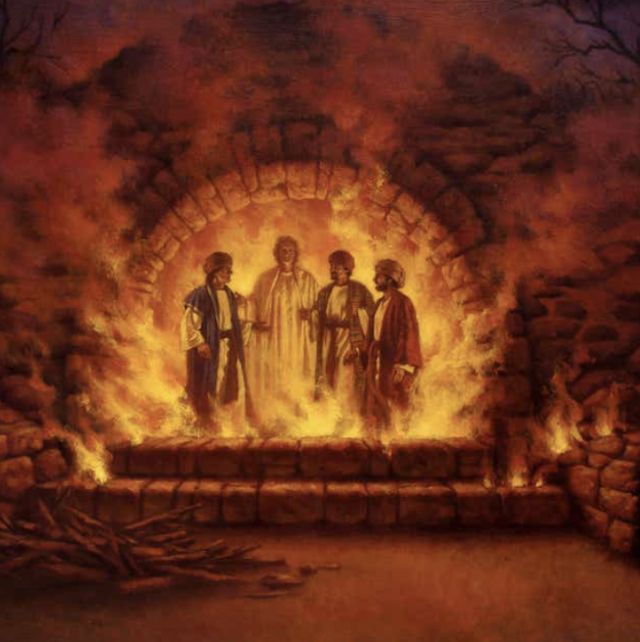
After the men were thrown into the furnace Nebuchadnezzar looked in and was astonished because their bonds were burned off and they walked around freely accompanied by a mysterious fourth figure. Nebuchadnezzar identified the fourth figure as a son of God (or “the gods” – Daniel 3:25, ESV) and it is presumed to be either an angel or a Christophany, a pre-incarnate appearance of Christ. While the figure’s exact identity is open to interpretation, what’s we do know is that to Nebuchadnezzar it revealed the powerful presence of God Himself as His divine protection and deliverance of His people in the midst of impossible circumstances (again, recalling the Exodus story).

Shadrach, Meshach, and Abednego were willing to die for their faith in God because they knew something else. They knew the end from the beginning! They knew that fatal faith is faith that you can die for because it is also faith that you can live (forever) for.

The writer of the book of Hebrews in the New Testament refers to the fatal faith of these Hebrew exiles and others with faith like them in ancient times: “For time would fail me to tell of Gideon, Barak, Samson, Jephthah, of David and Samuel and the prophets—who through faith conquered kingdoms, enforced justice, obtained promises, stopped the mouths of lions, quenched the power of fire, escaped the edge of the sword, were made strong out of weakness, became mighty in war, put foreign armies to flight (Hebrews 11:32-34, ESV).

And, the reason for their faith, the Hebrews writer explained, was that fatal faith was forward-looking faith, future-oriented faith. It was faith expressed as living in this world in expectation of living eternally in a heavenly home: “For people who speak thus make it clear that they are seeking a homeland… they desire a better country, that is, a heavenly one. Therefore God is not ashamed to be called their God, for he has prepared for them a city” (Hebrews 11:14-16, ESV).

So, how much heat can your faith in God take?

Emancipation Proclamation – Hebrews 13:1-8

First published December 2, 2014 and edited for re-publication here.
Emancipation_Proclamation

“Remember those who led you, who spoke the word of God to you and considering the result of their conduct, imitate their faith. Jesus Christ is the same yesterday, today and forever” (Hebrews 13:7-8, NASB).

Recently in the men’s Sunday School class I attend, the lesson was from Hebrews 13. And, this lesson from Hebrews 13 helped me resolve a theological dilemma I had wrestled with from Romans 6-8.

But, I love it when that happens! It reinforces the consistency of the Bible to me and why I should read and study all of it over and over again. And, of course, why it is so important for the Holy Spirit to enlighten us and counsel us when we study God’s word.

Let me explain…

Continue reading

Blind Faith – Hebrews 11:13

“These all died in faith, although they had not received the things that were promised. But they saw them from a distance, greeted them, and confessed that they were foreigners and temporary residents on the earth” (Hebrews 11:13, CSB).

According to the Hebrews writer, the presence of faith is based on the coexistence of hope. In fact, hope is the essential element of faith: “Now faith is the reality of what is hoped for, the proof of what is not seen.” (vs. 1).

You can’t have faith if there is no hope! Then, faith provides certainty to your hope, enabling you to believe in a reality you don’t see.

Yes, that’s the thing about faith–it’s blind! Because if you can see it, you can’t hope for it!

Continue reading

Timeless Faith – Hebrews 11

“Now faith is the reality of what is hoped for, the proof of what is not seen. For by this our ancestors were approved….. These all died in faith, although they had not received the things that were promised…. All these were approved through their faith, but they did not receive what was promised, since God had provided something better for us, so that they would not be made perfect without us” (Hebrews 11:1-2,13,39-40, CSB).

In Hebrews 11, the “faith” chapter, the Hebrews writer defines faith and then provides a chapter-long litany of Old Testament examples.

Unfortunately, for us modern, empirical types, the Hebrews writer’s definition of faith is the antithesis of the scientific standards of observable data. Faith according to the Hebrews writer is not based on observable data but it’s based on the “proof” of the unseen. It’s inscrutable!

And, while having faith means we have hope for something we do not see, it also provokes us to take certain actions in our lives (vs. 2).

Continue reading

Live Like You Are Saved! – Hebrews 10:19-39

“But we are not those who draw back and are destroyed, but those who have faith and are saved” (Hebrews 10:39, CSB).

The Hebrews writer made an elegant theological argument in the previous chapters and concluding in Chapter 10 that the Old Testament law and sacrificial system have been replaced through the sacrifice of Christ on the cross. The former required continual sacrifices, the latter was once and for all time.

The Hebrews writer reasoned that when there is absolute atonement for sin, there is no longer a need for continual sacrifice (vs. 18).

So, sin has to go before righteousness can prevail! The cross of Christ removes sin in your life and starts you down a new path, a “new and living way” (vs. 20) of living for God in righteousness and holiness.

Continue reading

Qualified – Hebrews 5:1-10

“After he was perfected, he became the source of eternal salvation for all who obey him….” (Hebrews 5:9, CSB).

The Hebrews writer gives us yet another Old Testament perspective of how Jesus is the fulfillment of God’s plan for human redemption. This verse is the conclusion of a broader argument about Jesus’ role as the everlasting High Priest to emphasize His unique qualifications as the both fully human and fully divine Savior.

The Hebrews writer explains that a High Priest was chosen from the Israelite people to make sacrifices for their sins. Because he was human, he had to offer sacrifices for his own sin as well as the sins of the people. In Leviticus 16 God implemented a Day of Atonement in which the High Priest performed a sacrifice for the atonement of the sin for the Israelites. The ceremony, which was conducted annually, began with a sacrifice for the atonement of the sins for the High Priest.

Continue reading

The Rest of the Story – Hebrews 4

“If Joshua gave the Israelites rest, God wouldn’t have spoken about another day later on. So you see that a sabbath rest is left open for God’s people. The one who entered God’s rest also rested from his works, just as God rested from his own. Therefore, let’s make every effort to enter that rest so that no one will fall by following the same example of disobedience, because God’s word is living, active, and sharper than any two-edged sword. It penetrates to the point that it separates the soul from the spirit and the joints from the marrow. It’s able to judge the heart’s thoughts and intentions. No creature is hidden from it, but rather everything is naked and exposed to the eyes of the one to whom we have to give an answer” (Hebrews 4:8-13, CSB).

The Hebrews writer gives us yet another Old Testament perspective of the Christian life. As we concluded in the previous post, our salvation in Christ and hope for eternal life is a reality that we should live out each day of our lives on earth.

In Hebrews 4 the Hebrews writer tells us that there is a “Rest” for God’s people to enter into. It has always been God’s plan since the Creation and still is today for His people to join Him in the restfulness of eternal life where God Himself abides (see vs. 1-4).

Continue reading

Drifting – Hebrews 2:1-10

For this reason, we must pay attention all the more to what we have heard, so that we will not drift away. For if the message spoken through angels was legally binding and every transgression and disobedience received a just punishment, how will we escape if we neglect such a great salvation? This salvation had its beginning when it was spoken of by the Lord, and it was confirmed to us by those who heard him. At the same time, God also testified by signs and wonders, various miracles, and distributions of gifts from the Holy Spirit according to his will (Hebrews 2:1-4, CSB).

Have you ever heard the the old saying, “up the river (or creek) without a paddle.” If you don’t have a paddle in your boat, you flow whatever direction the river current takes you. The boat drifts with the current.

But, a paddle lets you steer the boat; it lets you set a course and sail in a direction. It keeps you from drifting.

Continue reading

Make It So – Genesis 22:1-19

Then he said, “Do not lay a hand on the boy or do anything to him. For now I know that you fear God, since you have not withheld your only son from me.” Abraham looked up and saw a ram caught in the thicket by its horns. So Abraham went and took the ram and offered it as a burnt offering in place of his son. And Abraham named that place The Lord Will Provide…. (Genesis 22:12-14, CSB).

In Sir Patrick Stewart’s portrayal as Captain Jean-Luc Picard in the Star Trek: The Next Generation series, Stewart gave us one of the most iconic Star Trek phrases of all time, “Make it so!” This catchphrase was usually used when a crew member suggested a course of action for the Starship Enterprise to avoid or confront a dangerous situation.

In the story of Abraham’s test of faith in Genesis 22 Abraham believed that God would “Make It So” on His promise to Abraham.

Continue reading

Leftover Grace – Genesis 21:1-21

But God said to Abraham, “Do not be distressed about the boy and about your slave. Whatever Sarah says to you, listen to her, because your offspring will be traced through Isaac, and I will also make a nation of the slave’s son because he is your offspring” (Genesis 21:12-13, CSB).

In Genesis 15 God made a covenant with a childless and aged Abraham that his offspring would be so numerous they would become a great nation and that he would possess the land of Canaan, “the promised land.”

So, Sarah gave her Egyptian slave Hagar to Abraham to take as his wife as a way to fulfill God’s promise to them. Abraham had a child by Hagar named Ishmael.

Then, fourteen years later God fulfilled His promise to Abraham and Sarah became pregnant and bore Abraham a son named Isaac. While both boys were Abraham’s sons, Isaac was the son of God’s promise while Ismael was the son that Sarah and Abraham contrived to fulfill God’s promise.

Continue reading