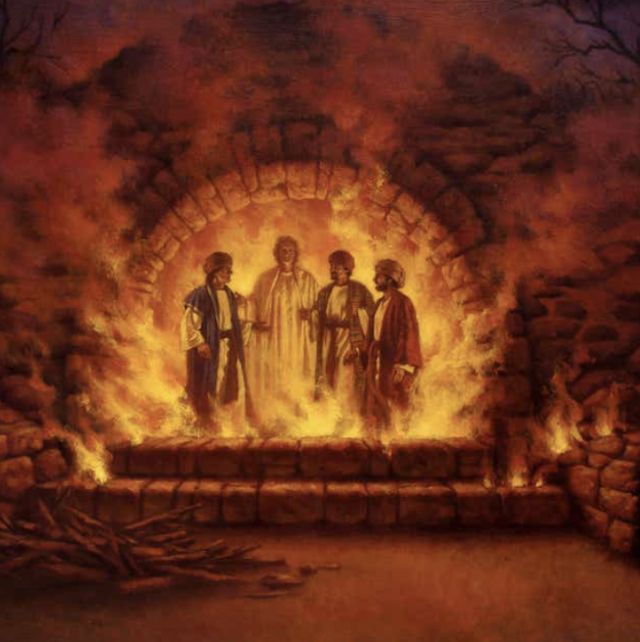
For the Sake of Others – Daniel 1

But Daniel resolved that he would not defile himself with the king’s food, or with the wine that he drank. Therefore he asked the chief of the eunuchs to allow him not to defile himself. And God gave Daniel favor and compassion in the sight of the chief of the eunuchs and the chief of the eunuchs said to Daniel, ‘I fear my lord the king, who assigned your food and drink; for why should he see that you were in worse condition than the youths who are of your own age. So you would endanger my head with the king.’ Then Daniel said to the steward whom the chief of the eunuchs had assigned over Daniel, Hananiah, Mishael, and Azariah, ‘Test your servants for ten days; let us be given vegetables to eat and water to drink……’ At the end of ten days it was seen that they were better in appearance and fatter in flesh than all the youths who ate the kings food” (Daniel 1:8-15, ESV).

Nebuchadnezzar, the king of Babylon, besieged Jerusalem in 605 BC and among the Jewish nobility and royal family deported to Babylon were Daniel and his three friends. They were to be trained in the Babylonian language and literature and assimilated into Babylonian culture. (vs. 1-4).

To protect themselves from being entangled in the temptations of the idolatrous Babylonian culture, Daniel and his friends used their distinctive kosher diet as a way of avoiding complete assimilation and retaining their distinctive identity as Jewish exiles in Babylon. This restrictive diet continually reminded them that they were the chosen people of God in a foreign land.

So, Daniel asked the chief of the eunuchs, who was in charge of training the youths, if they could only eat vegetables and drink water. The chief of the eunuchs was hesitant at first, believing that such a diet would diminish their health, but agreed to try it for ten days.

At the end of the ten days they were noticeably in better health than all the other youths who ate the king’s food!

Not only were they healthier, but God blessed them with learning and skill in all literature and wisdom and Daniel had understanding of dreams and visions (vs. 17).

Continue reading

How To Be a Christian Without Being Religious – Matthew 12:1-14

At that time Jesus passed through the grainfields on the Sabbath. His disciples were hungry and began to pick and eat some heads of grain. When the Pharisees saw this, they said to him, “See, your disciples are doing what is not lawful to do on the Sabbath.” He said to them, “…. If you had known what this means, I desire mercy and not sacrifice,you would not have condemned the innocent. For the Son of Man is Lord of the Sabbath” (Matthew 12:1-8, CSB).

In the early 1970’s Fritz Ridenour published a book, How To Be a Christian Without Being Religious. Presenting a practical commentary on the New Testament book of Romans, the book distinguishes between genuine faith and religious hypocrisy as it explores how “religion” as a practice can become empty when it is severed from authentic faith based on a personal relationship with Christ.

In Matthew 12 Jesus gives us a workshop on religion vs. relationship.

At the beginning of Matthew 12 Jesus and His disciples are walking through a grain field on the Sabbath. As they passed through the field they picked and ate some of the heads of grain. Some Pharisees saw the disciples picking grain on the Sabbath and complained to Jesus that it was unlawful. For modern disciples, the greater offense appears to be stealing another man’s grain. But, under the Mosaic law handpicking grain from a neighbor’s field was not considered stealing (see Deuteronomy 23:25).

First century rabbis divided work prohibitions into dozens of categories with each having many subcategories. Three prohibited categories were picking, threshing and winnowing; thus, by picking the grain and rubbing it between their hands to remove the husks the disciples were guilty on all three counts!

Continue reading

Live Like You Are Saved! – Hebrews 10:19-39

“But we are not those who draw back and are destroyed, but those who have faith and are saved” (Hebrews 10:39, CSB).

The Hebrews writer made an elegant theological argument in the previous chapters and concluding in Chapter 10 that the Old Testament law and sacrificial system have been replaced through the sacrifice of Christ on the cross. The former required continual sacrifices, the latter was once and for all time.

The Hebrews writer reasoned that when there is absolute atonement for sin, there is no longer a need for continual sacrifice (vs. 18).

So, sin has to go before righteousness can prevail! The cross of Christ removes sin in your life and starts you down a new path, a “new and living way” (vs. 20) of living for God in righteousness and holiness.

Continue reading

Avoiding Spiritual Laziness: The Key to Faithfulness – Hebrews 6:1-12

“Now we desire each of you to demonstrate the same diligence for the full assurance of your hope until the end, so that you won’t become lazy but will be imitators of those who inherit the promises through faith and perseverance” (Hebrews 6:11-12, CSB).

As we’ve mentioned previously in these posts from the Book of Hebrews, one of the primary themes of the Hebrew writer is faithfulness–the perseverance of one’s faith to the end of their life on earth.

Continuing this theme in Chapter 6, the Hebrews writer admonished the Hebrew Christians to become mature in their faith. While they may have experienced aspects of the Christian life, even belief in Christ and the fellowship of the Christian community and the work of the Holy Spirit in their midst, unless they became grounded in the teachings of Christ they were vulnerable to apostasy–to the abandoning of their faith.

Continue reading

Qualified – Hebrews 5:1-10

“After he was perfected, he became the source of eternal salvation for all who obey him….” (Hebrews 5:9, CSB).

The Hebrews writer gives us yet another Old Testament perspective of how Jesus is the fulfillment of God’s plan for human redemption. This verse is the conclusion of a broader argument about Jesus’ role as the everlasting High Priest to emphasize His unique qualifications as the both fully human and fully divine Savior.

The Hebrews writer explains that a High Priest was chosen from the Israelite people to make sacrifices for their sins. Because he was human, he had to offer sacrifices for his own sin as well as the sins of the people. In Leviticus 16 God implemented a Day of Atonement in which the High Priest performed a sacrifice for the atonement of the sin for the Israelites. The ceremony, which was conducted annually, began with a sacrifice for the atonement of the sins for the High Priest.

Continue reading

The Rest of the Story – Hebrews 4

“If Joshua gave the Israelites rest, God wouldn’t have spoken about another day later on. So you see that a sabbath rest is left open for God’s people. The one who entered God’s rest also rested from his works, just as God rested from his own. Therefore, let’s make every effort to enter that rest so that no one will fall by following the same example of disobedience, because God’s word is living, active, and sharper than any two-edged sword. It penetrates to the point that it separates the soul from the spirit and the joints from the marrow. It’s able to judge the heart’s thoughts and intentions. No creature is hidden from it, but rather everything is naked and exposed to the eyes of the one to whom we have to give an answer” (Hebrews 4:8-13, CSB).

The Hebrews writer gives us yet another Old Testament perspective of the Christian life. As we concluded in the previous post, our salvation in Christ and hope for eternal life is a reality that we should live out each day of our lives on earth.

In Hebrews 4 the Hebrews writer tells us that there is a “Rest” for God’s people to enter into. It has always been God’s plan since the Creation and still is today for His people to join Him in the restfulness of eternal life where God Himself abides (see vs. 1-4).

Continue reading

How to Fight Injustice: Part 2 – Habakkuk 3

“Though the fig tree may not blossom,
Nor fruit be on the vines;
Though the labor of the olive may fail,
And the fields yield no food;
Though the flock may be cut off from the fold,
And there be no herd in the stalls—
Yet I will rejoice in the Lord,
I will joy in the God of my salvation.”
(Habakkuk 3:17-18, NKJV)

Habakkuk was concerned about the prevalence of injustice in his nation, the kingdom of Judah–God’s chosen people. Habakkuk wondered why God allowed injustice to proliferate among His people: “Therefore the law is powerless and justice never goes forth. For the wicked surround the righteous; therefore perverse judgment proceeds” (vs. 1:4).

God responded that He was, in fact, planning to do something about the injustice in the land by sending the Babylonians to invade Judah and take its people into captivity.

Habakkuk probably had something less calamitous in mind than the downfall of his country when he addressed God about injustice in Judah. So, Habakkuk asked God why He would use the wicked (Babylonians) to punish the righteous (Judahites)? “Why do You look on those who deal treacherously, and hold Your tongue when the wicked devours a person more righteous than he?” (vs. 1:13).

God replied: “The just shall live by his faith!” (vs. 2:4). In other words, there was no entitlement for being God’s people. Nobody had an inherent claim to God’s name. God’s chosen people were those whom He justified–those who chose to believe in Him and His Mercy and live accordingly!

Continue reading

Good Intentions, Not So Good Advice – Job 1-42

“Now when Job’s three friends heard of all this evil that had come upon him, they came each from his own place…. They made an appointment together to come to show him sympathy and comfort him. And when they saw him from a distance, they did not recognize him. And they raised their voices and wept, and they tore their robes and sprinkled dust on their heads toward heaven. And they sat with him on the ground seven days and seven nights, and no one spoke a word to him, for they saw that his suffering was very great” (Job 2:11-13, ESV).

The past few weeks have been, it seems, a series of personal tragedies among some of my friends and colleagues. Terminal illness and death of young people runs counter-intuitive to our existence in this world. It’s just not how life is meant to be.

And, in the midst of great tragedy we are left wondering–why did this happen?

Then, we wonder what to say to our friends who are grieving and struggling with overwhelming loss. How can we explain “Why”?

For those who read and study the Bible, the Book of Job in the Old Testament is often the Bible story we fall back on for comfort and understanding in confronting adversity and tragedy. After all, Job’s ten children and who knows how many grandchildren died when a tornado caused the house where they were all eating together to fall in on them.

Besides his children Job lost all of his considerable wealth and his health and then even Job’s wife scorned him in his affliction.

And, all this happened as a result of some seemingly diabolical wager that Satan made with God.

Continue reading

An Inconvenient Truth: Part 1 – Deuteronomy 17:1

“You shall not sacrifice to the Lord your God an ox or a sheep in which is a blemish, any defect whatever, for that is an abomination to the Lord your God” (Deuteronomy 17:1, ESV).

This verse may at first seem like an Old Testament commandment that has little relevance for Christians today. I would submit, however, that it is a commandment of God that has much relevance for God’s people of all generations.

Let’s start by asking why God would require the Israelites to sacrifice only oxen or sheep without any physical defects when they made a sacrifice to God. What difference did it make to God since the animal was going to be killed and cooked or burned up anyway?

While there are several theological principles you could derive from this Old Testament commandment, here’s the one I want to address:

The fidelity of the sacrifice indicates the fidelity of the sacrificer.

Continue reading

Taming the Monster – 1 Timothy 4:7-8

taming-the-monster“I have fought the good fight, finished the race, and kept the faith. At last the champion’s wreath that is awarded for righteousness is waiting for me. The Lord, who is the righteous judge, is going to give it to me on that day. He’s giving it not only to me but also to all those who have set their heart on waiting for his appearance” (1 Timothy 4:7-8, CEB).

Recently, a friend congratulated me for getting a project started that I had been working on for some time–years, actually. He told me that getting this project going was like “taming a monster.”

I appreciated his kind words and encouragement.  I was quick to note, however, that it wasn’t due to any exceptional skills I possessed but because of the participation of others with expertise that this project ever got off the ground.

But, I think I do have the spiritual gift of perseverance!

Continue reading