Fatal Faith – Daniel 3

 “If this be so, our God whom we serve is able to deliver us from the burning fiery furnace, and he will deliver us out of your hand, O king. But if not, be it known to you, O king, that we will not serve your gods or worship the golden image that you have set up” (Daniel 3:17-18, ESV).

Daniel 2 tells the story of King Nebuchadnezzar of Babylon having a troubling dream that none of his wise men could explain. He demanded they not only interpret his dream but also describe the dream itself–otherwise they would be executed! Daniel, a Hebrew exile to Babylon, prayed to God who revealed to Daniel both the dream and its meaning. Daniel then explained the dream and its interpretation to King Nebuchadnezzar and prevented the execution of the Babylonian wise men including himself and his three fellow exiles.

At the end of Chapter 2 King Nebuchadnezzar proclaimed: “Truly, your God is God of gods and Lord of kings, and a revealer of mysteries, for you have been able to reveal this mystery” (vs. 47). Nevertheless, by the beginning of Daniel 3, some eight years later, Nebuchadnezzar’s acclaim for the sovereignty of Israel’s God seemed to have dissipated. In Daniel 3 Nebuchadnezzar made a 90-foot high golden image, presumably of himself, for all the Babylonians to worship!

Though not explicitly stated, there seems to be a literary connection between the stories in Daniel 2 and 3. In Daniel 2 Nebuchadnezzar dreams of a statue with a head of gold, which represented Nebuchadnezzar’s empire: “You are the head of gold” (Daniel 2:38, ESV). The body of the statue was made of several substances representing the rise and fall of multiple historical empires after the Babylonian empire. But, in Daniel 3 Nebuchadnezzar made an entire image of gold.

Although Daniel told Nebuchadnezzar that only God’s kingdom will stand forever (Daniel 2:44), the symbolism of an image constructed completely of gold presumed the permanence and supremacy of Nebuchadnezzar’s rule. The creation of the image was an act of religious defiance and self-exaltation. The story’s symbolism also recalls the events of Exodus 32 when the Israelites fashioned a golden calf at the foot of Mt. Sinai while Moses was on the mountain receiving the Law from God. Like Nebuchadnezzar, the Israelites were substituting human invention (idolatry) for divine revelation (God’s covenant) when God had miraculously demonstrated otherwise to both.

While the statue may not have been a straightforward image of Nebuchadnezzar, it likely represented his authority, his kingdom, and the allegiance he demanded. What it almost certainly was not, was Nebuchadnezzar’s attempt to honor or depict the God of Israel as he understood Him. So, the ulterior motives of Nebuchadnezzar became the context for the well-known account of the fatal faith demonstrated by Daniel’s three friends: Shadrach, Meshach, and Abednego.

King Nebuchadnezzar decreed that all people (of the Babylonian empire) should fall down and worship the giant golden statue he had constructed with the penalty of execution by being burned alive for those who didn’t comply. Nebuchadnezzar’s advisors informed him that Shadrach, Meshach, and Abednego, who were promoted to official positions in the province of Babylon after the dream interpretation episode (see Daniel 2:49), refused to bow down to the statue. Their faith in God prevented them from worshiping an idol and it was a fatal faith because it could result in their deaths. Their refusal to worship Nebuchadnezzar’s idol could cause them to suffer a violent and excruciating death by being burned alive (makes you wonder why this story is so popular in children’s Sunday School lessons).

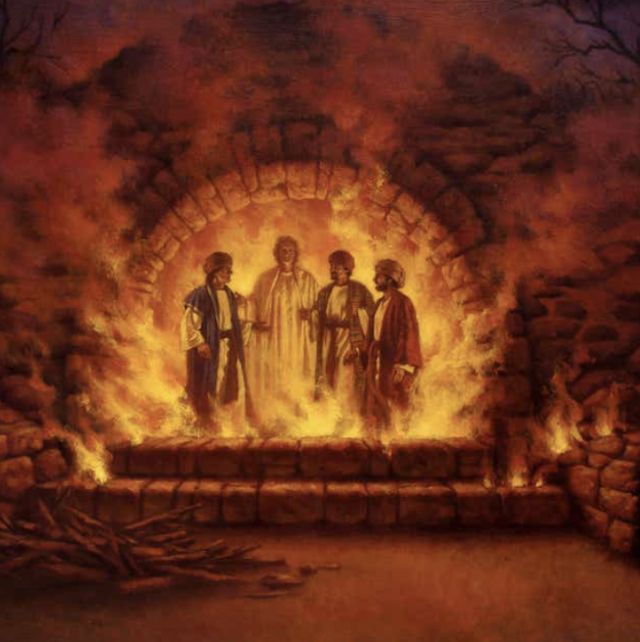
Nebuchadnezzar was furious and had Shadrach, Meshach, and Abednego brought in for questioning. When asked directly by King Nebuchadnezzar if they were going to worship the golden image with the threat of being thrown into a fiery furnace and burned alive if they did not, they responded with a definitive no-way! They declared that God could deliver them from being incinerated in the fiery furnace, but if He didn’t they still would never worship the golden idol!

Ancient Babylon was famous for massive brick construction and large furnaces were not uncommon. The furnace was likely a large industrial kiln used for smelting metals, firing bricks, and/or producing ceramics with an opening on the top or side large enough to cast people in and an opening to see inside. Furious at their resistance Nebuchadnezzar ordered the furnace heated much hotter than usual and had Shadrach, Meshach, and Abednego, bound and thrown into the burning furnace. The furnace was so hot that its temperature was lethal at close range and the soldiers who threw them into the fire were killed by the heat.

After the men were thrown into the furnace Nebuchadnezzar looked in and was astonished because their bonds were burned off and they walked around freely accompanied by a mysterious fourth figure. Nebuchadnezzar identified the fourth figure as a son of God (or “the gods” – Daniel 3:25, ESV) and it is presumed to be either an angel or a Christophany, a pre-incarnate appearance of Christ. While the figure’s exact identity is open to interpretation, what’s we do know is that to Nebuchadnezzar it revealed the powerful presence of God Himself as His divine protection and deliverance of His people in the midst of impossible circumstances (again, recalling the Exodus story).

Shadrach, Meshach, and Abednego were willing to die for their faith in God because they knew something else. They knew the end from the beginning! They knew that fatal faith is faith that you can die for because it is also faith that you can live (forever) for.

The writer of the book of Hebrews in the New Testament refers to the fatal faith of these Hebrew exiles and others with faith like them in ancient times: “For time would fail me to tell of Gideon, Barak, Samson, Jephthah, of David and Samuel and the prophets—who through faith conquered kingdoms, enforced justice, obtained promises, stopped the mouths of lions, quenched the power of fire, escaped the edge of the sword, were made strong out of weakness, became mighty in war, put foreign armies to flight (Hebrews 11:32-34, ESV).

And, the reason for their faith, the Hebrews writer explained, was that fatal faith was forward-looking faith, future-oriented faith. It was faith expressed as living in this world in expectation of living eternally in a heavenly home: “For people who speak thus make it clear that they are seeking a homeland… they desire a better country, that is, a heavenly one. Therefore God is not ashamed to be called their God, for he has prepared for them a city” (Hebrews 11:14-16, ESV).

So, how much heat can your faith in God take?

The Easy Way or The Hard Way – Revelation 7

Then one of the elders asked me, “Who are these people in white robes, and where did they come from?” I said to him, “Sir, you know.” Then he told me: These are the ones coming out of the great tribulation. They washed their robes and made them white in the blood of the Lamb…. The one seated on the throne will shelter them: They will no longer hunger; they will no longer thirst; the sun will no longer strike them, nor will any scorching heat. For the Lamb who is at the center of the throne will shepherd them; he will guide them to springs of the waters of life, and God will wipe away every tear from their eyes (Revelation 7:13-17, CSB).

Have you ever told somebody or been told by somebody, “There’s an easy way or there’s a hard way.”

Usually we’re saying that to somebody who is over-complicating a task or just being stubborn because they want to do things their own way even if there’s an easier or better way to do it.

The Book of Revelation describes a group of people who have chosen to enter God’s Kingdom THE HARD WAY!

Continue reading

Crybaby Christians – Hebrews 12:1-13

“Therefore, strengthen your tired hands and weakened knees, and make straight paths for your feet, so that what is lame may not be dislocated but healed instead” (Hebrews 12:12-13, CSB).

In the first half of Hebrews 12, the Hebrews writer expounds on a saying from Proverbs in the Old Testament: “For the Lord disciplines the one he loves and punishes every son he receives” (Hebrews 12:6, Proverbs 3:12).

First, the Hebrews writer reminds the Hebrew Christians that any suffering they are experiencing is not nearly as much as what Jesus, the Son of God, endured to the extent of shedding His blood from flogging and crucifixion.

Next, the Hebrews writer explains that when you do suffer, consider it the discipline of the Lord. Because the Lord disciplines His children with the same intent as a human father disciplines his children.

So, Christian suffering is the Lord’s discipline exacted upon His children in love to learn His righteousness.

Continue reading

Good Intentions, Not So Good Advice – Job 1-42

“Now when Job’s three friends heard of all this evil that had come upon him, they came each from his own place…. They made an appointment together to come to show him sympathy and comfort him. And when they saw him from a distance, they did not recognize him. And they raised their voices and wept, and they tore their robes and sprinkled dust on their heads toward heaven. And they sat with him on the ground seven days and seven nights, and no one spoke a word to him, for they saw that his suffering was very great” (Job 2:11-13, ESV).

The past few weeks have been, it seems, a series of personal tragedies among some of my friends and colleagues. Terminal illness and death of young people runs counter-intuitive to our existence in this world. It’s just not how life is meant to be.

And, in the midst of great tragedy we are left wondering–why did this happen?

Then, we wonder what to say to our friends who are grieving and struggling with overwhelming loss. How can we explain “Why”?

For those who read and study the Bible, the Book of Job in the Old Testament is often the Bible story we fall back on for comfort and understanding in confronting adversity and tragedy. After all, Job’s ten children and who knows how many grandchildren died when a tornado caused the house where they were all eating together to fall in on them.

Besides his children Job lost all of his considerable wealth and his health and then even Job’s wife scorned him in his affliction.

And, all this happened as a result of some seemingly diabolical wager that Satan made with God.

Continue reading

The Normal Christian Life: Part 2 – 2 Corinthians 6:8-10

“We are treated as impostors, and yet are true; as unknown, and yet well known; as dying, and behold we live; as punished, and yet not killed; as sorrowful, yet always rejoicing; as poor, yet making many rich, as having nothing, yet possessing everything” (2 Corinthians 6:8-10, ESV).

Paradox is used to reframe a reality that is outside of normal perceptions. When used in the Bible, paradox helps us perceive an alternative universe–the Kingdom of God–where God rules and reigns.

The normal Christian life is a great paradox. It’s life, but it’s death. It’s sorrow, yet joyful. It’s deficiency and sufficiency.

Continue reading

The Normal Christian Life: Part 1 – 2 Corinthians 4:7-12

“But we have this treasure in jars of clay to show that the surpassing power belongs to God and not to us.  We are afflicted in every way, but not crushed; perplexed, but not driven to despair; persecuted, but not forsaken; struck down, but not destroyed; always carrying in the body the death of Jesus, so that the life of Jesus may also be manifested in our bodies. For we who live are always being given over to death for Jesus’ sake, so that the life of Jesus may also be manifested in our mortal flesh. So death is at work in us, but life in you” (2 Corinthians 4:7-12, ESV).

The “treasure in jars of clay” verse (2 Corinthians 4:7) is notably in the top three of my favorite Bible verses! The “treasure” in these verses refers to “the light of the knowledge of the glory of God in the face of Jesus Christ” stated in vs 6. And God gives this knowledge of Himself – this treasure, revealed in Christ Jesus – to human beings to do with as they please,  accept it or reject it.

In these verses the Apostle Paul described what life is like for those who possess this treasure. The lifestyle he described might even be called “The Normal Christian Life” – affliction, bewilderment, persecution, adversity AND eternal life.

Continue reading

God’s YES Man – 2 Corinthians 1:19-22

This meditation was originally posted on 9/3/2013.

“For the Son of God, Jesus Christ, who was preached among you by us—by me and Silvanus and Timothy—did not become ‘Yes and no’; on the contrary, a final ‘Yes’ has come in Him. For every one of God’s promises is ‘Yes’ in Him. Therefore, the ‘Amen’ is also spoken through Him by us for God’s glory. Now it is God who strengthens us, with you, in Christ and has anointed us. He has also sealed us and given us the Spirit as a down payment in our hearts” (2 Corinthians 1:19-22, HCSB).

Do you ever get down and depressed because you feel like you’ve got so much to handle and you just can’t do it all? And then you get all locked up inside and you don’t do anything. I call it “gridlock of the soul.” Why even try, you wonder.

It seems like life is saying “No!” to you, “No you can’t. No you can’t. No, no, no!”

When life keeps telling you “No,” there is something you can do to escape soul gridlock.

Open your Bible to 2 Corinthians 1:19-22 and read, re-read, and read these verses again until you realize that when life seems to be telling you “No,” God is telling you “Yes!”

And not just “Yes,” but an emphatic “Yes,” God’s big “YES!”

Continue reading

A Half-Empty Glass – Philippians 4:11-13

glass half empty“I have learned in whatever state I am, to be content: I know how to be abased, and I know how to abound. Everywhere and in all things I have learned both to be full and to be hungry, both to abound and to suffer need. I can do all things through Christ who strengthens me” (Philippians 4:11-13, NKJV).

Is the glass half empty or half full?  This expression is commonly used as a litmus test to determine an individual’s worldview. Half full expresses optimism and half empty expresses pessimism.

The Apostle Paul seems like a “glass-half-full” type of guy. Unfortunately, I often fall into the “half-empty-glass” camp…

Sure, I try to look at problems as challenges, troubles as opportunities. But hard as I try, problems are just problems, trouble is just trouble. Although I don’t consider myself a pessimist, I try to avoid problems and trouble, not embrace them!

Continue reading

Moving On – Ezekiel 24:15-27

Moving-On“The Lord ’s word came to me: Human one, I am about to take the delight of your eyes away from you in a single stroke. Don’t mourn or weep. Don’t even let your tears well up. Sigh inwardly; be deathly still. Don’t perform mourning rites, but bind on your turban and put your shoes on your feet. And don’t cover your upper lip or eat in human company” (Ezekiel 24:15-17, CEB).

Like several of the Old Testament prophets, Ezekiel’s prophecies were often intertwined with his personal life. On one occasion God told Ezekiel that his beloved city of Jerusalem was about to be destroyed. Then, God told Ezekiel his wife was about to die!

And if that wasn’t enough bad news, God told Ezekiel not to mourn over his wife’s death and not even to participate in the rituals of grief and mourning that were a part of that ancient culture. Ezekiel was to keep his grief to himself.

Continue reading

A Punch in the Face – Philippians 4:12-13

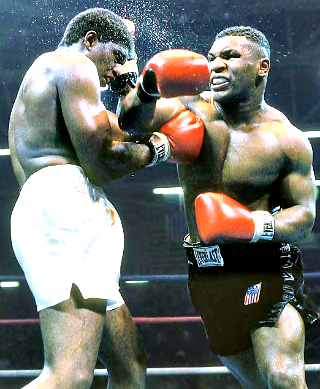
mike-tyson-left-hook“I know the experience of being in need and of having more than enough; I have learned the secret to being content in any and every circumstance, whether full or hungry or whether having plenty or being poor. I can endure all these things through the power of the one who gives me strength” (Philippians 4:12-13, NEB).

Former heavyweight boxing champion Mike Tyson was once asked by a reporter what he thought about an opponent who had a clever plan for defensing his left hook. Tyson responded, “Everyone has a plan until they get punched in the face.”

Sometimes Christians, especially affluent Christians, forget that bad things in life can happen to them. When everything seems to be going so good, we somehow get to thinking that we are fortunate because we deserve God’s great grace. We begin to think that certainly God won’t let anything bad happen to us because we are so blessed.

Continue reading