
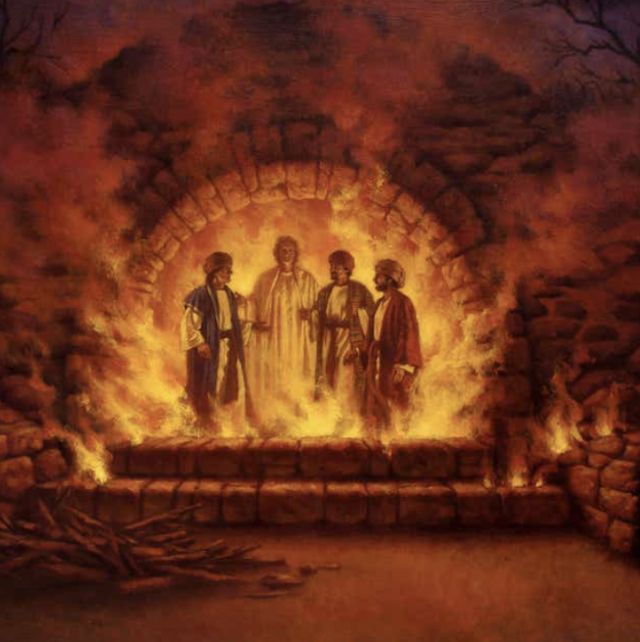
Fatal Faith – Daniel 3

 “If this be so, our God whom we serve is able to deliver us from the burning fiery furnace, and he will deliver us out of your hand, O king. But if not, be it known to you, O king, that we will not serve your gods or worship the golden image that you have set up” (Daniel 3:17-18, ESV).

Daniel 2 tells the story of King Nebuchadnezzar of Babylon having a troubling dream that none of his wise men could explain. He demanded they not only interpret his dream but also describe the dream itself–otherwise they would be executed! Daniel, a Hebrew exile to Babylon, prayed to God who revealed to Daniel both the dream and its meaning. Daniel then explained the dream and its interpretation to King Nebuchadnezzar and prevented the execution of the Babylonian wise men including himself and his three fellow exiles.

At the end of Chapter 2 King Nebuchadnezzar proclaimed: “Truly, your God is God of gods and Lord of kings, and a revealer of mysteries, for you have been able to reveal this mystery” (vs. 47). Nevertheless, by the beginning of Daniel 3, some eight years later, Nebuchadnezzar’s acclaim for the sovereignty of Israel’s God seemed to have dissipated. In Daniel 3 Nebuchadnezzar made a 90-foot high golden image, presumably of himself, for all the Babylonians to worship!

Though not explicitly stated, there seems to be a literary connection between the stories in Daniel 2 and 3. In Daniel 2 Nebuchadnezzar dreams of a statue with a head of gold, which represented Nebuchadnezzar’s empire: “You are the head of gold” (Daniel 2:38, ESV). The body of the statue was made of several substances representing the rise and fall of multiple historical empires after the Babylonian empire. But, in Daniel 3 Nebuchadnezzar made an entire image of gold.

Although Daniel told Nebuchadnezzar that only God’s kingdom will stand forever (Daniel 2:44), the symbolism of an image constructed completely of gold presumed the permanence and supremacy of Nebuchadnezzar’s rule. The creation of the image was an act of religious defiance and self-exaltation. The story’s symbolism also recalls the events of Exodus 32 when the Israelites fashioned a golden calf at the foot of Mt. Sinai while Moses was on the mountain receiving the Law from God. Like Nebuchadnezzar, the Israelites were substituting human invention (idolatry) for divine revelation (God’s covenant) when God had miraculously demonstrated otherwise to both.

While the statue may not have been a straightforward image of Nebuchadnezzar, it likely represented his authority, his kingdom, and the allegiance he demanded. What it almost certainly was not, was Nebuchadnezzar’s attempt to honor or depict the God of Israel as he understood Him. So, the ulterior motives of Nebuchadnezzar became the context for the well-known account of the fatal faith demonstrated by Daniel’s three friends: Shadrach, Meshach, and Abednego.

King Nebuchadnezzar decreed that all people (of the Babylonian empire) should fall down and worship the giant golden statue he had constructed with the penalty of execution by being burned alive for those who didn’t comply. Nebuchadnezzar’s advisors informed him that Shadrach, Meshach, and Abednego, who were promoted to official positions in the province of Babylon after the dream interpretation episode (see Daniel 2:49), refused to bow down to the statue. Their faith in God prevented them from worshiping an idol and it was a fatal faith because it could result in their deaths. Their refusal to worship Nebuchadnezzar’s idol could cause them to suffer a violent and excruciating death by being burned alive (makes you wonder why this story is so popular in children’s Sunday School lessons).

Nebuchadnezzar was furious and had Shadrach, Meshach, and Abednego brought in for questioning. When asked directly by King Nebuchadnezzar if they were going to worship the golden image with the threat of being thrown into a fiery furnace and burned alive if they did not, they responded with a definitive no-way! They declared that God could deliver them from being incinerated in the fiery furnace, but if He didn’t they still would never worship the golden idol!

Ancient Babylon was famous for massive brick construction and large furnaces were not uncommon. The furnace was likely a large industrial kiln used for smelting metals, firing bricks, and/or producing ceramics with an opening on the top or side large enough to cast people in and an opening to see inside. Furious at their resistance Nebuchadnezzar ordered the furnace heated much hotter than usual and had Shadrach, Meshach, and Abednego, bound and thrown into the burning furnace. The furnace was so hot that its temperature was lethal at close range and the soldiers who threw them into the fire were killed by the heat.

After the men were thrown into the furnace Nebuchadnezzar looked in and was astonished because their bonds were burned off and they walked around freely accompanied by a mysterious fourth figure. Nebuchadnezzar identified the fourth figure as a son of God (or “the gods” – Daniel 3:25, ESV) and it is presumed to be either an angel or a Christophany, a pre-incarnate appearance of Christ. While the figure’s exact identity is open to interpretation, what’s we do know is that to Nebuchadnezzar it revealed the powerful presence of God Himself as His divine protection and deliverance of His people in the midst of impossible circumstances (again, recalling the Exodus story).

Shadrach, Meshach, and Abednego were willing to die for their faith in God because they knew something else. They knew the end from the beginning! They knew that fatal faith is faith that you can die for because it is also faith that you can live (forever) for.

The writer of the book of Hebrews in the New Testament refers to the fatal faith of these Hebrew exiles and others with faith like them in ancient times: “For time would fail me to tell of Gideon, Barak, Samson, Jephthah, of David and Samuel and the prophets—who through faith conquered kingdoms, enforced justice, obtained promises, stopped the mouths of lions, quenched the power of fire, escaped the edge of the sword, were made strong out of weakness, became mighty in war, put foreign armies to flight (Hebrews 11:32-34, ESV).

And, the reason for their faith, the Hebrews writer explained, was that fatal faith was forward-looking faith, future-oriented faith. It was faith expressed as living in this world in expectation of living eternally in a heavenly home: “For people who speak thus make it clear that they are seeking a homeland… they desire a better country, that is, a heavenly one. Therefore God is not ashamed to be called their God, for he has prepared for them a city” (Hebrews 11:14-16, ESV).

So, how much heat can your faith in God take?

Modern Idols – Deuteronomy 5

Do not have other gods besides me. Do not make an idol for yourself in the shape of anything in the heavens above or on the earth below or in the waters under the earth. Do not bow in worship to them, and do not serve them, because I, the Lord your God, am a jealous God, bringing the consequences of the fathers’ iniquity on the children to the third and fourth generations of those who hate me, but showing faithful love to a thousand generations of those who love me and keep my commands (Deuteronomy 5:7-10, CSB; the first and second commandments of the Ten Commandments).

The first two commandments of the Ten Commandments address the worship of God. The first commands us to worship only the one true God and the second commands us to worship God in the correct way (or avoid idolatry).

The word “worship” is related to the idea of ascribing worth to something. We worship what we think is worthy or important.

What you think is important is a priority in your life. It’s what you idolize. And, it’s what you worship.

The litmus test of a priority is what you spend your time and money on. And, what you spend your time and money on is likely what you talk and think about. So, the things that are really important to you are those things you spend your time and money doing and talking and thinking about.

Continue reading

Forever Love – Exodus 20:4-6

“You shall not make for yourselves an image in the form of anything in heaven above or earth beneath or in the waters below. You shall not bow down to them or worship them, for I, the Lord your God am a jealous God, punishing the children for the sin of the parents to the third and fourth generation of those who hate me, but showing love to a thousand generations for those who love me and keep my commandments” (Exodus 20:4-6, NIV).

These verses are the 2nd Commandment of the Ten Commandments. Although I’ve read and repeated the 2nd Commandment many times, I’ve never paid much attention to the second part of the commandment, which explains the consequences of obeying or not obeying the commandment.

But, God uses the pronouncement of a curse and blessing in the 2nd Commandment to make a striking contrast between the everlasting effects of His boundless love for those who worship and obey Him with the exigency of punishment for idolators.

Continue reading

American Idolatry – Isaiah 2

materialism“Their land has also been filled with idols; they worship the work of their hands, that which their fingers have made… The proud look of man will be abased and the loftiness of man will be humbled, and the Lord alone will be exalted in that day” (Isaiah 2:8,11, NASB).

We tend to think that idolatry is an Old Testament phenomenon. Long ago, unenlightened people made little figurines from wood or stone or they built altars in the woods or on mountaintops. To us, that’s idolatry.

We think we’re more sophisticated today, so idolatry isn’t a big problem like it was in the Old Testament. But, it’s not that idolatry isn’t as prevalent today as in the Old Testament. It’s just that our idolatry manifests itself differently. It’s more subtle…and deceptive!

Continue reading

You Can’t Have It Both Ways – 1 Samuel 7:3

onewayJesus“If you are really serious about wanting to return to the Lord, get rid of your foreign gods and your images of Ashtoreth. Determine to obey only the Lord; then he will rescue you from the Philistines” (1 Samuel 7:3, NLT).

Samuel had gathered all of Israel together to repent of their idolatry and rededicate themselves to God.

While Israel was assembled, the Philistines attacked them. Samuel prayed and God helped the Israelites defeat the Philistines because they had repented and rededicated themselves to serving and obeying God. Consequently, the Philistines didn’t attack Israel again until after Saul became king.

Continue reading

American Idols – Psalm 106:20-21

“They traded their glorious God for a statue of a grass-eating bull. They forgot God, their savior, who had done such great things in Egypt” (Psalm 106:20-21, NLT).

This Psalm recounts the sin and rebellion of Israel during the exodus from Egypt.

The Israelites committed a major act of idolatry while Moses was on the mountain receiving God’s law for His chosen people.

What happened to the Israelites in Egypt can happen to Christians today. It’s just that we describe it using different terminology rather than the term “idolatry.”

Continue reading