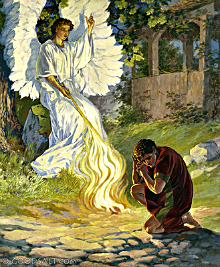

For the Sake of Others – Daniel 1

But Daniel resolved that he would not defile himself with the king’s food, or with the wine that he drank. Therefore he asked the chief of the eunuchs to allow him not to defile himself. And God gave Daniel favor and compassion in the sight of the chief of the eunuchs and the chief of the eunuchs said to Daniel, ‘I fear my lord the king, who assigned your food and drink; for why should he see that you were in worse condition than the youths who are of your own age. So you would endanger my head with the king.’ Then Daniel said to the steward whom the chief of the eunuchs had assigned over Daniel, Hananiah, Mishael, and Azariah, ‘Test your servants for ten days; let us be given vegetables to eat and water to drink……’ At the end of ten days it was seen that they were better in appearance and fatter in flesh than all the youths who ate the kings food” (Daniel 1:8-15, ESV).

Nebuchadnezzar, the king of Babylon, besieged Jerusalem in 605 BC and among the Jewish nobility and royal family deported to Babylon were Daniel and his three friends. They were to be trained in the Babylonian language and literature and assimilated into Babylonian culture. (vs. 1-4).

To protect themselves from being entangled in the temptations of the idolatrous Babylonian culture, Daniel and his friends used their distinctive kosher diet as a way of avoiding complete assimilation and retaining their distinctive identity as Jewish exiles in Babylon. This restrictive diet continually reminded them that they were the chosen people of God in a foreign land.

So, Daniel asked the chief of the eunuchs, who was in charge of training the youths, if they could only eat vegetables and drink water. The chief of the eunuchs was hesitant at first, believing that such a diet would diminish their health, but agreed to try it for ten days.

At the end of the ten days they were noticeably in better health than all the other youths who ate the king’s food!

Not only were they healthier, but God blessed them with learning and skill in all literature and wisdom and Daniel had understanding of dreams and visions (vs. 17).

Continue reading

The Next Big Thing

My goal is to know him and the power of his resurrection and the fellowship of his sufferings, being conformed to his death, assuming that I will somehow reach the resurrection from among the dead. Not that I have already reached the goal or am already perfect, but I make every effort to take hold of it because I also have been taken hold of by Christ Jesus. Brothers and sisters, I do not consider myself to have taken hold of it. But one thing I do: Forgetting what is behind and reaching forward to what is ahead, I pursue as my goal the prize promised by God’s heavenly call in Christ Jesus” (Philippians 3:10-14, CSB).

Successful business people are successful because they are forward-thinking. They don’t linger or loiter in current achievements no matter how great those achievements may be. Their current success doesn’t bind them to the status quo.

They are always looking ahead. They are always striving for the next big thing!

Because there is always a new project, an unreached goal out there to attain. There is always a next new accomplishment.

Continue reading

Gone Fishin’ – John 21:3

Gone-fishing-sign“Simon Peter said, ‘I’m going fishing.’ ‘We’ll come, too,’ they all said. So they went out in the boat, but they caught nothing all night” (John 21:3, NLT).

After Jesus’ death and resurrection, He appeared to the disciples and other people several times before He ascended to heaven. On the occasion described in the last chapter of the Gospel of John, Peter and several of the disciples had returned to Galilee and were taking up their old occupation of fishing, and apparently, not being very successful at it.

Continue reading

What Am I Supposed To Do? – John 14:10

God-at-Work-Sign“My Father who lives in me does his work through me” (John 14:10, NLT).

All right, you’re a Christian. Maybe you have been a Christian for all or most of your life or maybe just for a short time.

Either way, the same nagging question always lingers in the back of your mind: “Lord, what am I supposed to do with my life and with my salvation?”

Continue reading

Divine Labor – John 5:17,19

caution-god-at-work“But Jesus responded to them, ‘My Father is still working, and I am working also’ … ‘I assure you: The Son is not able to do anything on His own, but only what He sees the Father doing. For whatever the Father does, the Son also does these things in the same way” ( John 5:17, 19, HCSB).

This somewhat cryptic response to the Jewish religious leaders was given by Jesus as a defense for healing a man on the Sabbath who had been sick for 38 years.

So why did Jesus answer their accusations in this way?

Continue reading

Answering the Call – Ezekiel 1:3

phone_ringing“The Lord gave this message to Ezekiel son of Buzi, a priest, beside the Kebar River in the land of the Babylonians, and he felt the hand of the Lord take hold of him” (Ezekiel 1:3, NLT).

The word of the Lord first came to Ezekiel while he was living with the Judean exiles in Babylon.

Ezekiel was a priest by descent and, as such, his primary ministry was offering sacrifices in the Temple in Jerusalem. As one of the exiled Jews, Ezekiel was unable to serve as a priest in the usual ways.

Continue reading

The Reluctant Warrior – Judges 6:11-12

GIdeonCalling“The Angel of the Lord came, and He sat under the oak that was in Ophrah, which belonged to Joash, the Abiezrite. His son Gideon was threshing wheat in the wine vat in order to hide it from the Midianites. Then the Angel of the Lord appeared to him and said: ‘The Lord is with you, mighty warrior'” (Judges 6:11-12, HCSB).

God sent His personal representative, the Angel of the Lord, to Gideon at Ophrah. Because He was the Angel of the Lord, He spoke with God’s full authority.

Continue reading

Holy Slavery – Luke 17:5-10

Waiter“When you have done all that you were commanded, you should say, ‘We are good-for-nothing slaves; we’ve only done our duty.’” (Luke 17: 10, HCSB)

Slavery in the first century Roman world was much different from slavery in early American history. Roman slaves were either taken as the spoils of war or were slaves because they sold themselves into slavery, called bond-servants.

Continue reading

Extreme Makeover – Luke 6:27-36

extreme_makeover“But love your enemies, and do good, and lend, expecting nothing in return, and your reward will be great, and you will be sons of the Most High, for he is kind to the ungrateful and the evil.  Be merciful, even as your Father is merciful” (Luke 6:35-36, ESV).

Jesus told His disciples to love their enemies, do good and pray for those who hate and mistreat them, and give without expecting anything in return, even if someone is stealing from them.

Seems pretty radical doesn’t it?

Continue reading

Holy Ferocity – Acts 20:20-21, 27

“I did not shrink back from proclaiming to you anything that was profitable or from teaching it to you in public and from house to house. I testified to both Jews and Greeks about repentance toward God and faith in our Lord Jesus…for I did not shrink back from declaring to you the whole plan of God” (Acts 20:20-21, 27, HCSB).

These declarations are from the Apostle Paul’s farewell address to the elders of the church at Ephesus (vs. 17-38).

Continue reading