
On Earth as It Is in Heaven, Part 2 – Daniel 10

Daniel 10 introduces the book’s fourth and final vision, which includes Chapters 10, 11, and 12. It is set in about 537 BC, the third year of Cyrus and approximately two years after the vision of Chapter 9. Daniel’s Babylonian name, Beltshazzar, is used to remind us he is still in Babylonian exile.

Two years earlier the first group of Jewish exiles had returned to Jerusalem in response to Cyrus’s decree to rebuild the Jerusalem Temple (see Ezra 1-2). But we know from Daniel 9 that although some of the captives were returning, the end of the Babylonian exhile was not the end of conflict for the Jewish people.

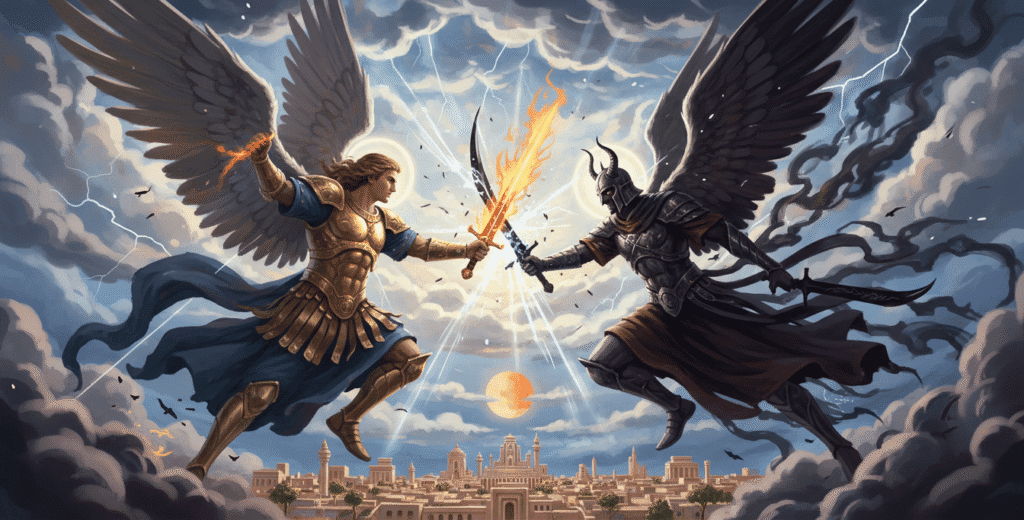
Daniel 10 momentarily pulls back the curtain separating the visible and invisible realms–the earthly and heavenly, the temporal and eternal–to reveal the divine realities behind human conflicts. This prologue to Daniel’s vision in Chapters 10-12 explained that the historical struggles of the Jews, Persia, and Greece (and all nations by extension) have a supernatural dimension.

Daniel 10:4-7 described a glorious being wearing linen, with eyes like flaming torches and a face like lightning that appeared to him in a vision. Possibly that figure was a manifestation of God Almighty (a theophany). If so, then the figure introduced in verses 5–6 need not be the same being as the messenger who later described needing Michael’s assistance to get his message through to Daniel. But, it seems improbable that God Himself could be held up in the spiritual realm for 21 days and would need assistance from another spiritual being (vs. 13).

While other supernatural beings appeared to Daniel later in the vision (vs. 12:5), the glorious figure described in vs. 10:5-6 was a heavenly attendant of God who reflected God’s glory and thereby demonstrated his credentials to bring the message. Without reading more into the story, he was also the one talking to Daniel in the vision.

The divine figure or angel told Daniel that the prince of Persia resisted him for 21 days until one of the chief princes, the archangel Michael, came to assist him. Some may argue that the “prince” mentioned here was a human ruler, but certainly it was a supernatural being who exercised authority over the Persian nation: “When the Most High gave to the nations their inheritance, when he divided mankind, he fixed the borders of the peoples according to the number of the sons of God” (Deuteronomy 32:8, ESV).

The 21-day delay (Daniel had spent three weeks in prayer and mourning – vs. 2-3) was because of the resistance of the (demonic) supernatural being that had spiritual dominion over the Persian territory attempting to prevent God’s message from being brought to Daniel (see vs. 1). To bring God’s message to Daniel, the heavenly messenger required the assistance from another spiritual being of greater authority.

While God rules over all creation, the biblical narrative includes real heavenly beings who exercise delegated authority. Some of these heavenly beings have rebelled against God’s plans and purposes. The struggles of earthly empires are connected to this supernatural reality. Yet neither rebellious spiritual powers nor oppressive earthly rulers can prevent God’s ultimate victory. His people will always be vindicated and God’s Kingdom will prevail.

We live in a world of dual realities and God’s will is exercised on earth as it is in heaven. But we must not forget that there are evil spiritual powers exercising spiritual authority over the nations of the earth and attempting to subvert God’s will (in heaven and on earth).

The Apostle Paul declares that Christians must not underestimate the demonic powers that are at work in this world nor try to fight against them in their own power: “Finally, be strong in the Lord and in the strength of his might. Put on the whole armor of God, that you may be able to stand against the schemes of the devil. For we do not wrestle against flesh and blood, but against the rulers, against the authorities, against the cosmic powers over this present darkness, against the spiritual forces of evil in the heavenly places (Ephesians 6:10-12, ESV).

Who’s Your Daddy? – John 8:30-59

Jesus said to them, “If God were your Father, you would love me, because I came from God and I am here. For I didn’t come on my own, but he sent me. Why don’t you understand what I say? Because you cannot listen to my word. You are of your father the devil, and you want to carry out your father’s desires.” (John 8:42-44, CSB)

Star Wars fans know well the iconic scene when Lord of the Dark Side, Darth Vader, reveals to Jedi warrior, Rebel hero, and disciple of the Force, Luke Skywalker, that he is Luke’s father. And, it then becomes a classic case of good vs. evil and what you think is good becomes evil.

There seems to be a similar theme in this discussion between Jesus and the Jewish religious leaders: what people think is the agent for “good” is actually the agent for “evil.”

The genealogy of Jesus is often questioned in the Gospel of John. Under a constant barrage of threats and accusations about His background hurled at Jesus by the Jewish religious leaders, He consistently maintained that He was sent from God the Father.

In fact, Jesus being one with God and being sent by God the Father–His Messiahship– is a recurring theme in John.

But, in this case Jesus turns the table on the Jewish leaders and throws shade on them about their genealogy!

Continue reading →

Resident Evil, Part 1 – Genesis 3:15

good_evil“I will put contempt between you and the woman, between your offspring and hers. They will strike your head, but you will strike at their heels.”” (Genesis 3:15, CEB).

Evil in the Old Testament is not personified as it is in the New Testament. Depending on your interpretation of the Hebrew word for Satan, meaning adversary, the term is more often a designation than a proper name in the Old Testament.

The Apostle Paul associates the serpent in Genesis 3 with a personified devil: “But I’m afraid that your minds might be seduced in the same way as the snake deceived Eve with his devious tricks. You might be unable to focus completely on a genuine and innocent commitment to Christ” (2 Corinthians 11:3, CEB).

The Apostle John clearly delineates the Tempter in the Garden of Eden as Satan or the devil: “So the great dragon was thrown down. The old snake, who is called the devil and Satan, the deceiver of the whole world, was thrown down to the earth; and his angels were thrown down with him” (Revelation 12:9, CEB). The word “old” here refers to the fact that Satan’s appearance on Earth was at an early stage of the world’s history and has long been occupied with the task of deceiving and opposing God’s elect.

Continue reading →

The Defectors – 1 Chronicles 12:1-22

armyboots“At that time men came day after day to help David until there was a great army like an army of God.” ( 1 Chronicles 12:1-22, HCSB).

1 Chronicles 12 records the assembling of David’s army during the years that David was in hiding from King Saul.

What’s interesting about these warriors that joined up with David was that they were defectors! They changed loyalties! They transferred their allegiance!

Continue reading →

Enemy Occupied Territory – Exodus 6:5-6

“You can be sure that I have heard the groans of the people of Israel, who are now slaves to the Egyptians. And I am well aware of my covenant with them. Therefore, say to the people of Israel: I am the Lord. I will free you from your oppression and will rescue you from your slavery in Egypt. I will redeem you with a powerful arm and great acts of judgment” (Exodus 6:5-6, NLT).

Moses was commissioned by God to lead the Israelites out of Egyptian bondage. Before confronting Pharaoh, Moses and his brother Aaron met with the Israelite leaders and rallied them with the hope that God would rescue them from Egyptian slavery, as stated in these verses.

When Moses and Aaron demanded in God’s name that Pharaoh release the Israelites, Pharaoh considered their demands an affront to his own sovereignty and reacted by increasing the Israelites’ workloads to an overwhelming level.

The more Moses demanded the release of the Israelites, the tougher Pharaoh made their lives.

This defining moment in the history of Israel is a classic case of the adversity one may encounter individually and collectively when trying to live faithfully for God.

When we are trying to live for God and obey Him, we should not be surprised or dismayed when we are confronted by hardships and adversities.

Because we live in enemy-occupied territory!

There is a dark power in the universe, Satan the devil, who was created by God but rebelled against Him.

And, Satan enticed humanity to commit the same sin (rebellion) he did. When humanity joined Satan in his rebellion against God, we became natural born citizens of Satan’s domain.

Since this dark power was originally created by God, his insurrection does not even constitute a war between equal or independent powers. It is more like a civil war—an uprising of a subversive political faction trying to overthrow a legitimate government.

And the main issue in this conflict is not an individual’s personal sins, though one’s sins may be many or few.

The real issue in this cosmic conflict is where your allegiance is—you are either a part of the rebellion or a citizen of God’s Kingdom (Colossians 1:12-13).

Satan and his cohorts continuously attempt to thwart the plans and purposes of God’s Kingdom that are being carried out by God’s people. And, Satan does not give up any ground without a fight!

But remember that God works best when all seems lost, when there’s no hope, when failure is inevitable, when it seems impossible to succeed!

So, we must stand firm in our faith when Satan causes adversity to attempt to deter us from obeying God.

We know that God will eventually rescue us and secure the final victory in our behalf.

“Put on all of God’s armor so that you will be able to stand firm against all strategies of the devil.” (Ephesians 6:11, NLT) 

Why Does God Allow Evil? – Revelation 12:7-11

“Then there was war in heaven. Michael and his angels fought against the dragon and his angels. And the dragon lost the battle, and he and his angels were forced out of heaven. This great dragon—the ancient serpent called the devil, or Satan, the one deceiving the whole world—was thrown down to the earth with all his angels. Then I heard a loud voice shouting across the heavens, ‘It has come at last— salvation and power and the Kingdom of our God, and the authority of his Christ. For the accuser of our brothers and sisters has been thrown down to earth—the one who accuses them before our God day and night. And they have defeated him by the blood of the Lamb and by their testimony.'” This passage from John’s revelation of the future indicates there is a rebellion against God that is of epochal or universal proportions. And this world and humanity are the battleground for this war. This passage explains that the dragon to which it refers is Satan and that he deceives the world and has a following of other angelic beings. Some interpret this time of the dragon’s defeat and ejection from heaven as referring to the incarnation, ministry, death, and resurrection of Jesus. Nevertheless, three principles arise from this passage that help explain the presence of evil in the created order:

  1. The events of this world are decreed and managed in heaven. God actively presides and rules over His created order. Thus, ultimate control and supreme authority over the universe emanate from God.
  2. The evil that exists in this world is of cosmic proportions. The evil of this world transcends earthly events and its fundamental nature is ultimate insubordination to God’s authority.
  3. Evil is fundamentally a spiritual issue and, therefore, must be addressed in the spiritual realm.

Our ancestors effectively joined Satan’s rebellion and so by being born human we are co-conspirators in this rebellion. God’s justice system requires supreme restitution for the crime of rebellion, but Christ received the punishment for this high crime on behalf of all human beings. In other words, Christ has come to defeat the rebellion of Satan and those of humanity who join Satan in this rebellion against God’s Kingdom: “But the Son of God came to destroy the works of the devil.” (I John 3:8). While the mastermind of this rebellion, Satan, has enjoined humanity in his sedition, is it the result of a cosmic error in planning by God? An unintended consequence of free will? Collateral damage to the created order? Absolutely not! The redemption of human beings has always been God’s plan since the creation of the world: “Come, you who are blessed by my Father, inherit the Kingdom prepared for you from the creation of the world” (Matthew 25:34). The redemption of humanity is not to fix any galactic mistake or oversight God made in creation. We know from the biblical record and from our own human experience that we often learn best by learning from our mistakes. The biblical narrative is replete with well-intentioned and some not-so-well-intentioned people not obeying God. Regrettably, people often better understand God’s will by not doing it! Mercy is better received by those in need of it! John’s revelation clearly discloses that God wins! God ultimately defeats the evil that has infiltrated this world though He may allow it to reside for a time to advance His redemptive plan. God is almighty and His plan is supreme, even to the extent that He can use the evil acts committed by persons and even the devil himself to work His good purposes. It seems that God is best able to redeem people in a world that is occupied by evil.