I saw in the night visions, and behold, with the clouds of heaven there came one like a son of man,and he came to the Ancient of Days and was presented before him. And to him was given dominion and glory and a kingdom, that all peoples, nations, and languages should serve him; his dominion is an everlasting dominion, which shall not pass away,and his kingdom one that shall not be destroyed (Daniel 7:13-14, ESV).
One of the literary themes in Daniel is portrayed by the lions in Chapter 6. The lions symbolized more than the Persian method used to execute Daniel. Beast imagery is used multiple times in the book of Daniel.
Daniel 6 linked the events of Daniel in the lion’s den to the prophetic vision of Daniel in Chapter 7 and his visions throughout the remainder of the book. In Chapter 6 Daniel is surrounded by deadly beasts. In Chapter 7 God’s faithful people are surrounded by beastly kingdoms.
Throughout the book of Daniel there is a progression of beastly ambitions by kings and kingdoms that are ultimately thwarted by God’s rule. In Daniel 4 King Nebuchadnezzar became like a beast until he acknowledged that God was the supreme ruler over earthly kingdoms. In Chapter 6 Daniel is thrown among beasts and is saved by a heavenly visitation, which King Darius acknowledged by decreeing that Daniel’s God is the Almighty God who exercises dominion over all the kingdoms of the earth. Then, in Daniel 7 beasts portrayed a series of earthly empires that emerged and declined under the sovereign rule of God.
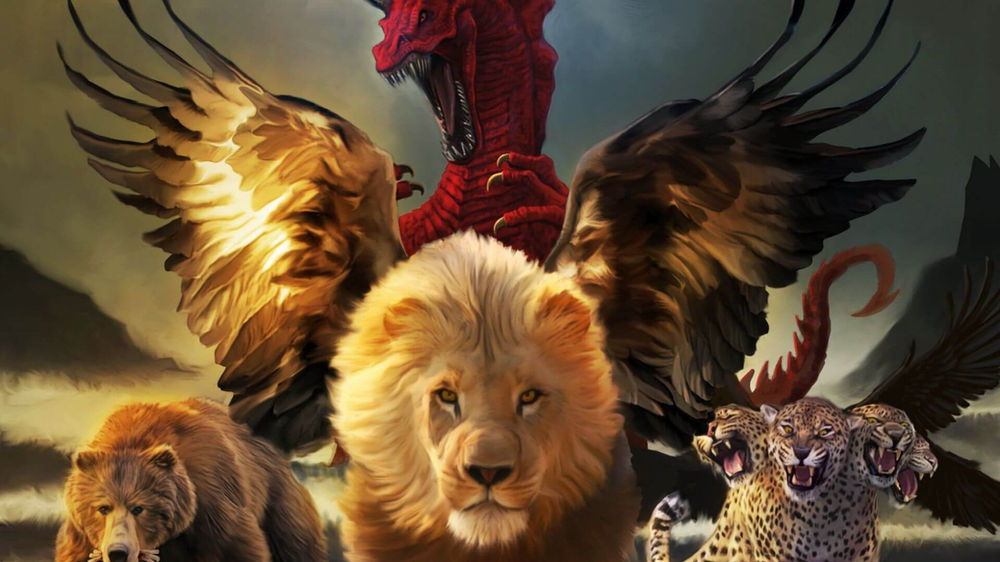
Daniel saw four great beasts rising from a turbulent sea–a lion, bear, leopard, and a terrifying unnamed fourth beast (vs. 1–8). In the ancient biblical worldview, the sea frequently represented chaos and disorder in contrast to God’s order. So, the turbulent sea symbolized the chaotic, restless world of humanity. The beast imagery of the vision is grotesquely powerful as beasts came out of the turbulent sea. The beasts represented earthly kingdoms arising from human turmoil, conflict, conquest, and violence.
The visions of Daniel 2 and Daniel 7 described essentially the same progression of empires from different perspectives. The most common interpretation is that the first beast, the lion with eagle’s wings represented the Babylonian Empire; the second beast, a bear raised up on one side with three ribs in its mouth is the Medo-Persion Empire and the third beast, a leopard with four wings and four heads is the Greek Empire.
The fourth beast was so terrifying it was almost indescribable in terms of animals that Daniel was familiar with. This beast had iron teeth and ten horns. Daniel then noticed a little horn arising among the ten horns of the fourth beast. It had humanlike eyes, spoke arrogantly, and eventually waged war against God’s holy people.
The common interpretation is the fourth beast represented the Roman Empire. Because the fourth beast’s destruction is also associated with the establishment of God’s everlasting kingdom, another view is that while Rome was the historical fourth empire, the final phase of the fourth beast may remain in the future. The ten horns may represent a final coalition of rulers from which the little horn—the Antichrist—will arise. This ruler persecutes God’s people before being destroyed when God’s Kingdom arrives. This interpretation links Daniel 7 with Revelation 13 and 17 because John’s beast has striking similarities to Daniel’s beasts and Revelation 17:12 speaks of ten horns representing ten kings.
As Daniel continues to observe, the scene suddenly shifts from earthly violence to a heavenly courtroom (vs. 9-10). Daniel sees the “Ancient of Days” (God the Father) take His seat on a fiery throne with thousands (more like millions if you do the math) serving Him. The Ancient of Days is presiding over the heavenly assembly and his divine council renders judgment over all that Daniel is witnessing, condemning and destroying the arrogant beast (vs. 11-12).
But that’s not the end of Daniel’s vision. Next, there appeared “one like a son of man” (vs. 13) riding upon the clouds to present Himself before the Ancient of Days. In biblical prophecy riding upon the clouds is associated with deity. But, what’s remarkable in Daniel 7:13-14 is that instead of the Ancient of Days riding the clouds, this other human-like figure comes riding the clouds. And, instead of riding the clouds to earth the Son of Man rides the clouds before the throne of the Ancient of Days, who then confers on Him all authority over the people and nations of the earth.
These two aspects of the vision (beasts and Son of Man) may seem somewhat disjointed. But, the vision of the cloud-riding Son of Man consummates the vision of the ambitious beasts.
As earthly empires rise and fall and the political power they wield becomes increasingly inhumane, violent, arrogant, and hostile toward God, God convenes His heavenly council and renders judgment upon the evil empires. Then, He confers supreme power and authority over the nations upon the Son of Man, who then shares His rule with the faithful people of God: “And the kingdom and the dominion and the greatness of the kingdoms under the whole heaven shall be given to the people of the saints of the Most High; his kingdom shall be an everlasting kingdom, and all dominions shall serve and obey him” (vs. 27).
So, the message of Daniel 7 isn’t so much about predicting what historical empire will replace another. Rather, it demonstrates there are two competing ruling powers on earth: The human kingdoms, the beasts that arise from the sea, attempt to replace God’s rule. God’s Kingdom rule is personified in the Son of Man who is conferred with dominion over all the nations of the earth.
Remarkably, the Son of Man does not amass His everlasting Kingdom for Himself but shares His reign with the faithful people of God who have sworn allegiance to God’s Kingdom.
Jesus said to them, “Truly, I say to you, in the new world, when the Son of Man will sit on his glorious throne, you who have followed me will also sit on twelve thrones, judging the twelve tribes of Israel.” (Matthew 19:28, ESV)


Thank you!
Get Outlook for iOShttps://aka.ms/o0ukef ________________________________