“And at the latter end of their kingdom, when the transgressors have reached their limit, a king of bold face, one who understands riddles, shall arise. His power shall be great—but not by his own power; and he shall cause fearful destruction and shall succeed in what he does, and destroy mighty men and the people who are the saints. By his cunning he shall make deceit prosper under his hand, and in his own mind he shall become great. Without warning he shall destroy many. And he shall even rise up against the Prince of princes, and he shall be broken—but by no human hand” (Daniel 8:23-25, ESV).
In the Lord’s Prayer we recite the words: “Your Kingdom come, your will be done on earth as it is in heaven.” (Matthew 6:10, ESV). Most of us who recite this prayer probably believe its supplication but don’t really think about the Old Testament theology behind our petition.
When we entreat God to accomplish His will on earth as in heaven, we are acknowledging that heaven and earth are two interconnected realms that God created and rules. And, the biblical pattern is that what happens in heaven impacts what happens on earth–and vice versa.
At a fundamental level the Bible is the story of God’s rule over those two realms through His created image-bearers. While the Bible primarily relates the story of humanity’s struggle with God, God’s created beings are both human and supernatural. The biblical story of God’s will unfolds simultaneously in the earthly and heavenly realms. But, sometimes the Bible provides us a glimpse into the corresponding events unfolding in the heavenly realm.
Daniel 8 is one such place in the Bible that reveals these parallel universes. The narrative of Daniel’s vision seems to allude to the activity of both heavenly beings and humans–the Israelites. Israel is being attacked on earth while a corresponding conflict is occurring in the unseen heavenly realm. Daniel described these earthly events using supernatural imagery because the earthly conflict reflected a corresponding heavenly conflict. So, Daniel 8 is an example of the biblical pattern of “on earth as it is in heaven.”
Chapter 8 records a second vision of Daniel that occurs two years after the vision in Chapter 7, sometime between 550 and 547 BC. While much debate surrounds the interpretation of Daniel’s other visions, this second vision attracts little disagreement among biblical scholars. Daniel has a vision that clearly describes the rise and fall of historical empires hundreds of years before all the events transpire!
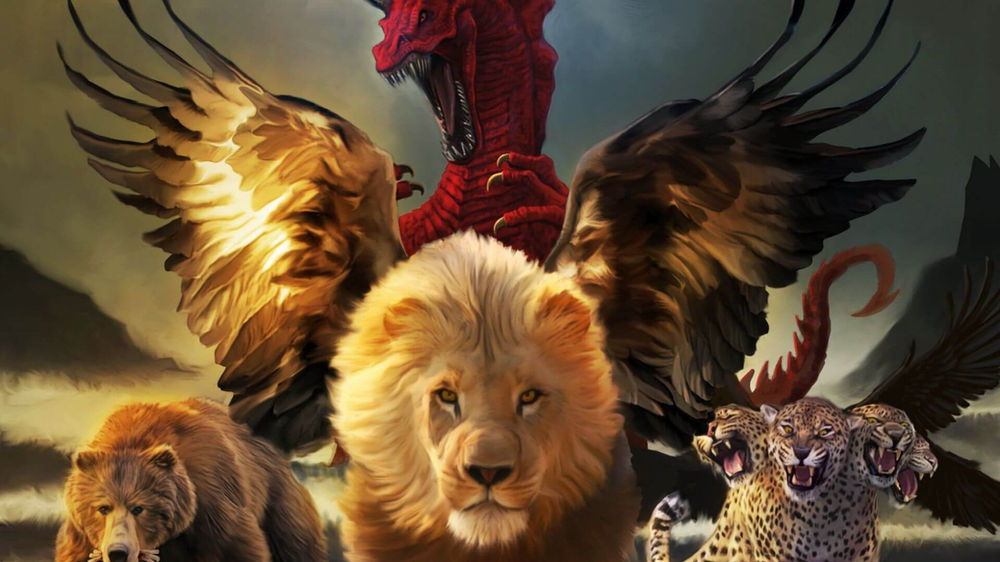
The ram’s two horns in vs. 6, 7, and 20 symbolize Media and Persia. The goat represents Greece whose first king was Alexander the Great (vs. 5-8, 21-22) and the small horn is the second-century BC Seleucid ruler, Antiochus IV Epiphanes (vs. 9, 23). From the historical record we know that Antiochus profaned the worship of God in Jerusalem by setting up a holy object sacred to the Greek god Zeus in the Jerusalem temple. Beginning in 167 BC, Antiochus also ordered the end to the daily sacrifice (vs. 10-13, 24-25). Antiochus died in late 164 BC and vs. 14 and 25 likely refer to his untimely death by illness or disease.
The army of Judas Maccabeus recaptured Jerusalem and re-dedicated the temple to the Lord—the origin of the Festival of Hanukkah. So, after about 3 years where daily sacrifice in the temple had ceased, the sanctuary was restored to its rightful state (vs. 14).
For many prophecy scholars Antiochus Epiphanes is a prototype for a later Antichrist figure, and that is what has relevance for this “on earth as it is in heaven” viewpoint. In Daniel 8:10–11 the little horn (reign of Antiochus IV Ephiphanes) grows toward heaven. It throws down some of the “host” and “stars,” and exalts itself against the “Prince of the host.” Modern readers often interpret the stars simply as persecuted Jews. But, in the Old Testament stars can represent members of the heavenly host.
If this is the case, Daniel portrayed events involving earthly kingdoms against the backdrop of supernatural rulers and a heavenly conflict. This language was designed to connect the heavenly realm with the earthly historical events of the vision. In other words, the earthly persecution associated with Antiochus has a corresponding cosmic dimension. Antiochus is a human Greek ruler but the biblical version portrays the profaning of the Jewish temple and subsequent end to daily sacrifice as part of a larger heavenly rebellion against God and his heavenly government.
So, Daniel 8 is much more than a history lesson. Beginning in vs. 10 Daniel described events beyond Greek and Jewish history. Antiochus certainly wasn’t climbing into heaven and knocking some of the stars from the sky. As we have stated, the “stars” and the “host of heaven” represented supernatural members of God’s heavenly host or council. Daniel described earthly events using supernatural imagery because the earthly conflict also reflected a heavenly conflict (that referenced a future earthly conflict).
But, that’s not the whole moral of this story. In vs. 11 the rebellious power of the great little horn became “as great as the Prince of the host.” While the Prince of the host is often referred to as an angel, it makes more sense that the Prince of the host was God Himself. In vs. 25 Daniel called Him the Prince of Princes. And, God Almighty is the One who will prevail over human and supernatural rebellion!
So, the attack against the Jewish temple is described as a simultaneous attack against God, the Prince of Princes. Although Antiochus perpetrated atrocities against the Jewish temple, its sacrificial system, and the Jewish people, from a heavenly perspective he attacked God’s sacred space, His people, and His heavenly Kingdom. Antiochus is also a manifestation of a future Antichrist ideology that “will throw truth to the ground” (vs. 12.)
While God permits rebellion and desecration to continue for a time, ultimately God’s Kingdom is sovereign over all the kingdoms of the earth (and heaven). While earthly rulers “shall make deceit prosper under his hand, and in his own mind he shall become great” and “without warning he shall destroy many” and “shall even rise up against the Prince of princes” (vs. 25), the Sovereign Lord of heaven and earth, will restore all that has been upended by earthly and heavenly rebellion “to its rightful state” (vs. 14).
For Christ has entered, not into holy places made with hands, which are copies of the true things, but into heaven itself, now to appear in the presence of God on our behalf. (Hebrews 9:24, ESV)