Inevitable – Daniel 5

“And you his son, Belshazzar, have not humbled your heart, though you knew all this, but you have lifted up yourself against the Lord of heaven” (Daniel 5:22-23, ESV).

You have certainly heard and probably used the expression, “the writing is on the wall” or “the handwriting is on the wall.” The phrase is often used whenever an inevitable result or imminent danger has become apparent. In Daniel 5, what should have been apparent and inevitable to King Belshazzar of Babylon seemed to allude him.

Belshazzar’s feast in Daniel 5 took place years, possibly decades, after the events of King Nebuchadnezzar in Daniel 4 and under the kingship of a different king of Babylon. King Belshazzar was once thought to be a fictional king because ancient records named Nabonidus as Babylon’s last king. Later cuneiform discoveries showed that Belshazzar was Nabonidus’s son and served as co-regent while Nabonidus was away from Babylon.

Belshazzar also could have been Nebuchadnezzar II’s grandson through his mother though this is not certain. Daniel’s ascribing him as Nebuchadnezzar’s “son” in vs. 22 is consistent with ancient usage where the term often means descendant or royal successor.

In this chapter King Belshazzar held a great feast for a thousand of his lords and drank wine in front of all those gathered for the feast. Belshazzar commanded that the vessels of gold and of silver that King Nebuchadnezzar had taken from the temple in Jerusalem be brought in so that he and his lords, his wives, and his concubines could drink from them (vs. 1-3). Basically, they were indulging in a drunken revelry and debasing sacred Jewish temple vessels by using them as wine goblets.

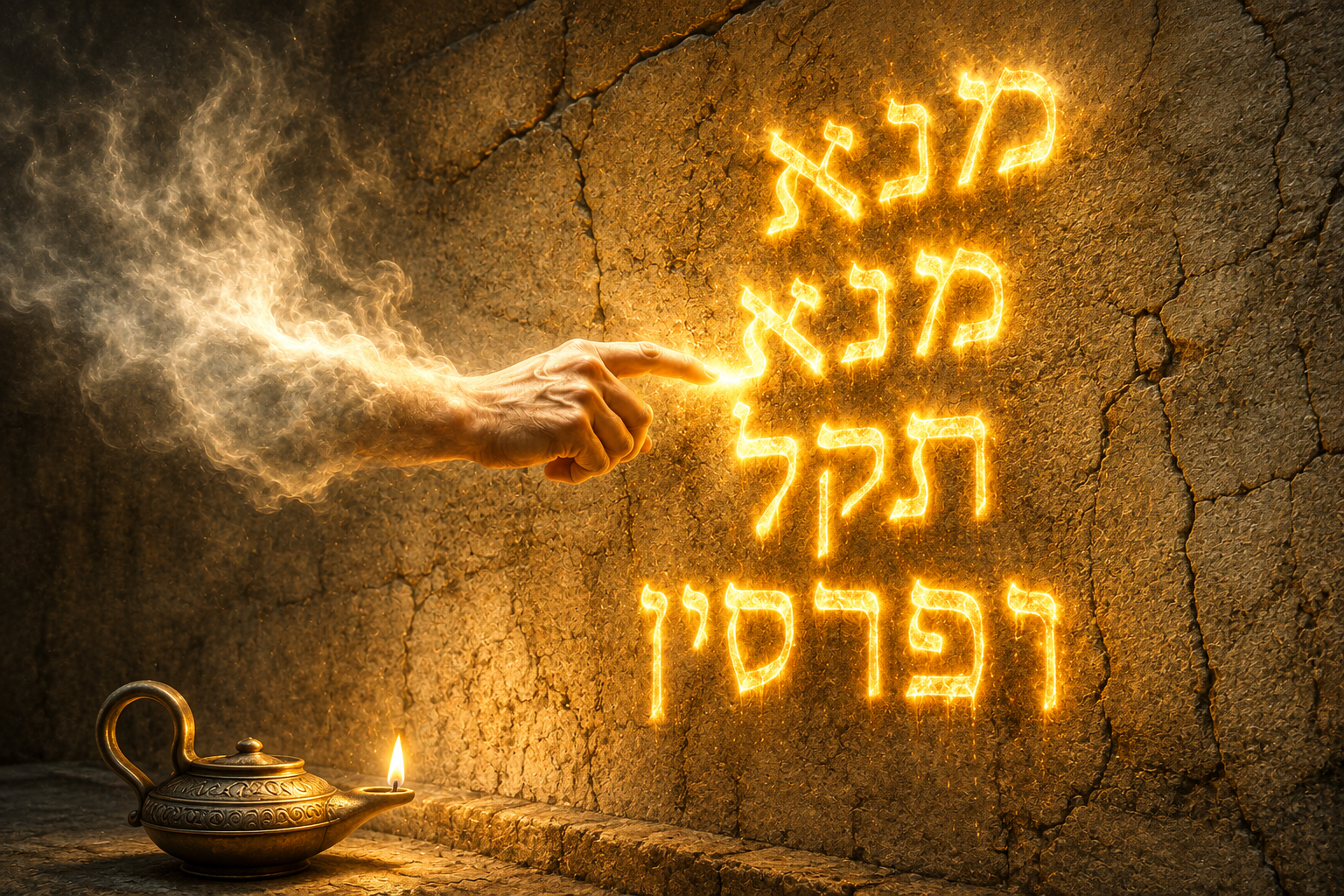
Suddenly, a disembodied hand began to write words on the palace wall during the feast. The king saw the hand as it wrote and became quite alarmed and called for the wise men of Babylon to interpret the writing. The wise men were perplexed and couldn’t interpret the handwriting. The queen then urged Belshazzar to have Daniel brought in to interpret the handwriting on the wall.

We don’t know what words were written on the wall until Daniel gave his interpretation. But, before interpreting the words Daniel reminded King Belshazzar about the events we read about in Daniel 4. King Nebuchadnezzar was humbled by God until he recognized that the Most High God rules the kingdoms of mankind and designates who rules over them according to His will.

The words written on the palace wall were “Mene, Mene, Tekel, and Parsin.” The words were of Aramaic origin. Literally, the expression meant two minas, a shekel and two parts or alternatively numbered, weighed, divided. Daniel’s interpretation was based on an elaborate wordplay, relying on the fact that each word can denote a different coin and the third word can be interpreted as Persia.

Daniel’s interpretation was a divine verdict against King Belshazzar:

  • Mene – God has numbered your kingdom.
  • Tekel – You have been weighed and found wanting.
  • Peres – Your kingdom is divided and given to the Medes and Persians.

King Belshazzar’s offense resulted in the loss of his life and his kingdom (see vs. 30-31). But, his offense was not merely a drunken act of disrespect and sacrilege….

Belshazzar’s offense was that he challenged the authority of God. “But you have lifted up yourself against the Lord of heaven. And the vessels of his house have been brought in before you, and you and your lords, your wives, and your concubines have drunk wine from them. And you have praised the gods of silver and gold, of bronze, iron, wood, and stone, which do not see or hear or know, but the God in whose hand is your breath, and whose are all your ways, you have not honored” (vs. 23).

And, Belshazzar could not plead ignorance to this offense (see vs. 22). It was a deliberate act of spiritual rebellion!

While immoral behavior is certainly offensive to God, it can often be a sign of a much greater offense that is even more concerning to God–that is, spiritual rebellion.

Belshazzar’s downfall was inevitable because he knowingly exalted himself against the God of Israel despite the witness of Nebuchadnezzar’s experience. The handwriting on the wall was not merely a prediction of Babylon’s fall but a declaration that the Most High God alone determines the rise and fall of the kingdoms of this world.

And, as we shall see as we study Daniel that this is a theme that culminates in Daniel’s later visions of God’s ultimate kingdom overcoming every human and spiritual empire.

Therefore we must pay much closer attention to what we have heard, lest we drift away from it. For since the message declared by angels proved to be reliable, and every transgression or disobedience received a just retribution, how shall we escape if we neglect such a great salvation? (Hebrews 2:1-3, ESV)

Pompous People – Daniel 4

“Now I, Nebuchadnezzar, praise and extol and honor the King of heaven, for all his works are right and his ways are just; and those who walk in pride he is able to humble” (Daniel 4:37, ESV).

Have you ever been watching a movie and the chronological order of the story reverts to a previous or later time like “3 days ago” or “5 years later”?

If the story in Daniel 4 was a movie, Chapter 4 would begin with “8 years later” in the subtitle because the narrative of the chapter begins at the end of the story. The proclamation of God’s sovereignty Nebuchadnezzar makes in vs. 3, “His kingdom is an everlasting kingdom, and his dominion endures from generation to generation,” is the result of the events that take place in the remainder of the chapter 8 years earlier!

Nebuchadnezzar has yet another dream that he wants to know the meaning of and he calls on the the wise men of Babylon for its interpretation. This time, in contrast to his dream in Daniel 2, Nebuchadnezzar tells the wise men about the dream. And again, among the king’s advisors only Daniel is able to interpret the dream.

Continue reading

Absolute Power – Daniel 2

“Blessed be the name of God forever and ever,
    to whom belong wisdom and might.
He changes times and seasons;
    he removes kings and sets up kings;
he gives wisdom to the wise
    and knowledge to those who have
    understanding;
he reveals deep and hidden things;
    he knows what is in the darkness,
    and the light dwells with him

(Daniel 2:20-22, ESV).

In Daniel 1 the king of Babylon invaded Judah and besieged Jerusalem. Many people from the nobility and royal family of Judah were exiled to Babylon. Daniel and three of his friends were among the exiles. As youths they were to be educated in the Chaldean language and culture. The faithfulness of Daniel and his friends is tested and with God’s favor upon them they are proven to have greater understanding and knowledge than all the Chaldean wise men in Nebuchadnezzar’s court.

In Daniel 2 King Nebuchadnezzar had a dream and wanted the wise men of his court to interpret it. The thing is, he didn’t want them just to interpret the dream; he wanted them to reveal what the dream was and then interpret it.

King Nebuchadnezzar wasn’t exactly an enlightened ruler and when his wise men couldn’t tell him the dream, he was furious and decreed for them all to be executed. Apparently, Daniel and his friends were at the top of the kill list. When the captain of the king’s guard came to take them to be executed, Daniel requested a meeting with the king to tell him he could interpret the dream.

Daniel told his friends about King Nebuchadnezzar’s decree and they all prayed and asked for God’s help in knowing and interpreting the dream to Nebuchadnezzar. And, God revealed the dream and its interpretation in a night vision to Daniel! In response to revealing Nebuchadnezzar’s dream to him, Daniel proclaimed the song of praise celebrating God’s power, wisdom, and control over history in vs. 20-22.

Continue reading

Role Player – Genesis 20-21:6

“The Lord came to Sarah as he had said, and the Lord did for Sarah what he had promised. Sarah became pregnant and bore a son to Abraham in his old age, at the appointed time God had told him” (Genesis 21:1-2, CSB).

In basketball not every great player is a starter. You have players who come off the bench who are great defensive players, great rebounders, great ball-handlers or great 3-point shooters. These players may not be the stars of the team but you can’t be a championship team without great role players.

After the destruction of Sodom and Gomorrah, Genesis returned to the story of Abraham. Genesis 20 is devoted to God’s rescue of Abraham’s wife, Sarah, from the harem of King Abimilech.

Abraham had continued his travels around the Promised Land and settled for a while in the region of the Negev. The Negev is a desert region in southern Israel. Abraham obviously had a large entourage and a large number of flocks so when he entered the region he likely requested permission from the king to encamp there.

In making his request Abraham told King Abimelech that Sarah was his sister, not his wife. While it was true that Sarah was Abraham’s half-sister (Genesis 20:12), Abraham omitted the part that she was also his wife. Abimilech took Sarah into his household (or harem) as one of his wives, possibly to seal the deal.

Continue reading

What Is God Like? Rugged Determination – Ezekiel 1

“As I looked at the creatures, suddenly there was a wheel on the earth corresponding to all four faces of the creatures. The appearance and composition of the wheels were like sparkling topaz. There was one shape for all four of them, as if one wheel were inside another. When they moved in any of the four directions, they moved without swerving. Their rims were tall and terrifying, because all four of them were filled with eyes all around. When the creatures moved, the wheels moved next to them. Whenever the creatures rose above the earth, the wheels also rose up. Wherever the wind would appear to go, the wind would make them go there too. The wheels rose up beside them, because the spirit of the creatures was in the wheels. When they moved, the wheels moved; when they stood still, the wheels stood still; and when they rose above the earth, the wheels rose up along with them, because the spirit of the creatures was in the wheels” (Ezekiel 1:15-21, CEB).

What if God threw open the gates of heaven and let you see what He was doing. How would you describe it? The words or analogies you would use to describe it would be limited by your own personal experiences and understanding. Maybe you would use unusual descriptions of what you’re familiar with to describe what you’re not familiar with.

And, could you take it all in at once? Perhaps you would focus on a few aspects of the scene that stand out to you the most.

That’s what happened to the prophet Ezekiel when he got a glimpse of what God was doing. His description is rather perplexing. It almost seems like he’s describing a UFO sighting or a scene from a Star Wars movie with ancient terminology!

Ezekiel saw something that looked like a tornado or whirlwind moving closer to him. As the storm moved closer he was able to observe more precise details and features of what he saw.

Continue reading

The Crooked Path – Ecclesiastes 7:13-14

“Consider God’s work! Who can straighten what God has made crooked? When times are good, enjoy the good; when times are bad, consider: God has made the former as well as the latter so that people can’t discover anything that will come to be after them” (Ecclesiastes 7:13-14, CEB).

How great is God’s work in His Creation. God knows exactly how He has made us and what we need to live fulfilling lives.

These verses notify us that although God is sovereign, our lives aren’t predetermined. Good times and bad times are both part of life. They make life a crooked path.

Continue reading

The Wrestling Match – Genesis 32:27-31

“He said to Jacob, ‘What’s your name?’ and he said, ‘Jacob.’ Then he said, ‘Your name won’t be Jacob any longer, but Israel, because you struggled with God and with men and won.’ Jacob also asked and said, ‘Tell me your name.’ But he said, ‘Why do you ask for my name?’ and he blessed Jacob there. Jacob named the place Peniel, ‘because I’ve seen God face-to-face, and my life has been saved.’ The sun rose as Jacob passed Penuel, limping because of his thigh” (Genesis 32:27-31,CEB).

I once heard it preached that choosing to believe Jesus was the Son of God and died for our sins so we could have eternal life was more plausible than choosing not to believe.  Because, if you believed and got to the end of your life and it wasn’t true, you still lived a good life with no regrets. But, if you didn’t believe and it was true then you risked a dreadful eternity.

In other words, it is more logical (and eternally safe) to believe in God than not to believe. And, we get to choose…

While our modern minds try to analyze everything, even faith in God, and make it logical and rational and human-centric, the biblical pattern is actually something quite different: God chooses us and we choose whether to accept His challenge or not.

And, it’s not like a debate.

It’s more like a wrestling match!

In fact, struggling with God is the normal Christian life.

Continue reading

Casting Crowns – Revelation 4:9-11

Casting Crowns“The twenty-four elders fall down before him who is seated on the throne and worship him who lives forever and ever. They cast their crowns before the throne, saying, Worthy are you, our Lord and God, to receive glory and honor and power, for you created all things, and by your will they existed and were created.” (Revelation 4:9-11, ESV).

The twenty-four elders may represent the orders of priests serving in the Old Testament temple or they may symbolize the unity of God’s people as encompassing the twelve tribes of Old Testament Israel and the twelve apostles of the New Testament church–like the new Jerusalem’s twelve gates and twelve foundations in Revelation 21. Their thrones resemble those of God’s heavenly court in Daniel 7.

Continue reading

Hold On! Part 2 – Hebrews 12:28-29

HoldOn“Therefore, since we are receiving a kingdom that cannot be shaken, let us hold on to grace. By it, we may serve God acceptably, with reverence and awe, for our God is a consuming fire” (Hebrews 12:28-29, HCSB).

In Part 1 of this meditation on grace, we saw how the Hebrews writer assembled an argument showing that God’s grace demonstrated to us through Christ is superior to the Old Testament law and temple worship because Christ was its culmination.

So, the new covenant is superior to the old because now we enter into God’s presence through a relationship or covenant based on receiving His grace through Christ (what the Hebrews writer called approaching Mt. Zion), not on adherence to the law (what the Hebrews writer called approaching Mt. Sinai).

When we receive God’s grace through believing in Christ as our Savior, we must hold on to it! And then, the grace of God becomes the source of our strength for serving God and His Kingdom.

Continue reading

Resident Evil – 2 Kings 14:23-27

resident-evil-logo“Jeroboam II, the son of Jehoash, began to rule over Israel in the fifteenth year of King Amaziah’s reign in Judah. Jeroboam reigned in Samaria forty-one years. He did what was evil in the Lord’s sight…Jeroboam II recovered the territories of Israel between Lebo-hamath and the Dead Sea, just as the Lord, the God of Israel, had promised through Jonah son of Amittai, the prophet from Gath-hepher. For the Lord saw the bitter suffering of everyone in Israel, and that there was no one in Israel, slave or free, to help them. And because the Lord had not said he would blot out the name of Israel completely, he used Jeroboam II, the son of Jehoash, to save them.” (Kings 14:23-27, NLT).

Jeroboam II ruled over the northern kingdom of Israel from 793 – 753 BC. He perpetuated the apostate religion established by Jeroboam I, the first king of Israel.

Continue reading