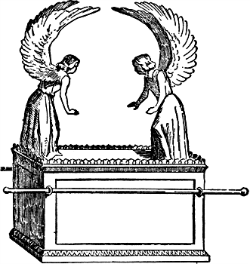
How Not to Accomplish God’s Will – I Samuel 4:1-16

arkofcovenant“The man said to Eli, ‘I am the one who came from the battle line. Indeed, I escaped from the battle line today.’ And he said, How did things go, my son?” Then the one who brought the news replied, ‘Israel has fled before the Philistines and there has also been a great slaughter among the people, and your two sons also, Hophni and Phinehas, are dead, and the ark of God has been taken'” (1 Samuel 4:16-19, NASB).

When the Philistines captured the ark of the covenant from the Israelites, it was the direct result of the presumption of the Israelites that God was on their side no matter what they did or didn’t do.

The ark of the covenant was the visible sign of the presence and power of God. Until this time the ark had been housed in the tabernacle (tent sanctuary) at Shiloh, where it resided since the Israelites entered the promised land (Joshua 18:1). Now, Israel was disastrously defeated by the Philistines and the elders of Israel realized that the defeat was the work of the Lord.

Continue reading

Your Brother’s Keeper – 1 Corinthians 8

BrotherkeeperIf food causes my brother to stumble, I will never eat meat again, so that I will not cause my brother to stumble” (1 Corinthians 8:13, NASB).

In Genesis 4, Cain killed his brother, Abel, out of jealousy. When God asked Cain where his brother was, Cain answered with that ageless question, “Am I my brother’s keeper?: (Genesis 4:9).

In 1 Corinthians 8 the Apostle Paul addressed a moral dilemma confronting the Corinthian Christians, that of eating meat that was offered as a sacrifice to an idol in a pagan temple. While this issue is not one to which we relate today, the resolution to the dilemma that Paul presents here has relevance for any moral dilemma of any age and culture.

Because these pagan temples offered parts of animals in sacrifice to idols, they also often functioned as butcher shops and banquet halls. Public and private dinner parties were held in temple dining rooms and meat from the temple was sold to the public in the marketplace.

Continue reading

Waiting for Grace – Isaiah 30:18

alone-with-god“Therefore the Lord longs to be gracious to you, and therefore He waits on high to have compassion on you. For the Lord is a God of justice; how blessed are all those who long for Him” (Isaiah 30:18, NASB).

Notice the amazing logic of grace that is explained in this verse:

  1. God’s people have forsaken Him for a false salvation (vs. 1–17).
  2. God is gracious to them, but He waits for just the right time to extend His grace.
  3. Because He is the God of justice, He knows the perfect way to achieve his purpose and  the perfect time to take action.
  4. Then, those who wait on God to extend His grace and mercy will certainly receive it and be restored.

Continue reading

Your Heavenly Assignment – 1 Corinthians 7:17

Divine_Providence“Only let each person lead the life that the Lord has assigned to him, and to which God has called him” (1 Corinthians 7:17, ESV).

This admonition is given in the context of believer/unbeliever marriage. The Apostle Paul explains that if one marriage partner gets saved and the other doesn’t, the Christian should remain married to his or her unbelieving spouse because the marriage vow is a sacred one, even between unbelievers, and because the believing husband or wife can be a witness to the unbelieving one.

So, following Jesus isn’t an excuse to escape your marriage commitment, even if your spouse remains an unbeliever.

Continue reading

The Gideon Leadership Strategy – Judges 6

Gideon_Sword“Then the sons of Israel did what was evil in the sight of the Lord; and the Lord gave them into the hands of Midian seven years” (Judges 6::1, NASB).

After the time of the conquest of Canaan by the Israelites, each of the tribes settled in the land allocated to them. Since, the Israelites had not completely conquered or subdued all the various Canaanite people-groups as a nation, it was left to the tribes to fight against the Canaanites still remaining in the land they occupied.

The Israelite tribes often formed regional alliances among themselves to fight against the Canaanites. And the Canaanites often formed coalitions with one another and with people groups surrounding the land of Canaan to fight against the Israelites.

Continue reading

A Test of Love – Judges 2:11-23

lovetest“So the anger of the Lord burned against Israel, and He said, ‘Because this nation has transgressed My covenant which I commanded their fathers and has not listened to My voice, I also will no longer drive out before them any of the nations which Joshua left when he died, in order to test Israel by them, whether they will keep the way of the Lord to walk in it as their fathers did, or not.’ So the Lord allowed those nations to remain, not driving them out quickly; and He did not give them into the hand of Joshua” (Judges 2:20-23, NASB).

Because of Israel’s continual disobedience to God’s covenant with them, God allowed other Canaanite people-groups whom the Israelites were supposed to destroy completely to remain in the promised land. Although God left these enemies in the land to test the Israelites (3:1-4), it was Israel who failed to drive them out as God had commanded.

Continue reading

A Living Example – 2 Thessalonians 3:7-9

setting-the-example“For you yourselves know how you ought to follow our example, because we did not act in an undisciplined manner among you, nor did we eat anyone’s bread without paying for it, but with labor and hardship we kept working night and day so that we would not be a burden to any of you; not because we do not have the right to this, but in order to offer ourselves as a model for you, so that you would follow our example” (2 Thessalonians 3:7-9, NASB).

What greater way to teach than to model or be an example of the lesson you are teaching! But, when you set yourself up an example, it requires an extremely high level of accountability and responsibility.

Continue reading

Word! – 1 Thessalonians 2:13

God's_Word“For this reason we also constantly thank God that when you received the word of God which you heard from us, you accepted it not as the word of men, but for what it really is, the word of God, which also performs its work in you who believe” (1 Thessalonians 2:13, NASB).

The Apostle Paul praised the Thessalonians for accepting his preaching as if it was words spoken by God. The words he spoke to them weren’t just impotent words spoken by human beings but the very Word of God.

Continue reading

Wait Training, Part 1: Strengthening Your Faith – Isaiah 40:31

wait-trainingBut they that wait upon the Lord shall renew their strength; they shall mount up with wings as eagles; they shall run, and not be weary; and they shall walk, and not faint” (Isaiah 40:31, KJV).

When I was younger, we often sang this verse at prayer meetings or Bible studies as a song. Then, at the end of the verse we added this refrain to the song: “Teach me Lord, teach me Lord, to wait.”

The Hebrew word that is translated “they that wait upon” in the KJV finds its root in another Hebrew word that means to wait or look for, to hope for or expect. The sense of the waiting in this verse is eager expectation or anticipation. So, the NIV translates it as “those who hope” and the HCSB translates it as “those who trust.”

Unfortunately, when we talk about “waiting upon the Lord,” it’s not necessarily waiting with hopeful anticipation, but more like waiting with dreaded apprehension! For us, waiting upon the Lord is exceedingly distressful and practically unbearable. Instead of eagerly waiting upon the Lord, we impatiently wait upon the Lord.

Continue reading

Tolerance – Isaiah 5:20

tolerance“Woe to those who call evil good, and good evil; who substitute darkness for light and light for darkness, who substitute bitter for sweet and sweet for bitter!” (Isaiah 5:20, NASB).

There are those in this world who are trying to tell us what we know is evil is good and what we know is good is evil. Sometimes, they do it openly, but more often than not they do it inconspicuously. And, they tell us it’s for our own good. They say it will make the world a better place.

And, before you know it, we develop a tolerance for evil. Sometimes, this tolerance for evil comes in the form of compromise. And, sometimes, this tolerance for evil comes in the name of “tolerance” itself! And then, those who won’t compromise or don’t demonstrate an acceptable level of tolerance are called “intolerant” or “bigot.”

Continue reading