
No Membership Requirements – Acts 14:26 – 15:35

Originally published March 9, 2011.

“For it was the Holy Spirit’s decision—and ours—not to place further burdens on you beyond these requirements: that you abstain from food offered to idols, from blood, from eating anything that has been strangled, and from sexual immorality. You will do well if you keep yourselves from these things” (Acts 15:28-29, CSB).

After arriving back in Antioch after their first missionary journey, Paul and Barnabas reported to the church that God “had opened the door of faith to the Gentiles” (vs. 14:27) in Asia. But some men came to Antioch from Jerusalem teaching that unless you are circumcised you “cannot be saved” (vs. 15:1).

Paul and Barnabas debated with these men about this doctrine and were unable to reach an understanding with them. So, the Antioch church sent Paul and Barnabas to Jerusalem to discuss the issue with the apostles and elders there. At this time the Jerusalem church was considered the headquarters of the Christian movement.

Continue reading
The Cosmic Struggle – Genesis 32:24-32

Originally published on August 21, 2013.

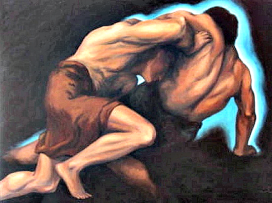
Picture of Jacob wrestling with God

“Your name will no longer be Jacob,” he said. “It will be Israel because you have struggled with God and with men and have prevailed.” (Genesis 32:28, CSB).

After twenty years of separation, Jacob attempted to reconcile with his estranged brother, Esau, whom Jacob had tricked into giving up his birth right to him.

Fearing that his encounter with Esau may be a hostile one, Jacob appropriated from his flocks a considerable gift to assuage any revenge Esau might want to take on Jacob and his family. Then, Jacob sent his gift ahead with some of his servants to meet Esau first while Jacob and his immediate family remained behind.

Continue reading

The Place Where Heaven and Earth Meet – Genesis 32:1-23

Originally published January 26, 2012.

“Jacob went on his way, and God’s angels met him. When he saw them, Jacob said, ‘This is God’s camp.’ So he called that place Mahanaim” (Genesis 32:1-2, CSB).

While Jacob was on a journey returning to the Promised Land, he met angels at a place where he stopped to camp. Jacob called the place where he met the angels, Mahanaim, which means in Hebrew, Two Camps. This was also the place where he would have the famed wrestling match with God.

Jacob may have designated the place as Two Camps because he was acknowledging the convergence of two realities at that place—the unseen world of God as represented by the angels and his own physical and material world consisting of his family, servants, and livestock.

Continue reading

Focal Point – Genesis 28:18-22

Originally published January, 2014.

“Early in the morning Jacob took the stone that was near his head and set it up as a marker. He poured oil on top of it and named the place Bethel…Then Jacob made a vow: ‘If God will be with me and watch over me on this journey, if He provides me with food to eat and clothing to wear, and if I return safely to my father’s house, then the Lord will be my God. This stone that I have set up as a marker will be God’s house, and I will give to You a tenth of all that You give me'” (Genesis 28:18-22, HCSB).

Jacob was on a journey to Haran and at the end of one of the days during his journey he stopped and camped outdoors.

That night God appeared to Jacob in a dream of a stairway that started from where he was and reached to heaven. Angels were ascending and descending the stairway. In the dream God transferred to Jacob all the essential elements of the covenant He had established with his grandfather and father, Abraham and Isaac.

When Jacob awoke, he took the stone that was near his head and set it up as as a marker or a memorial and anointed it with oil and named the place, Bethel, meaning house of God. Then Jacob made the vow stated in these verses.

Continue reading

An Expensive Meal – Genesis 25:19-34

Originally published on January 22, 2014

“So Esau swore an oath, thereby selling all his rights as the firstborn to his brother, Jacob. Then Jacob gave Esau some bread and lentil stew. Esau ate the meal, then got up and left. He showed contempt for his rights as the firstborn” (Genesis 25:33-34, NLT).

Esau and Jacob were twin sons of Isaac. As they grew up, Esau, the firstborn of the twins, was an outdoorsman and preferred by his father, Isaac. Jacob was a homebody and preferred by his mother, Rebekah.

We see these personality traits on display in this story. Esau had been out in the woods, possibly hunting, while Jacob was at home cooking. When Esau came home exhausted and hungry, he asked Jacob for some stew. Jacob said he would trade Esau some stew for Esau’s rights as the firstborn son. Esau swore an oath selling his birthright to his brother for the price of a meal.

Continue reading

Make It So – Genesis 22:1-19

Then he said, “Do not lay a hand on the boy or do anything to him. For now I know that you fear God, since you have not withheld your only son from me.” Abraham looked up and saw a ram caught in the thicket by its horns. So Abraham went and took the ram and offered it as a burnt offering in place of his son. And Abraham named that place The Lord Will Provide…. (Genesis 22:12-14, CSB).

In Sir Patrick Stewart’s portrayal as Captain Jean-Luc Picard in the Star Trek: The Next Generation series, Stewart gave us one of the most iconic Star Trek phrases of all time, “Make it so!” This catchphrase was usually used when a crew member suggested a course of action for the Starship Enterprise to avoid or confront a dangerous situation.

In the story of Abraham’s test of faith in Genesis 22 Abraham believed that God would “Make It So” on His promise to Abraham.

Continue reading

Leftover Grace – Genesis 21:1-21

But God said to Abraham, “Do not be distressed about the boy and about your slave. Whatever Sarah says to you, listen to her, because your offspring will be traced through Isaac, and I will also make a nation of the slave’s son because he is your offspring” (Genesis 21:12-13, CSB).

In Genesis 15 God made a covenant with a childless and aged Abraham that his offspring would be so numerous they would become a great nation and that he would possess the land of Canaan, “the promised land.”

So, Sarah gave her Egyptian slave Hagar to Abraham to take as his wife as a way to fulfill God’s promise to them. Abraham had a child by Hagar named Ishmael.

Then, fourteen years later God fulfilled His promise to Abraham and Sarah became pregnant and bore Abraham a son named Isaac. While both boys were Abraham’s sons, Isaac was the son of God’s promise while Ismael was the son that Sarah and Abraham contrived to fulfill God’s promise.

Continue reading

Role Player – Genesis 20-21:6

“The Lord came to Sarah as he had said, and the Lord did for Sarah what he had promised. Sarah became pregnant and bore a son to Abraham in his old age, at the appointed time God had told him” (Genesis 21:1-2, CSB).

In basketball not every great player is a starter. You have players who come off the bench who are great defensive players, great rebounders, great ball-handlers or great 3-point shooters. These players may not be the stars of the team but you can’t be a championship team without great role players.

After the destruction of Sodom and Gomorrah, Genesis returned to the story of Abraham. Genesis 20 is devoted to God’s rescue of Abraham’s wife, Sarah, from the harem of King Abimilech.

Abraham had continued his travels around the Promised Land and settled for a while in the region of the Negev. The Negev is a desert region in southern Israel. Abraham obviously had a large entourage and a large number of flocks so when he entered the region he likely requested permission from the king to encamp there.

In making his request Abraham told King Abimelech that Sarah was his sister, not his wife. While it was true that Sarah was Abraham’s half-sister (Genesis 20:12), Abraham omitted the part that she was also his wife. Abimilech took Sarah into his household (or harem) as one of his wives, possibly to seal the deal.

Continue reading

Mass Destruction – Genesis 18:1-19:27

Previously posted on January 14, 2013

“Then out of the sky the Lord rained on Sodom and Gomorrah burning sulfur from the Lord. He demolished these cities, the entire plain, all the inhabitants of the cities, and whatever grew on the ground. But Lot’s wife looked back and became a pillar of salt.” (Genesis 19:24-26, CSB).

One of the most provocative stories in Genesis is the mass destruction of Sodom and Gomorrah. Perhaps, it is the strange interplay between good fortune and bad fortune expressed in the events leading up to the destruction that makes the story so foreboding.

It’s the middle of an otherwise ordinary day in the arid land where Abraham resides when the heat is at its blistering peak. Abraham is resting at the entrance to his tent when he sees three travelers standing nearby. His nomadic sense of hospitality demands that he invites them to stop and refresh themselves before proceeding on their journey .

Continue reading

When God Pays A Visit – Genesis 18

JesusAtTheDoor

“Now the Lord appeared to him by the oaks of Mamre, while he was sitting at the tent door in the heat of the day. When he lifted up his eyes and looked, behold, three men were standing opposite him…He said, ‘I will surely return to you at this time next year; and behold, Sarah your wife will have a son’….Then the men turned away from there and went toward Sodom, while Abraham was still standing before the Lord. Abraham came near and said, ‘Will You indeed sweep away the righteous with the wicked?… Shall not the Judge of all the earth deal justly?’” (Genesis 18:1-2,22-23,25, NASB).

Genesis 18 is a theological nexus that reveals the link between God’s mercy and wrath, between human rebellion and redemption. And it does so in a most dramatic way.

Three defining moments occur in this chapter that reveal the cosmic interaction between mercy and wrath, between human rebellion and divine redemption: 1) the announcement of the birth of Isaac; 2) the plan to destroy Sodom and Gomorrah; and 3) God’s restraint for Lot and his family.

One day while Abraham was sitting on the front porch of his tent, God paid him a visit. God appeared in front of Abraham in the form of three men (a theophany). Some think the three men signify the Trinity, God the Father, God the Son, and God the Holy Spirit. The text indicates that two of them were angels so at least one of the three persons appearing at Abraham’s tent was God Himself,  “the Lord” (see vs. 1, 13, 17, 20, 26, 33, 19:1)!

Continue reading