
Doing What God Does – Exodus 20:1-17

ten-commandments“Then God gave the people all these instructions: I am the Lord your God, who rescued you from the land of Egypt, the place of your slavery. You must not have any other god but me.” (Exodus 20:1-3, NLT).

This verse is the preamble and the first of the Ten Commandments in Exodus Chapter 20. The Ten Commandments are sort of an executive summary of the expanded terms of God’s covenant with the Israelites in Chapters 21-23.

The terms of the covenant specified the behavior the Israelites were expected to demonstrate if they were to be in a covenant relationship with God Almighty. The first four commandments (vs. 2-11) described what our behavior should be in relation to God while the remaining six commandments (vs. 12-17) described what our behavior should be in relation to other human beings.

Continue reading

God Prevails! The Key to a Victorious Christian Life – Exodus 17:10-16

MosesHandsLifted“Joshua did as Moses had told him, and fought against Amalek, while Moses, Aaron, and Hur went up to the top of the hill. While Moses held up his hand, Israel prevailed, but whenever he put his hand down, Amalek prevailed. When Moses’ hands grew heavy, they took a stone and put it under him, and he sat down on it. Then Aaron and Hur supported his hands, one on one side and one on the other so that his hands remained steady until the sun went down. So Joshua defeated Amalek and his army with the sword…. And Moses built an altar and named it, ‘The Lord Is My Banner.’ He said, ‘Indeed, my hand is lifted up toward the Lord’s throne.'”  (Exodus 17:10-16, HCSB).

The Amalekites were probably a nomadic people who resided in the area of the Negev on the northern part of the Sinai peninsula and came down to the southern part of Sinai to attack the Israelites. The attack of the Amalekites was particularly offensive because they attacked the weakest Israelites, the stragglers who were at the rear (Deuteronomy 25:17-18).

While the Israelites were fighting the Amalekites under the military leadership of Joshua, Moses, Aaron, and Hur were standing on a hilltop watching the battle. When Moses raised his hands holding the staff of God, the Israelites prevailed in battle. When Moses’ arms grew weary and fell down to his side, the Amalekites prevailed in battle.

Continue reading

Qualified for Membership – Acts 11:15-18

membershipcard“As I began to speak, the Holy Spirit came down on them, just as on us at the beginning. Then I remembered the word of the Lord, how He said, ‘John baptized with water, but you will be baptized with the Holy Spirit. Therefore, if God gave them the same gift that He also gave to us when we believed on the Lord Jesus Christ, how could I possibly hinder God? When they heard this they became silent. Then they glorified God, saying, ‘So God has granted repentance resulting in life even to the Gentiles!'” (Acts 11:15-18, HCSB).

Citizenship is generally a function of where you are born. You are a citizen of the country in which you are geographically born or of which your parents are a citizen.

The same is true for citizenship in the Kingdom of God. Kingdom citizens must be born of God; they must be birthed by the Holy Spirit.

Continue reading

How To Deal With Guilt – Psalm 51:9-11

guilt“Don’t keep looking at my sins. Remove the stain of my guilt. Create in me a clean heart, O God. Renew a loyal spirit within me. Do not banish me from your presence, and don’t take your Holy Spirit from me. Restore to me the joy of your salvation and make me willing to obey you” (Psalm 51:9-11, NLT).

All of us commit sins and our sinning is usually accompanied by a personal sense of guilt. We’ve failed God…

While the psalmist understood that he needed absolution from the guilt of sin as legal consequence of God’s universal justice system, he also understood that guilt had serious and debilitating psychological and spiritual consequences for individuals that needed to be addressed before God.

Continue reading

Grace/Not Grace – Exodus 15:19

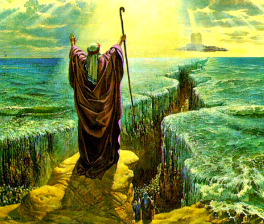
moses-parting-the-red-sea“For the horses of Pharaoh with his chariots and his horsemen went into the sea, and the Lord brought back the waters of the sea on them, but the sons of Israel walked on dry land through the midst of the sea” (Exodus 15:19, NASB).

You might notice in this verse from the Song of Moses, which proclaims God’s greatness in helping Israel escape from Egypt, that the same miracle that God used to deliver the Israelites is also the same miracle that God used to destroy Pharaoh’s army!

Continue reading

God’s Distinctive People – Exodus 11-12

DistinctivePeople

“That you may understand how the Lord makes a distinction between Egypt and Israel” (Exodus 11:7, NASB).

This statement is the conclusion of Moses’ declaration to Pharaoh before God sent the final plague, the deaths of all the firstborns, against Egypt. The plagues God sent against Egypt to convince Pharaoh to emancipate the Israelites demonstrated that what matters to God is where your allegiance falls.

The Israelites couldn’t serve serve God and Pharaoh!

You can’t be a child of God and a child of this world!

Continue reading

The City of God – Psalm 48:1-2

kingdom_of_God2“How great is the Lord, how deserving of praise, in the city of our God, which sits on his holy mountain! It is high and magnificent; the whole earth rejoices to see it! Mount Zion, the holy mountain, is the city of the great King!” (Psalm 48:1-2, NLT).

Zion is the Hebrew name for the mountain in Jerusalem where the Temple was located. On the one hand Zion was synonymous with the actual city of Jerusalem that was destroyed in 586 BC and again in AD 70. On the other hand Zion was the City of God that transcended geographical location. Zion was the City in which God dwelled!

Continue reading

I Pledge Allegiance – Exodus 7-10

allegiance“Let my people go, so they may serve me” (Exodus 7:16; 8:1, 20;  9:1, 13; 10:3, NASB).

If I asked the question, “What did God tell Moses to say to Pharaoh?” you would probably respond, “Let my people go!” At least that’s the way I remember it, but that’s not the whole story.

A closer reading of the story of the plagues God sent against Egypt to convince Pharaoh to emancipate the Israelites in Exodus 7-10 reveals there’s more to God’s directive to Pharaoh than just release the Isralites. And, what else God told Moses to tell Pharaoh suggests that the conflict between God and Pharoah played out in this narrative was of cosmic proportions!

Continue reading

The Gospel According to John 3:16

ForGodSoLoved-JesusOnCross

The way we sometimes present the gospel would make this verse read more like this: “For we sinned so much that God gave His only begotten Son, that whoever believes in Him will quit sinning.”

We make the gospel out to be about our sin rather than God’s love. We send people down the Roman Road–“all have sinned” (Romans 3:23)–instead of up the Via Dolorosa–“He gave His only begotten Son” (John 3:16).

Continue reading

God Will Take Notice – Exodus 2:23-25

ear-hearing“The Israelites groaned because of their difficult labor, and they cried out; and their cry for help ascended to God because of the difficult labor. So God heard their groaning, and He remembered His covenant with Abraham, Isaac, and Jacob. God saw the Israelites, and He took notice” (Exodus 2:23-25, HCSB).

Hundreds of years had passed since Joseph was prime minister of Egypt and had urged his father, Jacob, and his brothers to move down to Egypt. From the original seventy migrants, the Israelites had grown into a huge nation probably numbering in the millions.

Continue reading