Drifting – Hebrews 2:1-10

For this reason, we must pay attention all the more to what we have heard, so that we will not drift away. For if the message spoken through angels was legally binding and every transgression and disobedience received a just punishment, how will we escape if we neglect such a great salvation? This salvation had its beginning when it was spoken of by the Lord, and it was confirmed to us by those who heard him. At the same time, God also testified by signs and wonders, various miracles, and distributions of gifts from the Holy Spirit according to his will (Hebrews 2:1-4, CSB).

Have you ever heard the the old saying, “up the river (or creek) without a paddle.” If you don’t have a paddle in your boat, you flow whatever direction the river current takes you. The boat drifts with the current.

But, a paddle lets you steer the boat; it lets you set a course and sail in a direction. It keeps you from drifting.

Continue reading

Are You Listening? – Hebrews 1:1-4

Long ago God spoke to our ancestors by the prophets at different times and in different ways. In these last days, he has spoken to us by his Son (Hebrews 1:1-2, CSB).

Are you listening? Because God is speaking.

God spoke in a variety of ways in the Old Testament. The revelation given through the Old Testament prophets was brought in various ways – sometimes through parables, narrative, prophecy, psalms, proverbs, and sometimes through some very dramatic or unorthodox methods:

Continue reading

What’s In a Name? – Exodus 3

Then Moses asked God, “If I go to the Israelites and say to them: The God of your fathers has sent me to you and they ask me, ‘what is His name?’ what should I tell them?” God replied to Moses “I AM WHO I AM. This is what you are to say to the Israelites: I AM has sent me to you.” God also said to Moses, “Say this to the Israelites: Yahweh, the God of your fathers, the God of Abraham, the God of Isaac, and the God of Jacob, has sent me to you. This is My name forever; this is how I am to be remembered in every generation. (Exodus 3:13-15, CSB)

In Exodus 3 God commissioned Moses to lead the people out of 400 years of Egyptian slavery and revealed both His nature and His name to Moses on Mount Horeb. There is some significant wordplay at work in this revelation that is not so apparent in the English translation. Knowing a little of this Hebrew wordplay can certainly strengthen our understanding of God’s purpose in our lives and our world.

Continue reading

Paying Attention – Acts 16:11-15

“A God-fearing woman named Lydia, a dealer in purple cloth from the city of Thyatira, was listening. The Lord opened her heart to respond to what Paul was saying” (Acts 16:14, CSB).

The events in these verses take place during Paul’s second missionary journey. Paul and Barnabas had decided to go visit the churches they had established during their first missionary journey. When they disagreed about who should be on their evangelistic team, they parted company and Paul selected Silas to accompany him on his second missionary journey.

Paul and Silas set out across the regions of Phrygia and Galatia, which is in the eastern half of the modern country of Turkey. But, Paul’s plans to journey north into the region of Bithynia were constrained by the Holy Spirit and instead they traveled west to Troas on the coast of the Aegean Sea.

At Troas Paul had a vision of a man pleading with him to cross over the Aegean Sea into Macedonia, just to the north of the modern country of Greece. Paul and Silas would evangelize in Macedonia and eventually travel south into the Greek cities of Athens and Corinth.

Continue reading

God Is Good, All The Time – Genesis 50:15-21

Originally posted February 11, 2011

But Joseph said to them, “Don’t be afraid. Am I in the place of God? You planned evil against me; God planned it for good to bring about the present result—the survival of many people. Therefore don’t be afraid. I will take care of you and your children.” And he comforted them and spoke kindly to them (Genesis 50:19-21, CSB).

This response by Joseph to his brothers has been a recurring theological theme of the saga of Abraham and his offspring in the book of Genesis. It is the result of God’s covenant with Abraham.

Upon the death of Jacob, Joseph’s brothers were afraid that he would take revenge on them for selling him into slavery many years earlier. So, they sent a message to Joseph begging his forgiveness.

When Joseph received their message, he wept because his brothers still feared reprisal from him. Then they came to Joseph and bowed down before him and told him they would be his slaves.

Continue reading

No Membership Requirements – Acts 14:26 – 15:35

Originally published March 9, 2011.

“For it was the Holy Spirit’s decision—and ours—not to place further burdens on you beyond these requirements: that you abstain from food offered to idols, from blood, from eating anything that has been strangled, and from sexual immorality. You will do well if you keep yourselves from these things” (Acts 15:28-29, CSB).

After arriving back in Antioch after their first missionary journey, Paul and Barnabas reported to the church that God “had opened the door of faith to the Gentiles” (vs. 14:27) in Asia. But some men came to Antioch from Jerusalem teaching that unless you are circumcised you “cannot be saved” (vs. 15:1).

Paul and Barnabas debated with these men about this doctrine and were unable to reach an understanding with them. So, the Antioch church sent Paul and Barnabas to Jerusalem to discuss the issue with the apostles and elders there. At this time the Jerusalem church was considered the headquarters of the Christian movement.

Continue reading

The Cosmic Struggle – Genesis 32:24-32

Originally published on August 21, 2013.

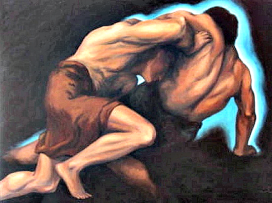
Picture of Jacob wrestling with God

“Your name will no longer be Jacob,” he said. “It will be Israel because you have struggled with God and with men and have prevailed.” (Genesis 32:28, CSB).

After twenty years of separation, Jacob attempted to reconcile with his estranged brother, Esau, whom Jacob had tricked into giving up his birth right to him.

Fearing that his encounter with Esau may be a hostile one, Jacob appropriated from his flocks a considerable gift to assuage any revenge Esau might want to take on Jacob and his family. Then, Jacob sent his gift ahead with some of his servants to meet Esau first while Jacob and his immediate family remained behind.

Continue reading

The Place Where Heaven and Earth Meet – Genesis 32:1-23

Originally published January 26, 2012.

“Jacob went on his way, and God’s angels met him. When he saw them, Jacob said, ‘This is God’s camp.’ So he called that place Mahanaim” (Genesis 32:1-2, CSB).

While Jacob was on a journey returning to the Promised Land, he met angels at a place where he stopped to camp. Jacob called the place where he met the angels, Mahanaim, which means in Hebrew, Two Camps. This was also the place where he would have the famed wrestling match with God.

Jacob may have designated the place as Two Camps because he was acknowledging the convergence of two realities at that place—the unseen world of God as represented by the angels and his own physical and material world consisting of his family, servants, and livestock.

Continue reading

Focal Point – Genesis 28:18-22

Originally published January, 2014.

“Early in the morning Jacob took the stone that was near his head and set it up as a marker. He poured oil on top of it and named the place Bethel…Then Jacob made a vow: ‘If God will be with me and watch over me on this journey, if He provides me with food to eat and clothing to wear, and if I return safely to my father’s house, then the Lord will be my God. This stone that I have set up as a marker will be God’s house, and I will give to You a tenth of all that You give me'” (Genesis 28:18-22, HCSB).

Jacob was on a journey to Haran and at the end of one of the days during his journey he stopped and camped outdoors.

That night God appeared to Jacob in a dream of a stairway that started from where he was and reached to heaven. Angels were ascending and descending the stairway. In the dream God transferred to Jacob all the essential elements of the covenant He had established with his grandfather and father, Abraham and Isaac.

When Jacob awoke, he took the stone that was near his head and set it up as as a marker or a memorial and anointed it with oil and named the place, Bethel, meaning house of God. Then Jacob made the vow stated in these verses.

Continue reading

An Expensive Meal – Genesis 25:19-34

Originally published on January 22, 2014

“So Esau swore an oath, thereby selling all his rights as the firstborn to his brother, Jacob. Then Jacob gave Esau some bread and lentil stew. Esau ate the meal, then got up and left. He showed contempt for his rights as the firstborn” (Genesis 25:33-34, NLT).

Esau and Jacob were twin sons of Isaac. As they grew up, Esau, the firstborn of the twins, was an outdoorsman and preferred by his father, Isaac. Jacob was a homebody and preferred by his mother, Rebekah.

We see these personality traits on display in this story. Esau had been out in the woods, possibly hunting, while Jacob was at home cooking. When Esau came home exhausted and hungry, he asked Jacob for some stew. Jacob said he would trade Esau some stew for Esau’s rights as the firstborn son. Esau swore an oath selling his birthright to his brother for the price of a meal.

Continue reading