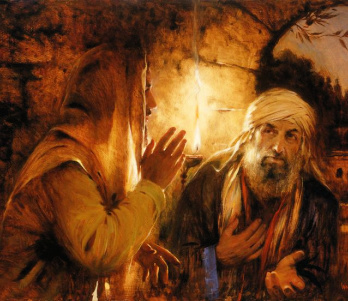

The Nicodemus Dilemma – John 3:1-21

“How can these things be?” asked Nicodemus (John 3:9, CSB).

During the twilight discussion between Jesus and Nicodemus, an iconic declaration is spoken by Jesus that is often included in tracts, sermons and Sunday School lessons: John 3:3: “Unless someone is born again he cannot see the kingdom of God.”

But little is discussed of Nicodemus’ side of the conversation and what he said to prompt Jesus to make this momentous pronouncement.

John indicates that Jesus went to Jerusalem for the Passover Festival at the beginning of his ministry. During the Passover Festival Jesus drove the money changers from the Temple and performed many miracles. As a result of the miracles many people in Jerusalem believed that Jesus was the Messiah (see John 2:13-25).

Probably during this Passover Festival in Jerusalem Nicodemus held his meeting with Jesus. Nicodemus was a Pharisee and ruler of the Jews and came to Jesus at night. Maybe Nicodemus was trying to avoid public scrutiny because of his religious and political position or he wanted to have a one-on-one conversation with Jesus when there weren’t crowds surrounding Jesus.

Having witnessed Jesus’ ministry in Jerusalem, Nicodemus apparently felt a disconnect between his religious understanding and what he observed in the ministry of Jesus at Jerusalem. Nicodemus’ dilemma is apparent in the questions he asked Jesus during their discussion.

To begin the conversation, it appears that Nicodemus wanted verification of Jesus’ calling. So, Nicodemus injected an offhanded question about His authenticity into a polite acknowledgement of His ministry. First, Nicodemus said, “Rabbi, we know that you are a teacher who has come from God, for no one could perform these signs you do unless God were with him.” (vs. 2).

Nicodemus’ probably expected Jesus to affirm that He was, indeed, sent from God. But Jesus skipped over the small talk and took aim at the question that was really bothering Nicodemus–how to enter the kingdom of God. Today we might ask, “How do I get saved?”

Jesus turned the conversation into a theological challenge to Nicodemus’ rather than a debate over His divinity. Jesus did this by making the outrageous pronouncement, “Unless someone is born again (or born from above), he cannot see the kingdom of God.”

When confronted with this incredible and even bizarre declaration of Jesus, a bewildered Nicodemus responded to Jesus with as ridiculous an assertion as he thought Jesus was making to him: “How can anyone be born when he is old?” …. “Can he enter his mother’s womb a second time and be born?” (vs. 4).

Nicodemus’ reaction was certainly one I can relate to as a fellow inhabitant of this world when confronted with the other-wordly declarations and supernatural actions of Jesus!

Fortunately, Jesus explained to Nicodemus exactly what He meant by being born again. “Jesus answered, “Truly I tell you, unless someone is born of water and the Spirit, he cannot enter the kingdom of God” ( vs. 5).

Unfortunately, His explanation ran contrary to Nicodemus’ existing religious perceptions. Nicodemus then articulated his dilemma and the dilemma of many of us who think we’ve got God all figured out and neatly stored away in our religious beliefs box.

“How can these things be?” (vs. 9).

We have all experienced the Nicodemus dilemma because it’s the human dilemma. When confronted with the reality of God’s Kingdom, it challenges the reality I experience in this world.

Jesus’ teachings (and His life, death and resurrection) subvert our closely-held and common beliefs about what it takes to obtain eternal life. Like Nicodemus, I might think that if I’m a good person, if I follow the rules, or if I do more good than bad in my life then God will accept me in because I’m one of the good (religious) guys.

But, that’s not what Jesus said–at all! Jesus said that entering the Kingdom of God is supernaturally-enabled!

Jesus stipulated that human beings must have a spiritual re-birth to make it into heaven. If you are a human being, you have been born once (of water). But, to enter the Kingdom of God you must be born a second time by/of the Spirit of God.

Being born again means entering into an eternal relationship with God through Jesus Christ and enabled by the Holy Spirit.

It’s just that simple….and profound!

For God loved the world in this way: He gave his one and only Son, so that everyone who believes in him will not perish but have eternal life. (John 3:16, CSB)

Jesus: Emotional Supporter or Revolutionary Ringleader – John 14:1-16

Thomas said to him, ‘Lord, we don’t know where you are going, so how can we know the way?’ Jesus answered, ‘I am the way and the truth and the life'” (John 14:5-6, NIV).

Recently, I was standing in the Sunday morning contemporary church service singing the lyrics of a worship song. As we sang the words of the chorus a few too many times it caused me to wonder if these lyrics were even biblical.

Did Jesus come to hold my hand and help me through all my problems? Did he come to make me feel better about myself?

Sometimes our worship songs and even our preaching romanticizes the unconditional love of God so that Jesus is portrayed as our best friend who is always ready to support our emotional needs whenever we’re confronted with problems.

But, if we want to put God’s love in some sort of context, I think God’s love is more like the unconditional love of a good parent than the affection of a best friend.

Continue reading

Qualified – Hebrews 5:1-10

“After he was perfected, he became the source of eternal salvation for all who obey him….” (Hebrews 5:9, CSB).

The Hebrews writer gives us yet another Old Testament perspective of how Jesus is the fulfillment of God’s plan for human redemption. This verse is the conclusion of a broader argument about Jesus’ role as the everlasting High Priest to emphasize His unique qualifications as the both fully human and fully divine Savior.

The Hebrews writer explains that a High Priest was chosen from the Israelite people to make sacrifices for their sins. Because he was human, he had to offer sacrifices for his own sin as well as the sins of the people. In Leviticus 16 God implemented a Day of Atonement in which the High Priest performed a sacrifice for the atonement of the sin for the Israelites. The ceremony, which was conducted annually, began with a sacrifice for the atonement of the sins for the High Priest.

Continue reading

The Rest of the Story – Hebrews 4

“If Joshua gave the Israelites rest, God wouldn’t have spoken about another day later on. So you see that a sabbath rest is left open for God’s people. The one who entered God’s rest also rested from his works, just as God rested from his own. Therefore, let’s make every effort to enter that rest so that no one will fall by following the same example of disobedience, because God’s word is living, active, and sharper than any two-edged sword. It penetrates to the point that it separates the soul from the spirit and the joints from the marrow. It’s able to judge the heart’s thoughts and intentions. No creature is hidden from it, but rather everything is naked and exposed to the eyes of the one to whom we have to give an answer” (Hebrews 4:8-13, CSB).

The Hebrews writer gives us yet another Old Testament perspective of the Christian life. As we concluded in the previous post, our salvation in Christ and hope for eternal life is a reality that we should live out each day of our lives on earth.

In Hebrews 4 the Hebrews writer tells us that there is a “Rest” for God’s people to enter into. It has always been God’s plan since the Creation and still is today for His people to join Him in the restfulness of eternal life where God Himself abides (see vs. 1-4).

Continue reading

Drifting – Hebrews 2:1-10

For this reason, we must pay attention all the more to what we have heard, so that we will not drift away. For if the message spoken through angels was legally binding and every transgression and disobedience received a just punishment, how will we escape if we neglect such a great salvation? This salvation had its beginning when it was spoken of by the Lord, and it was confirmed to us by those who heard him. At the same time, God also testified by signs and wonders, various miracles, and distributions of gifts from the Holy Spirit according to his will (Hebrews 2:1-4, CSB).

Have you ever heard the the old saying, “up the river (or creek) without a paddle.” If you don’t have a paddle in your boat, you flow whatever direction the river current takes you. The boat drifts with the current.

But, a paddle lets you steer the boat; it lets you set a course and sail in a direction. It keeps you from drifting.

Continue reading

No Membership Requirements – Acts 14:26 – 15:35

Originally published March 9, 2011.

“For it was the Holy Spirit’s decision—and ours—not to place further burdens on you beyond these requirements: that you abstain from food offered to idols, from blood, from eating anything that has been strangled, and from sexual immorality. You will do well if you keep yourselves from these things” (Acts 15:28-29, CSB).

After arriving back in Antioch after their first missionary journey, Paul and Barnabas reported to the church that God “had opened the door of faith to the Gentiles” (vs. 14:27) in Asia. But some men came to Antioch from Jerusalem teaching that unless you are circumcised you “cannot be saved” (vs. 15:1).

Paul and Barnabas debated with these men about this doctrine and were unable to reach an understanding with them. So, the Antioch church sent Paul and Barnabas to Jerusalem to discuss the issue with the apostles and elders there. At this time the Jerusalem church was considered the headquarters of the Christian movement.

Continue reading

Salvation in the Old Testament – Genesis 15:1-6

Abram believed the Lord, and he credited it to him as righteousness.(Genesis 15:6, CSB).

In studying the Old Testament Christians may question how people were saved in Old Testament times. Early in my seminary studies this was a question I had as well and researched for a paper for one of my classes.

There is sometimes a misconception among Christians that people were “saved” in the Old Testament by keeping the Law (of Moses) while people are saved in the New Testament by grace through faith.

Genesis 15:6 gives us an unequivocal answer to the question: righteousness is imputed by God by faith, not law-keeping. And, that is both an Old Testament and New Testament proposition. In fact, in Romans 1-8 the Apostle Paul makes this proposition and this verse central to his whole argument.

Continue reading

Who’s Your Daddy? – John 8:30-59

Jesus said to them, “If God were your Father, you would love me, because I came from God and I am here. For I didn’t come on my own, but he sent me. Why don’t you understand what I say? Because you cannot listen to my word. You are of your father the devil, and you want to carry out your father’s desires.” (John 8:42-44, CSB)

Star Wars fans know well the iconic scene when Lord of the Dark Side, Darth Vader, reveals to Jedi warrior, Rebel hero, and disciple of the Force, Luke Skywalker, that he is Luke’s father. And, it then becomes a classic case of good vs. evil and what you think is good becomes evil.

There seems to be a similar theme in this discussion between Jesus and the Jewish religious leaders: what people think is the agent for “good” is actually the agent for “evil.”

The genealogy of Jesus is often questioned in the Gospel of John. Under a constant barrage of threats and accusations about His background hurled at Jesus by the Jewish religious leaders, He consistently maintained that He was sent from God the Father.

In fact, Jesus being one with God and being sent by God the Father–His Messiahship– is a recurring theme in John.

But, in this case Jesus turns the table on the Jewish leaders and throws shade on them about their genealogy!

Continue reading

When God Cries Out – John 7:37-39

“On the last and most important day of the festival, Jesus stood up and cried out, ‘If anyone is thirsty, let him come to me and drink. The one who believes in me, as the Scripture has said, will have streams of living water flow from deep within him.’ He said this about the Spirit. Those who believed in Jesus were going to receive the Spirit, for the Spirit had not yet been given because Jesus had not yet been glorified.” (John 7:37-39, CSB).

God is passionate about your salvation….

In John 7 Jesus went down to Jerusalem for the Feast of Tabernacles. About halfway through the week-long celebration He went up to the Temple and began to teach.

The Feast of Tabernacles, also known as the Feast of Booths and Sukkot, is the seventh and last feast that the Lord commanded Israel to observe. It is one of the three feasts each year that Jews were to observe by appearing before the Lord (see Deuteronomy 16:16). As one of the pilgrim feasts when Jewish males were commanded to go to Jerusalem, the Feast of Tabernacles was also the time when they brought their tithes and offerings to the Temple.

With the influx of people coming to Jerusalem at this time, we can only imagine what the scene must have been like. Thousands of people coming together to remember and celebrate God’s deliverance and His provision, all living in temporary shelters or booths as part of the requirements of the feast.

Continue reading

The What and Why of Salvation – John 3

“The one who believes in the Son has eternal life, but the one who rejects the Son will not see life; instead, the wrath of God remains on him” (John 3:36, CSB).

John 3 contains two Messiah-affirming stories of Jesus: (1) the secret meeting between Nicodemus the Pharisee and Jesus from which originates those iconic and rudimentary Christian propositions: “You must be born again” and John 3:16: “For God so loved the world….” and, (2) the defection of some of John the Baptist’s disciples to Jesus’ ministry, which John the Baptist acknowledges with a seeming air of expectancy, “He must increase but I must decrease” (vs. 30).

Then, the final six verses of Chapter 3 provide a theological recap of the case John is making through these two stories for the Messiahship of Jesus.

John declares that there is some metaphysical angst that accompanies unbelief in Christ’s divinity–the potential for eliciting the wrath of God. We often express this tension in the gospel message in terms like this: “If you believe in Jesus you go to heaven when you die, but if you don’t believe in Him you go to hell when you die.”

Continue reading