Why Things Happen Like They Do – Job 37:13

crossroads-2“He makes these things happen either to punish people or to show his unfailing love.” (Job 37:13, NLT).

During Elihu’s discourse to Job, Elihu counseled Job to proclaim God’s majesty and the greatness of God’s providential action in His creation rather than questioning God’s judgment and justice by proclaiming his own righteousness.

God is sovereign and He wants His good plans and purposes to be accomplished. God is greater than evil and can even use the evil actions of Satan and human beings to accomplish His good purposes.

So the same act by God can serve multiple causes–judgment and love. God’s redemptive action in His creation and in our individual lives may provide for our correction; it may enable his plans and purposes; or maybe it’s just because God is good to us that He causes things to happen the way they do!

If you are a child of God, you can be assured that God is working His will for your good and your good for His will.

And we know that God causes everything to work together for the good of those who love God and are called according to his purpose for them. (Romans 8:28, NLT)

An Offer You Can’t Refuse – Genesis 17:1-2

offeryoucantrefuse“When Abram was 99 years old, the Lord appeared to him, saying, I am God Almighty. Live in My presence and be blameless. I will establish My covenant between Me and you, and I will multiply you greatly” (Genesis 17:1-2, ESV).

Thirteen years after Ishmael’s birth, God again appeared to Abram, whom He renamed as Abraham during this appearance. In these verses God calls Himself “El Shaddai,” for which the meaning is unknown, but its translation as “God Almighty” is based on a tradition going back more than two thousand years.

Continue reading

The Secret Practice of Discipleship – Matthew 6:1-18

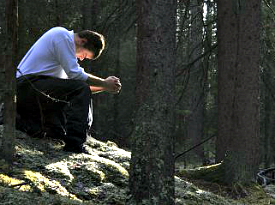
Secret-Prayer“Watch out! Don’t do your good deeds publicly, to be admired by others, for you will lose the reward from your Father in heaven…Give your gifts in private, and your Father, who sees everything, will reward you” (Matthew 6:1, 4, NLT).

When we practice the spiritual disciplines of giving, praying, and fasting we are cultivating a quality of life that helps us develop an authentic relationship with God.

Continue reading

Shine! – Matthew 5:14-16, Part 3: Good Works

Light of the World-Good Works“You are the light of the world. A city set on a hill cannot be hidden; nor does anyone light a lamp and put it under a basket, but on the lampstand, and it gives light to all who are in the house. Let your light shine before men in such a way that they may see your good works, and glorify your Father who is in heaven” (Matthew 5:14-16, NASB).

This familiar verse is from the Sermon on the Mount. You’ve probably read it, sung about it, had it taught to you in Sunday School lessons, or had it preached to you in sermons on many occasions.

I know I have. And I’ve even expounded on it more than a few times myself in these Meditations. But in all my elucidations about being the light of the world, there’s one very important point I haven’t explained very well–how to emit light.

What do I actually do to radiate light so that people will glorify God? How do I shine?

Continue reading

Because It’s the Religious Thing To Do – Matthew 3:7-10

baptism“But when he saw many of the Pharisees and Sadducees coming for baptism, he said to them, ‘You brood of vipers, who warned you to flee from the wrath to come. Therefore bear fruit in keeping with repentance; and do not suppose that you can say to yourselves, ‘We have Abraham for out father’; for I say to you that from these stones God is able to raise up children to Abraham. The axe is already laid at the root of the trees; therefore every tree that does not bear good fruit is cut down and thrown into the fire” (Matthew 3:7-10, NASB).

This declaration was made by John the Baptist when the religious leaders came to be baptized by him. John warned them that they weren’t repenting and looking for a Savior as he was preaching. They didn’t think they needed saving and so they were just being baptized because it was the religious thing to do!

Continue reading

How Would God Describe You? – Job 1

Satan_Before_the_Lord_Giaquinto“Have you considered My servant Job? For there is no one like him on the earth, a blameless and upright man, fearing God and turning away from evil” (Job 1:8, NASB).

In this verse God is describing Job to Satan, showcasing him as an example of faithfulness among human beings. God repeats this same description to the devil in vs. 2:3. And, the book of Job begins with this same description: “There was a man in the land of Uz whose name was Job; and that man was blameless, upright, fearing God and turning away from evil” (vs. 1:1).

Continue reading

Pay It Forward – Malachi 3:10

pay-it-forward2“Bring the full tenth into the storehouse  so that there may be food in my house. ‘Test Me in this way,’ says the Lord of Hosts. See if I will not open the floodgates of heaven for you and pour out a blessing for you without measure” (Malachi 3:10, HCSB).

The prophet Malachi accuses the people of Israel of robbing God (vs. 8) because they did not pay their tithes. The tithes were used to support the priests and Levites, whose ministry was essential if Israel was to be faithful to God in its calling as His chosen people. Because their land was cursed by drought and pestilence (vs. 9,11), they felt justified not giving their tithes.

Continue reading

Jesus Loves Me, This I Know – Malachi 1:2

Jesus Loves Me kids“I have always loved you,” says the Lord” (Malachi 1:2, NLT).

Malachi wrote to the Jewish exiles that had resettled in Judah probably sometime during the reign of King Darius of Persia (521-486 BC). Malachi begins his oracle by conveying the simple truth that God has always loved Israel.

Continue reading

Holy Cooking Pots – Zechariah 14:20-21

cooking_pot“On that day even the harness bells of the horses will be inscribed with these words: Holy to the Lord. And the cooking pots in the Temple of the Lord will be as sacred as the basins used beside the altar. In fact, every cooking pot in Jerusalem and Judah will be holy to the Lord of Heaven’s Armies. All who come to worship will be free to use any of these pots to boil their sacrifices” (Zechariah 14:20-21, NLT).

The last chapter of the book of Zechariah closes with visions of both the salvation and judgment that occurs at the coming of God’s universal Kingdom–“the day of the Lord.”

These last verses of the chapter and the book describe the pervasiveness of God’s holiness in His Kingdom. So much so that even the inscription on the harness bells of horses and the cooking pots in the Temple will be holy.

Continue reading