The Next Big Thing

My goal is to know him and the power of his resurrection and the fellowship of his sufferings, being conformed to his death, assuming that I will somehow reach the resurrection from among the dead. Not that I have already reached the goal or am already perfect, but I make every effort to take hold of it because I also have been taken hold of by Christ Jesus. Brothers and sisters, I do not consider myself to have taken hold of it. But one thing I do: Forgetting what is behind and reaching forward to what is ahead, I pursue as my goal the prize promised by God’s heavenly call in Christ Jesus” (Philippians 3:10-14, CSB).

Successful business people are successful because they are forward-thinking. They don’t linger or loiter in current achievements no matter how great those achievements may be. Their current success doesn’t bind them to the status quo.

They are always looking ahead. They are always striving for the next big thing!

Because there is always a new project, an unreached goal out there to attain. There is always a next new accomplishment.

Continue reading

Emancipation Proclamation – Hebrews 13:1-8

First published December 2, 2014 and edited for re-publication here.
Emancipation_Proclamation

“Remember those who led you, who spoke the word of God to you and considering the result of their conduct, imitate their faith. Jesus Christ is the same yesterday, today and forever” (Hebrews 13:7-8, NASB).

Recently in the men’s Sunday School class I attend, the lesson was from Hebrews 13. And, this lesson from Hebrews 13 helped me resolve a theological dilemma I had wrestled with from Romans 6-8.

But, I love it when that happens! It reinforces the consistency of the Bible to me and why I should read and study all of it over and over again. And, of course, why it is so important for the Holy Spirit to enlighten us and counsel us when we study God’s word.

Let me explain…

Continue reading

Crybaby Christians – Hebrews 12:1-13

“Therefore, strengthen your tired hands and weakened knees, and make straight paths for your feet, so that what is lame may not be dislocated but healed instead” (Hebrews 12:12-13, CSB).

In the first half of Hebrews 12, the Hebrews writer expounds on a saying from Proverbs in the Old Testament: “For the Lord disciplines the one he loves and punishes every son he receives” (Hebrews 12:6, Proverbs 3:12).

First, the Hebrews writer reminds the Hebrew Christians that any suffering they are experiencing is not nearly as much as what Jesus, the Son of God, endured to the extent of shedding His blood from flogging and crucifixion.

Next, the Hebrews writer explains that when you do suffer, consider it the discipline of the Lord. Because the Lord disciplines His children with the same intent as a human father disciplines his children.

So, Christian suffering is the Lord’s discipline exacted upon His children in love to learn His righteousness.

Continue reading

Cosmic Convergence- Hebrews 12:18-24

“Instead, you have come to Mount Zion, to the city of the living God (the heavenly Jerusalem), to myriads of angels, a festive gathering, to the assembly of the firstborn whose names have been written in heaven, to a Judge, who is God of all, to the spirits of righteous people made perfect, and to Jesus, the mediator of a new covenant, and to the sprinkled blood, which says better things than the blood of Abel.”

The Hebrews writer develops a final, astounding contrast between the Old Testament law and sacrificial system and the gospel of Christ. While the messages of the two are inter-dependent (see Hebrews 11:40), certainly the greatness of the new covenant symbolized by Mt. Zion where God resides greatly exceeds and even overshadows the old covenant revelation at Mount Sinai.

The Hebrews writer declared that under the new covenant it’s like getting a glimpse of heaven! With the new covenant believers encounter God. Mediated by the blood of Jesus and the indwelling Holy Spirit, Christians on the Earth share in worship with innumerable angels and the great assembly of those who have come before and died in faith and are already in God’s presence.

Continue reading

Blind Faith – Hebrews 11:13

“These all died in faith, although they had not received the things that were promised. But they saw them from a distance, greeted them, and confessed that they were foreigners and temporary residents on the earth” (Hebrews 11:13, CSB).

According to the Hebrews writer, the presence of faith is based on the coexistence of hope. In fact, hope is the essential element of faith: “Now faith is the reality of what is hoped for, the proof of what is not seen.” (vs. 1).

You can’t have faith if there is no hope! Then, faith provides certainty to your hope, enabling you to believe in a reality you don’t see.

Yes, that’s the thing about faith–it’s blind! Because if you can see it, you can’t hope for it!

Continue reading

Timeless Faith – Hebrews 11

“Now faith is the reality of what is hoped for, the proof of what is not seen. For by this our ancestors were approved….. These all died in faith, although they had not received the things that were promised…. All these were approved through their faith, but they did not receive what was promised, since God had provided something better for us, so that they would not be made perfect without us” (Hebrews 11:1-2,13,39-40, CSB).

In Hebrews 11, the “faith” chapter, the Hebrews writer defines faith and then provides a chapter-long litany of Old Testament examples.

Unfortunately, for us modern, empirical types, the Hebrews writer’s definition of faith is the antithesis of the scientific standards of observable data. Faith according to the Hebrews writer is not based on observable data but it’s based on the “proof” of the unseen. It’s inscrutable!

And, while having faith means we have hope for something we do not see, it also provokes us to take certain actions in our lives (vs. 2).

Continue reading

Live Like You Are Saved! – Hebrews 10:19-39

“But we are not those who draw back and are destroyed, but those who have faith and are saved” (Hebrews 10:39, CSB).

The Hebrews writer made an elegant theological argument in the previous chapters and concluding in Chapter 10 that the Old Testament law and sacrificial system have been replaced through the sacrifice of Christ on the cross. The former required continual sacrifices, the latter was once and for all time.

The Hebrews writer reasoned that when there is absolute atonement for sin, there is no longer a need for continual sacrifice (vs. 18).

So, sin has to go before righteousness can prevail! The cross of Christ removes sin in your life and starts you down a new path, a “new and living way” (vs. 20) of living for God in righteousness and holiness.

Continue reading

Planned Obsolescence– Hebrews 8-9

“But Jesus has now obtained a superior ministry, and to that degree he is the mediator of a better covenant, which has been established on better promises. For if that first covenant had been faultless, there would have been no occasion for a second one. But finding fault with his people, he says: ‘See, the days are coming, says the Lord when I will make a new covenant with the house of Israel and with the house of Judah’ …. By saying a new covenant, he has declared that the first is obsolete. And what is obsolete and growing old is about to pass away” (Hebrews 8:6-8,13, CSB).

The Hebrews writer explained that the Old Testament covenant law has been replaced with the new covenant of the gospel of Christ. Although the old has been replaced with the new, both were necessary functions of God’s unfolding plan of redemption for rebellious humanity.

But, the Hebrews writer said the new covenant of the resurrected Christ was actually the fulfillment of the temporary atoning measures provided in the Mosaic law. In other words, the ministry of Christ was superior to the Mosaic law because it was founded on better promises than the old covenant. While the Mosaic law convicted of sin, the gospel of Christ conveyed eternal life.

Continue reading

Avoiding Spiritual Laziness: The Key to Faithfulness – Hebrews 6:1-12

“Now we desire each of you to demonstrate the same diligence for the full assurance of your hope until the end, so that you won’t become lazy but will be imitators of those who inherit the promises through faith and perseverance” (Hebrews 6:11-12, CSB).

As we’ve mentioned previously in these posts from the Book of Hebrews, one of the primary themes of the Hebrew writer is faithfulness–the perseverance of one’s faith to the end of their life on earth.

Continuing this theme in Chapter 6, the Hebrews writer admonished the Hebrew Christians to become mature in their faith. While they may have experienced aspects of the Christian life, even belief in Christ and the fellowship of the Christian community and the work of the Holy Spirit in their midst, unless they became grounded in the teachings of Christ they were vulnerable to apostasy–to the abandoning of their faith.

Continue reading

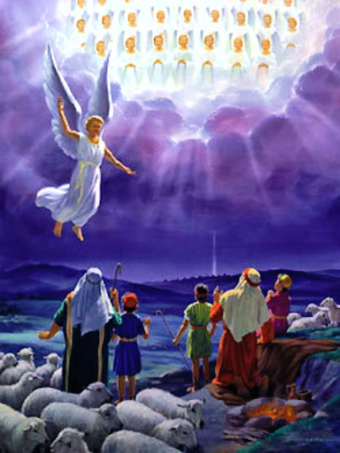
Peace on Earth, Good Will Toward Men – Luke 2:8-20

This is a re-post of one of my favorite Christmas devotionals.

And suddenly there was with the angel a multitude of the heavenly host praising God and saying:
“Glory to God in the highest,
And on earth peace, goodwill toward men!”
(Luke 2:13-14, NKJV)

We often sing or say or write this angelic announcement of the Incarnation in our Christmas songs and greetings as if the angels declared the birth of the Messiah brought new conditions to the earth–peace and good will.

We think of “peace” as meaning nations not at war with one another and “good will” as people being kind to one another. Yet we know that on earth nations are at war with one another and human beings showing kindness to other human beings is often lacking.

Continue reading