
Timeless Faith – Hebrews 11

“Now faith is the reality of what is hoped for, the proof of what is not seen. For by this our ancestors were approved….. These all died in faith, although they had not received the things that were promised…. All these were approved through their faith, but they did not receive what was promised, since God had provided something better for us, so that they would not be made perfect without us” (Hebrews 11:1-2,13,39-40, CSB).

In Hebrews 11, the “faith” chapter, the Hebrews writer defines faith and then provides a chapter-long litany of Old Testament examples.

Unfortunately, for us modern, empirical types, the Hebrews writer’s definition of faith is the antithesis of the scientific standards of observable data. Faith according to the Hebrews writer is not based on observable data but it’s based on the “proof” of the unseen. It’s inscrutable!

And, while having faith means we have hope for something we do not see, it also provokes us to take certain actions in our lives (vs. 2).

Continue reading

Live Like You Are Saved! – Hebrews 10:19-39

“But we are not those who draw back and are destroyed, but those who have faith and are saved” (Hebrews 10:39, CSB).

The Hebrews writer made an elegant theological argument in the previous chapters and concluding in Chapter 10 that the Old Testament law and sacrificial system have been replaced through the sacrifice of Christ on the cross. The former required continual sacrifices, the latter was once and for all time.

The Hebrews writer reasoned that when there is absolute atonement for sin, there is no longer a need for continual sacrifice (vs. 18).

So, sin has to go before righteousness can prevail! The cross of Christ removes sin in your life and starts you down a new path, a “new and living way” (vs. 20) of living for God in righteousness and holiness.

Continue reading

Planned Obsolescence– Hebrews 8-9

“But Jesus has now obtained a superior ministry, and to that degree he is the mediator of a better covenant, which has been established on better promises. For if that first covenant had been faultless, there would have been no occasion for a second one. But finding fault with his people, he says: ‘See, the days are coming, says the Lord when I will make a new covenant with the house of Israel and with the house of Judah’ …. By saying a new covenant, he has declared that the first is obsolete. And what is obsolete and growing old is about to pass away” (Hebrews 8:6-8,13, CSB).

The Hebrews writer explained that the Old Testament covenant law has been replaced with the new covenant of the gospel of Christ. Although the old has been replaced with the new, both were necessary functions of God’s unfolding plan of redemption for rebellious humanity.

But, the Hebrews writer said the new covenant of the resurrected Christ was actually the fulfillment of the temporary atoning measures provided in the Mosaic law. In other words, the ministry of Christ was superior to the Mosaic law because it was founded on better promises than the old covenant. While the Mosaic law convicted of sin, the gospel of Christ conveyed eternal life.

Continue reading

Avoiding Spiritual Laziness: The Key to Faithfulness – Hebrews 6:1-12

“Now we desire each of you to demonstrate the same diligence for the full assurance of your hope until the end, so that you won’t become lazy but will be imitators of those who inherit the promises through faith and perseverance” (Hebrews 6:11-12, CSB).

As we’ve mentioned previously in these posts from the Book of Hebrews, one of the primary themes of the Hebrew writer is faithfulness–the perseverance of one’s faith to the end of their life on earth.

Continuing this theme in Chapter 6, the Hebrews writer admonished the Hebrew Christians to become mature in their faith. While they may have experienced aspects of the Christian life, even belief in Christ and the fellowship of the Christian community and the work of the Holy Spirit in their midst, unless they became grounded in the teachings of Christ they were vulnerable to apostasy–to the abandoning of their faith.

Continue reading

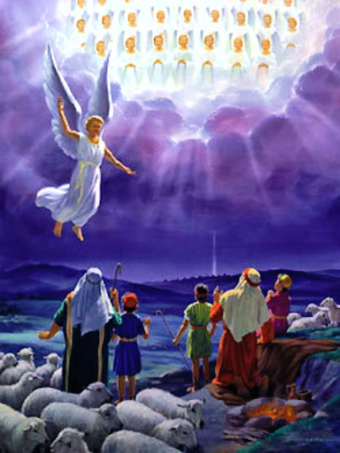
Peace on Earth, Good Will Toward Men – Luke 2:8-20

This is a re-post of one of my favorite Christmas devotionals.

And suddenly there was with the angel a multitude of the heavenly host praising God and saying:
“Glory to God in the highest,
And on earth peace, goodwill toward men!”
(Luke 2:13-14, NKJV)

We often sing or say or write this angelic announcement of the Incarnation in our Christmas songs and greetings as if the angels declared the birth of the Messiah brought new conditions to the earth–peace and good will.

We think of “peace” as meaning nations not at war with one another and “good will” as people being kind to one another. Yet we know that on earth nations are at war with one another and human beings showing kindness to other human beings is often lacking.

Continue reading

Discernment- Hebrews 5:11-14

First published October 2, 2010 and edited for re-publication here.

“But solid food is for the mature, whose senses are trained by practice to distinguish between good and evil” (Hebrews 5:14, CSB).

As I have grown older and lived through many social and cultural changes in our world, one of my biggest concerns for our younger generations is the blurring of the line between good and evil.

With all the information that confronts us every minute of every day in this digital age in which we live, it becomes more difficult for some to distinguish between what’s right and what’s wrong!

But, discernment between good and evil is a fundamental proposition of our humanity and morality. In the Bible, it’s a compelling part of the Creation story. And, it’s a basic element of humanity’s separation from God and the rationale for God’s cosmic plan for the redemption of humanity.

Continue reading

Qualified – Hebrews 5:1-10

“After he was perfected, he became the source of eternal salvation for all who obey him….” (Hebrews 5:9, CSB).

The Hebrews writer gives us yet another Old Testament perspective of how Jesus is the fulfillment of God’s plan for human redemption. This verse is the conclusion of a broader argument about Jesus’ role as the everlasting High Priest to emphasize His unique qualifications as the both fully human and fully divine Savior.

The Hebrews writer explains that a High Priest was chosen from the Israelite people to make sacrifices for their sins. Because he was human, he had to offer sacrifices for his own sin as well as the sins of the people. In Leviticus 16 God implemented a Day of Atonement in which the High Priest performed a sacrifice for the atonement of the sin for the Israelites. The ceremony, which was conducted annually, began with a sacrifice for the atonement of the sins for the High Priest.

Continue reading

The Rest of the Story – Hebrews 4

“If Joshua gave the Israelites rest, God wouldn’t have spoken about another day later on. So you see that a sabbath rest is left open for God’s people. The one who entered God’s rest also rested from his works, just as God rested from his own. Therefore, let’s make every effort to enter that rest so that no one will fall by following the same example of disobedience, because God’s word is living, active, and sharper than any two-edged sword. It penetrates to the point that it separates the soul from the spirit and the joints from the marrow. It’s able to judge the heart’s thoughts and intentions. No creature is hidden from it, but rather everything is naked and exposed to the eyes of the one to whom we have to give an answer” (Hebrews 4:8-13, CSB).

The Hebrews writer gives us yet another Old Testament perspective of the Christian life. As we concluded in the previous post, our salvation in Christ and hope for eternal life is a reality that we should live out each day of our lives on earth.

In Hebrews 4 the Hebrews writer tells us that there is a “Rest” for God’s people to enter into. It has always been God’s plan since the Creation and still is today for His people to join Him in the restfulness of eternal life where God Himself abides (see vs. 1-4).

Continue reading

Running Out of Time – Hebrews 3:1-15

Watch out, brothers and sisters, so that there won’t be in any of you an evil, unbelieving heart that turns away from the living God. But encourage each other daily, while it is still called today, so that none of you is hardened by sin’s deception. For we have become participants in Christ if we hold firmly until the end the reality that we had at the start” (Hebrews 3:12-14, CSB).

Have you ever tried to imagine what life would be like without Time? It’s hard, if not impossible to imagine because our whole existence in this world is measured by Time: how old we are, what year it is, when we are born and when we die.

Everything we are and we do in this world is defined by the dimension of Time. Tomorrow becomes Today and then Today turns in to Yesterday. We progress through our lives from one element in time–an hour, a day, a week, a month, a year–to the next.

Continue reading

A Birds’-Eye View of Incarnation – Hebrews 2:14-18

Now since the children have flesh and blood in common, Jesus also shared in these, so that through his death he might destroy the one holding the power of death—that is, the devil— and free those who were held in slavery all their lives by the fear of death. For it is clear that he does not reach out to help angels, but to help Abraham’s offspring. Therefore, he had to be like his brothers and sisters in every way, so that he could become a merciful and faithful high priest in matters pertaining to God, to make atonement for the sins of the people. For since he himself has suffered when he was tempted, he is able to help those who are tempted. (Hebrews 2:14-18, CSB).

In these verses the Hebrews writer paints a powerful picture of the significance of Jesus’ incarnation in the context of Jewish temple theology.

But, I am reminded of a story told every Christmas season by legendary radio announcer Paul Harvey that provides a most interesting and insightful perspective on incarnation.

Paul Harvey recounted in his radio broadcast the tale of a good but not very religious man who had stayed at home while his family went to church on Christmas Eve. Then…..

Continue reading