The What and Why of Salvation – John 3

“The one who believes in the Son has eternal life, but the one who rejects the Son will not see life; instead, the wrath of God remains on him” (John 3:36, CSB).

John 3 contains two Messiah-affirming stories of Jesus: (1) the secret meeting between Nicodemus the Pharisee and Jesus from which originates those iconic and rudimentary Christian propositions: “You must be born again” and John 3:16: “For God so loved the world….” and, (2) the defection of some of John the Baptist’s disciples to Jesus’ ministry, which John the Baptist acknowledges with a seeming air of expectancy, “He must increase but I must decrease” (vs. 30).

Then, the final six verses of Chapter 3 provide a theological recap of the case John is making through these two stories for the Messiahship of Jesus.

John declares that there is some metaphysical angst that accompanies unbelief in Christ’s divinity–the potential for eliciting the wrath of God. We often express this tension in the gospel message in terms like this: “If you believe in Jesus you go to heaven when you die, but if you don’t believe in Him you go to hell when you die.”

Continue reading

Good Intentions Are Not Good Enough – John 2

While he was in Jerusalem during the Passover Festival, many believed in his name when they saw the signs he was doing. Jesus, however, would not entrust himself to them, since he knew them all and because he did not need anyone to testify about man; for he himself knew what was in man. (John 2:23-25, CSB).

John 2 describes the launching of Jesus’ public ministry through two gospel stories that are very familiar to us – the first miracle of Jesus and the first cleansing of the temple in Jerusalem.

In the first miracle story Jesus was attending the wedding of a family friend when it became apparent that the celebration was low on wine. Jesus’ mother asked Jesus to take care of the wine problem and in a sort of obtuse remark, Jesus responded to His mother that His time hadn’t come (probably meaning the time for Him to be identified as the crucified Messiah had not yet arrived).

Yet, the time to begin His public ministry had arrived and he performed an inaugurating miracle by turning large vats of water–specifically, over 100 gallons–into fine wine! This act didn’t go unnoticed by both the maitre d’ of the ceremony nor by His disciples: “Jesus did this, the first of his signs, in Cana of Galilee. He revealed his glory, and his disciples believed in him” (vs. 11).

Continue reading

What Are You Looking For? – John 1:29-50

“When Jesus turned and noticed them following him, he asked them, ‘What are you looking for?’ They said to him, ‘Rabbi’ (which means ‘Teacher’), ‘where are you staying?’ ‘Come and you’ll see,’ he replied. So they went and saw where he was staying, and they stayed with him that day. (John 1:38-39, CSB).

Jesus’ first two disciples were actually disciples of John the Baptist before becoming Jesus’ followers. One of them was Andrew and the other was not named but perhaps was John, the author of this gospel.

Nevertheless, the two left John the Baptist to become followers of Jesus.

John the Baptist didn’t seem to be grieved by the two abandoning him and following after Jesus. In fact, John actually encouraged his disciples to follow Jesus: “The next day, John was standing with two of his disciples. When he saw Jesus passing by, he said, ‘Look, the Lamb of God!’ The two disciples heard him say this and followed Jesus” (vs. 1:35-37, CSB).

Then the dominoes started to fall.

Continue reading

Little Town of Bethlehem: A Christmas Story Prequel – Micah 5

“Bethlehem Ephrathah, you are small among the clans of Judah; one will come from you to be ruler over Israel for me. His origin is from antiquity, from ancient times” (Micah 5:2, CSB).

Micah 5 describes a set of events that present a tragic yet hopeful prequel to the Christmas story.


Therefore, Israel will be abandoned until the time
when she who is in labor has given birth;
then the rest of the ruler’s brothers will return
to the people of Israel.
He will stand and shepherd them
in the strength of the Lord,
in the majestic name of the Lord his God.
They will live securely,
for then his greatness will extend
to the ends of the earth
(vs. 3-4).

The prophet Micah identified himself by his hometown, called Moresheth Gath, located near the border of Philistia and Judah about twenty-five miles southwest of Jerusalem. Micah prophesied during the time surrounding the tragic fall of Israel to the Assyrian Empire in 722 BC, an event he predicted in Chapter 1.

The book of Micah provides one of the most unambiguous prophecies of Christ’s birth in all the Old Testament. Some seven hundred years before Christ’s birth Micah reveals that Bethlehem is the birthplace of Messiah!

Continue reading

How to Fight Injustice: Part 2 – Habakkuk 3

“Though the fig tree may not blossom,
Nor fruit be on the vines;
Though the labor of the olive may fail,
And the fields yield no food;
Though the flock may be cut off from the fold,
And there be no herd in the stalls—
Yet I will rejoice in the Lord,
I will joy in the God of my salvation.”
(Habakkuk 3:17-18, NKJV)

Habakkuk was concerned about the prevalence of injustice in his nation, the kingdom of Judah–God’s chosen people. Habakkuk wondered why God allowed injustice to proliferate among His people: “Therefore the law is powerless and justice never goes forth. For the wicked surround the righteous; therefore perverse judgment proceeds” (vs. 1:4).

God responded that He was, in fact, planning to do something about the injustice in the land by sending the Babylonians to invade Judah and take its people into captivity.

Habakkuk probably had something less calamitous in mind than the downfall of his country when he addressed God about injustice in Judah. So, Habakkuk asked God why He would use the wicked (Babylonians) to punish the righteous (Judahites)? “Why do You look on those who deal treacherously, and hold Your tongue when the wicked devours a person more righteous than he?” (vs. 1:13).

God replied: “The just shall live by his faith!” (vs. 2:4). In other words, there was no entitlement for being God’s people. Nobody had an inherent claim to God’s name. God’s chosen people were those whom He justified–those who chose to believe in Him and His Mercy and live accordingly!

Continue reading

How to Fight Injustice: Part 1 – Habakkuk 1-2

“Then the Lord answered me and said: ‘Write the vision and make it plain on tablets that he may run who reads it. For the vision is yet for an appointed time; but at the end it will speak and it will not lie. Though it tarries, wait for it because it will surely come; it will not tarry. Behold the proud, his soul is not upright in him; but the just shall live by his faith'” (Habakkuk 2:2-4, NKJV)

The book of Habakkuk is one of my favorite in the Bible. We know Habakkuk wrote his prophecy some time before the siege and capture of Jerusalem in 586 BC by the Babylonians because his prophecy was actually a prediction of the Babylonian conquest of Judah.

In this short book Habakkuk asked God two challenging questions and God answered both in Chapters 1 and 2. Then, Habakkuk offered an inspirational prayer that concludes with a memorable proclamation of faith in Chapter 3 that we will consider in the following post.

But the significance of the book of Habakkuk is that it contains one of the most familiar (and powerful) verses in the Bible–both Old and New Testament–that is a fundamental premise of our Christian theology. And, you know it, whether you know it comes from Habakkuk or not!

Like many good citizens today, Habakkuk was concerned about injustice in his nation, the kingdom of Judah. Habakkuk wondered why God allowed such oppression to proliferate among His chosen people: “Therefore the law is powerless and justice never goes forth. For the wicked surround the righteous; therefore perverse judgment proceeds” (vs. 1:4).

Continue reading

Raptured: Part 3 – 1 Corinthians 15:35-58

“For I declare to you, brothers and sisters, that flesh and blood cannot inherit the kingdom of God, nor does the perishable inherit the imperishable. Listen, I tell you a mystery: We will not all sleep, but we will all be changed— in a flash, in the twinkling of an eye, at the last trumpet. For the trumpet will sound, the dead will be raised imperishable, and we will be changed. For the perishable must clothe itself with the imperishable, and the mortal with immortality.” (1 Corinthians 15:50-53, NIV).

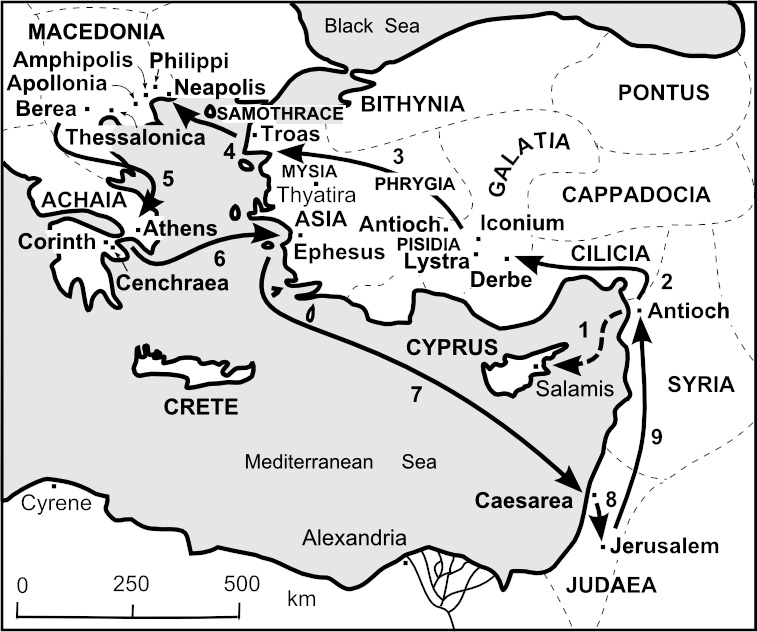
Around 50 AD the Apostle Paul conducted his second missionary journey and traveled through Macedonia (modern-day Greece). Due to some troubles caused by some of the citizens of Thessalonica, Paul was forced to escape from the city under the cover of night.

Paul moved on to Athens and then Corinth where he remained for about a year and a half. While at Corinth and possibly due to his abbreviated visit to Thessalonica, Paul wrote two letters to the church at Thessalonica. Paul departed Corinth after a year and a half and went to Jerusalem, then later traveled to Ephesus where he stayed for three years conducting his apostolic ministry (c. AD 53-55). It is believed that while Paul was residing in Ephesus that he wrote 1 Corinthians.

In the first Thessalonian letter Paul addressed the state of the Christian dead. The dead in Christ are not forgotten by God when they die but both the the dead in Christ and those who are alive when Christ returns will be caught up in the air–or raptured–at Christ’s coming. In the second letter Paul assured the Thessalonians that the Rapture could not have occurred because certain apocalyptic events including the revealing of the antichrist must take place.

Paul declares a similar message to the Corinthians but with some additional nuances.

Continue reading

Raptured: Part 2 – 2 Thessalonians 2:1-12

“Concerning the coming of our Lord Jesus Christ and our being gathered to him…. Don’t let anyone deceive you in any way, for that day will not come until the rebellion occurs and the man of lawlessness is revealed, the man doomed to destruction…. whom the Lord Jesus will overthrow with the breath of his mouth and destroy by the splendor of his coming” (2 Thessalonians 1-8, NIV).

Around 50 AD the Apostle Paul conducted his second missionary journey, traveling through Macedonia which is modern-day Greece. Due to some troubles caused by local Thessalonian citizens, Paul was forced to escape from the city of Thessalonica under the cover of night.

Paul’s Second Missionary Journey

Paul moved on to Athens and then Corinth where he remained for about a year and a half. While at Corinth and possibly due to his abbreviated visit to Thessalonica, Paul wrote two letters to the church at Thessalonica. Included in these two letters were descriptions about the Second Coming of Christ and the fate of those who die before Christ’s return.

In his first letter to the Thessalonians Paul explained that the dead in Christ (those who die before the Second Coming) are not forgotten by God when they die. Paul said that when Christ comes to gather his people, the dead in Christ AND those who are alive shall be caught away–or raptured–to meet the Lord in the air (1 Thessalonians 4:16-17).

Continue reading

Raptured: Part 1 – 1 Thessalonians 4:13-18 (Updated)

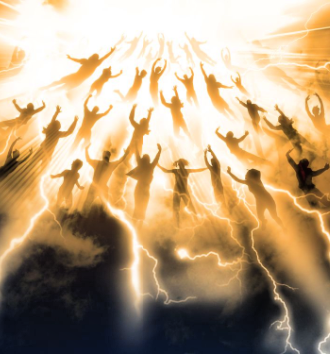
For we believe that Jesus died and rose again, and so we believe that God will bring with Jesus those who have fallen asleep in him. According to the Lord’s word, we tell you that we who are still alive, who are left until the coming of the Lord, will certainly not precede those who have fallen asleep. For the Lord himself will come down from heaven, with a loud command, with the voice of the archangel and with the trumpet call of God, and the dead in Christ will rise first. After that, we who are still alive and are left will be caught up together with them in the clouds to meet the Lord in the air. And so we will be with the Lord forever” (1 Thessalonians 4:14-17, NIV).

Around 50 AD the Apostle Paul and Barnabas left Antioch and returned to the towns in Galatia and Pisidia they had visited on their previous journey (Paul’s second missionary journey is described in Acts 16-18). They had an argument about whether to take John Mark with them again and agreed to disagree and each went their separate way. Barnabas decided to re-visit the Jewish believers in Cyprus while Paul re-visited the Gentile believers in Galatia.

Paul’s Second Missionary Journey

Paul and his missionary team of Silas and Timothy traveled through the Roman provinces of Galatia and Phrygia but the Holy Spirit prevented them from preaching in the Roman province of Asia. One night Paul dreamed a man from Macedonia (in modern-day Greece) was begging him to come and help the people of Macedonia.

Paul’s team sailed across the Aegean Sea and began their journey through Greece. When they reached the city of Thessalonica, Paul and Silas preached in the Jewish synagogue on three consecutive Sabbaths. But some of the Jews became jealous and incited some bad characters in the town to form a mob and cause a riot. Paul and Silas were forced to escape from Thessalonica under the cover of night.

Continue reading

Living Up – Philippians 3:12-21

“Only let us live up to what we have already attained. Join together in following my example, brothers and sisters, and just as you have us as a model, keep your eyes on those who live as we do” (Philippians 3:16-17, NIV).

In the 3rd chapter of his letter to the Philippians the Apostle Paul delineates two conflicting lifestyles. One lifestyle is characterized by having confidence in oneself and the material things of this world. Let’s call this living down.

The other lifestyle is characterized by faith in Christ and believing in His resurrection power. This lifestyle is characterized by living one’s life on this earth in preparation for the world to come. Let’s call this living up.

Continue reading