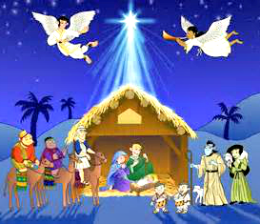
Peace on Earth, Good Will Toward Men – Luke 2:8-20

This is a re-post of one of my favorite Christmas devotionals.
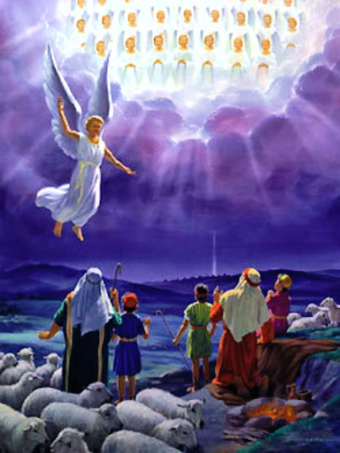
And suddenly there was with the angel a multitude of the heavenly host praising God and saying:
“Glory to God in the highest,
And on earth peace, goodwill toward men!”
(Luke 2:13-14, NKJV)

We often sing or say or write this angelic announcement of the Incarnation in our Christmas songs and greetings as if the angels declared the birth of the Messiah brought new conditions to the earth–peace and good will.

We think of “peace” as meaning nations not at war with one another and “good will” as people being kind to one another. Yet we know that on earth nations are at war with one another and human beings showing kindness to other human beings is often lacking.

Continue reading

A Birds’-Eye View of Incarnation – Hebrews 2:14-18

Now since the children have flesh and blood in common, Jesus also shared in these, so that through his death he might destroy the one holding the power of death—that is, the devil— and free those who were held in slavery all their lives by the fear of death. For it is clear that he does not reach out to help angels, but to help Abraham’s offspring. Therefore, he had to be like his brothers and sisters in every way, so that he could become a merciful and faithful high priest in matters pertaining to God, to make atonement for the sins of the people. For since he himself has suffered when he was tempted, he is able to help those who are tempted. (Hebrews 2:14-18, CSB).

In these verses the Hebrews writer paints a powerful picture of the significance of Jesus’ incarnation in the context of Jewish temple theology.

But, I am reminded of a story told every Christmas season by legendary radio announcer Paul Harvey that provides a most interesting and insightful perspective on incarnation.

Paul Harvey recounted in his radio broadcast the tale of a good but not very religious man who had stayed at home while his family went to church on Christmas Eve. Then…..

Continue reading

What’s In a Name? – Exodus 3

Then Moses asked God, “If I go to the Israelites and say to them: The God of your fathers has sent me to you and they ask me, ‘what is His name?’ what should I tell them?” God replied to Moses “I AM WHO I AM. This is what you are to say to the Israelites: I AM has sent me to you.” God also said to Moses, “Say this to the Israelites: Yahweh, the God of your fathers, the God of Abraham, the God of Isaac, and the God of Jacob, has sent me to you. This is My name forever; this is how I am to be remembered in every generation. (Exodus 3:13-15, CSB)

In Exodus 3 God commissioned Moses to lead the people out of 400 years of Egyptian slavery and revealed both His nature and His name to Moses on Mount Horeb. There is some significant wordplay at work in this revelation that is not so apparent in the English translation. Knowing a little of this Hebrew wordplay can certainly strengthen our understanding of God’s purpose in our lives and our world.

Continue reading

Peace on Earth, Good Will Toward Men – Luke 2:8-20

And suddenly there was with the angel a multitude of the heavenly host praising God and saying:
“Glory to God in the highest,
And on earth peace, goodwill toward men!”
(Luke 2:13-14, NKJV)

We often sing or say or write this angelic announcement of the Incarnation in our Christmas songs and greetings as if the angels declared the birth of the Messiah brought new conditions to the earth–peace and good will.

We think of “peace” as meaning nations not at war with one another and “good will” as people being kind to one another. Yet we know that on earth nations are at war with one another and human beings showing kindness to other human beings is often lacking.

Continue reading

The Scarred God – John 20:24-29

Then he said to Thomas, “Put your finger here and look at my hands. Reach out your hand and put it into my side. Don’t be faithless, but believe.” Thomas responded to him, “My Lord and my God! Jesus said, “Because you have seen me, you have believed. Blessed are those who have not seen and yet believe.” (John 20:27-29, CSB)

NOTE: In the title of this post don’t misread “Scarred” meaning disfigured as “Scared” meaning afraid.

Did you know that Jesus was talking about you when He spoke these words to Thomas during one of His appearances to His disciples after His resurrection?

Christians today face a dilemma they have faced since Jesus made this statement to Thomas—that of living in that period in time after Christ’s first coming and before His second coming.

Some theologians have called the age in which we live “between the times,” meaning the period of time between Christ’s first and second comings.

While the first generation of Christians was closely connected to Christ’s first coming, all Christians since have had to address the ambiguity of the time between His first and second comings.

Continue reading

Beyond Logic – A Commentary on Christmas

The word became flesh and dwelt among us (John 1:14, ESV).

Harry Reasoner was a broadcast journalist for CBS Radio in the early 1960s. He teamed up with Mike Wallce in the 1970s to create the CBS news magazine show, 60 Minutes. He later became anchor of the ABC Evening News, but after two years went back to CBS and 60 Minutes where he remained until he retired. Mr. Reasoner died in 1991.

Reasoner delivered a commentary on Christmas on his early radio program that he later delivered to a national audience on 60 Minutes and then later on ABC Evening News. This commentary has been reprinted many times and in several versions.

During this 2020 Christmas season I would like to share this Christmas commentary from the 20th century broadcast journalist Harry Reasoner:

It’s so revolutionary a thought that it probably could only come from a God that is beyond logic, and beyond theology.”

HARRY REASONER
Continue reading

It’s A Boy! It’s the Messiah! – Luke 2:1-20

incarnation_shepherds“But the angel said to them, ‘Do not be afraid; for behold, I bring you good news of great joy which will be for all the people; for today in the city of David there has been born for you a Savior, who is Christ the Lord’…they made known the statement which had been told them about this Child. And all who heard it wondered at the things which were told them by the shepherds” (Luke 2:10-11, 17-18, NASB).

A new father wants to tell somebody about the great event. Imagine a proud new father excitedly telling his friends and even people he doesn’t know, “It’s a boy!” or “It’s a girl!”

Continue reading

A Christmas Story, Sort Of – 2 Chronicles 31:21-22

nativity_scene“In this way, King Hezekiah handled the distribution throughout all Judah, doing what was pleasing and good in the sight of the Lord his God. In all that he did in the service of the Temple of God and in his efforts to follow God’s laws and commands, Hezekiah sought his God wholeheartedly. As a result, he was very successful” (2 Chronicles 31:21-22, NLT).

The reign of King Hezekiah of Judah as described in 2 Chronicles 31 and 32 was distinguished by his zeal to resume Temple worship and adherence to God’s law. As a result of Hezekiah’s devotion and obedience to God’s will, he was successful in everything he did (vs. 32:30).

Continue reading

Christology For Dummies – Colossians 1:15-20

theologyfordummiesChrist is the visible image of the invisible God. He existed before anything was created and is supreme over all creation, for through him God created everything in the heavenly realms and on earth. He made the things we can see and the things we can’t see—such as thrones, kingdoms, rulers, and authorities in the unseen world. Everything was created through him and for him. He existed before anything else, and he holds all creation together. Christ is also the head of the church, which is his body. He is the beginning, supreme over all who rise from the dead. So he is first in everything. For God in all his fullness was pleased to live in Christ, and through him God reconciled everything to himself. He made peace with everything in heaven and on earth by means of Christ’s blood on the cross” (Colossians 1:15-20, NLT).

In the series of short declarations in these verses, the Apostle Paul presents a concise yet comprehensive theology of Christ–a Christology–that you don’t have to be a biblical scholar or theologian to understand and appreciate.

Continue reading