Emancipation Proclamation – Hebrews 13:1-8

First published December 2, 2014 and edited for re-publication here.
Emancipation_Proclamation

“Remember those who led you, who spoke the word of God to you and considering the result of their conduct, imitate their faith. Jesus Christ is the same yesterday, today and forever” (Hebrews 13:7-8, NASB).

Recently in the men’s Sunday School class I attend, the lesson was from Hebrews 13. And, this lesson from Hebrews 13 helped me resolve a theological dilemma I had wrestled with from Romans 6-8.

But, I love it when that happens! It reinforces the consistency of the Bible to me and why I should read and study all of it over and over again. And, of course, why it is so important for the Holy Spirit to enlighten us and counsel us when we study God’s word.

Let me explain…

Continue reading

Blind Faith – Hebrews 11:13

“These all died in faith, although they had not received the things that were promised. But they saw them from a distance, greeted them, and confessed that they were foreigners and temporary residents on the earth” (Hebrews 11:13, CSB).

According to the Hebrews writer, the presence of faith is based on the coexistence of hope. In fact, hope is the essential element of faith: “Now faith is the reality of what is hoped for, the proof of what is not seen.” (vs. 1).

You can’t have faith if there is no hope! Then, faith provides certainty to your hope, enabling you to believe in a reality you don’t see.

Yes, that’s the thing about faith–it’s blind! Because if you can see it, you can’t hope for it!

Continue reading

Timeless Faith – Hebrews 11

“Now faith is the reality of what is hoped for, the proof of what is not seen. For by this our ancestors were approved….. These all died in faith, although they had not received the things that were promised…. All these were approved through their faith, but they did not receive what was promised, since God had provided something better for us, so that they would not be made perfect without us” (Hebrews 11:1-2,13,39-40, CSB).

In Hebrews 11, the “faith” chapter, the Hebrews writer defines faith and then provides a chapter-long litany of Old Testament examples.

Unfortunately, for us modern, empirical types, the Hebrews writer’s definition of faith is the antithesis of the scientific standards of observable data. Faith according to the Hebrews writer is not based on observable data but it’s based on the “proof” of the unseen. It’s inscrutable!

And, while having faith means we have hope for something we do not see, it also provokes us to take certain actions in our lives (vs. 2).

Continue reading

Live Like You Are Saved! – Hebrews 10:19-39

“But we are not those who draw back and are destroyed, but those who have faith and are saved” (Hebrews 10:39, CSB).

The Hebrews writer made an elegant theological argument in the previous chapters and concluding in Chapter 10 that the Old Testament law and sacrificial system have been replaced through the sacrifice of Christ on the cross. The former required continual sacrifices, the latter was once and for all time.

The Hebrews writer reasoned that when there is absolute atonement for sin, there is no longer a need for continual sacrifice (vs. 18).

So, sin has to go before righteousness can prevail! The cross of Christ removes sin in your life and starts you down a new path, a “new and living way” (vs. 20) of living for God in righteousness and holiness.

Continue reading

Qualified – Hebrews 5:1-10

“After he was perfected, he became the source of eternal salvation for all who obey him….” (Hebrews 5:9, CSB).

The Hebrews writer gives us yet another Old Testament perspective of how Jesus is the fulfillment of God’s plan for human redemption. This verse is the conclusion of a broader argument about Jesus’ role as the everlasting High Priest to emphasize His unique qualifications as the both fully human and fully divine Savior.

The Hebrews writer explains that a High Priest was chosen from the Israelite people to make sacrifices for their sins. Because he was human, he had to offer sacrifices for his own sin as well as the sins of the people. In Leviticus 16 God implemented a Day of Atonement in which the High Priest performed a sacrifice for the atonement of the sin for the Israelites. The ceremony, which was conducted annually, began with a sacrifice for the atonement of the sins for the High Priest.

Continue reading

The Rest of the Story – Hebrews 4

“If Joshua gave the Israelites rest, God wouldn’t have spoken about another day later on. So you see that a sabbath rest is left open for God’s people. The one who entered God’s rest also rested from his works, just as God rested from his own. Therefore, let’s make every effort to enter that rest so that no one will fall by following the same example of disobedience, because God’s word is living, active, and sharper than any two-edged sword. It penetrates to the point that it separates the soul from the spirit and the joints from the marrow. It’s able to judge the heart’s thoughts and intentions. No creature is hidden from it, but rather everything is naked and exposed to the eyes of the one to whom we have to give an answer” (Hebrews 4:8-13, CSB).

The Hebrews writer gives us yet another Old Testament perspective of the Christian life. As we concluded in the previous post, our salvation in Christ and hope for eternal life is a reality that we should live out each day of our lives on earth.

In Hebrews 4 the Hebrews writer tells us that there is a “Rest” for God’s people to enter into. It has always been God’s plan since the Creation and still is today for His people to join Him in the restfulness of eternal life where God Himself abides (see vs. 1-4).

Continue reading

Make It So – Genesis 22:1-19

Then he said, “Do not lay a hand on the boy or do anything to him. For now I know that you fear God, since you have not withheld your only son from me.” Abraham looked up and saw a ram caught in the thicket by its horns. So Abraham went and took the ram and offered it as a burnt offering in place of his son. And Abraham named that place The Lord Will Provide…. (Genesis 22:12-14, CSB).

In Sir Patrick Stewart’s portrayal as Captain Jean-Luc Picard in the Star Trek: The Next Generation series, Stewart gave us one of the most iconic Star Trek phrases of all time, “Make it so!” This catchphrase was usually used when a crew member suggested a course of action for the Starship Enterprise to avoid or confront a dangerous situation.

In the story of Abraham’s test of faith in Genesis 22 Abraham believed that God would “Make It So” on His promise to Abraham.

Continue reading

Salvation in the Old Testament – Genesis 15:1-6

Abram believed the Lord, and he credited it to him as righteousness.(Genesis 15:6, CSB).

In studying the Old Testament Christians may question how people were saved in Old Testament times. Early in my seminary studies this was a question I had as well and researched for a paper for one of my classes.

There is sometimes a misconception among Christians that people were “saved” in the Old Testament by keeping the Law (of Moses) while people are saved in the New Testament by grace through faith.

Genesis 15:6 gives us an unequivocal answer to the question: righteousness is imputed by God by faith, not law-keeping. And, that is both an Old Testament and New Testament proposition. In fact, in Romans 1-8 the Apostle Paul makes this proposition and this verse central to his whole argument.

Continue reading

Acceptable Worship – Genesis 4:1-15

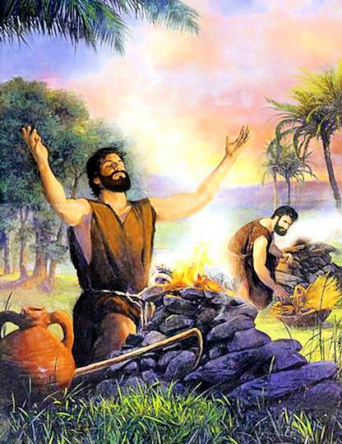
In the course of time Cain presented some of the land’s produce as an offering to the Lord. And Abel also presented an offering—some of the firstborn of his flock and their fat portions. The Lord had regard for Abel and his offering, but he did not have regard for Cain and his offering. Cain was furious, and he looked despondent (Genesis 4:3-5, CSB).

The story of the first murder is recorded only four chapters into the Bible. I am always intrigued by the incidents leading up to the murder. God’s regard for Abel’s offering of the firstborn of his flock and His disregard for Cain’s offering of some of the land’s produce creates a theological dilemma for me and seems to be the circumstance that sets in motion the tragic chain of events ending in murder.

Continue reading

Signs – John 6:22-59

“Jesus answered, ‘Truly I tell you, you are looking for me, not because you saw the signs, but because you ate the loaves and were filled. Don’t work for the food that perishes but for the food that lasts for eternal life, which the Son of Man will give you, because God the Father has set his seal of approval on him.’ ‘What can we do to perform the works of God?’ they asked. Jesus replied, ‘This is the work of God—that you believe in the one he has sent.’ “What sign, then, are you going to do so that we may see and believe you?’ they asked” (John 6:26-30, CSB).

The signs or miracles Jesus performed weren’t so much to get people to believe in Him as to validate His Messiahship. Jesus was more interested in granting people eternal life than in performing miracles to heal or feed them.

Jesus wanted more from our belief than just believing in the miracles He performed.

Belief in His Messiahship was the belief Jesus wanted His disciples to have. Jesus described it as a life-sustaining belief: “Truly I tell you, unless you eat the flesh of the Son of Man and drink his blood, you do not have life in yourselves. The one who eats my flesh and drinks my blood has eternal life, and I will raise him up on the last day, because my flesh is true food and my blood is true drink” (vs. 53-55).

Continue reading