
Peace on Earth, Good Will Toward Men – Luke 2:8-20

This is a re-post of one of my favorite Christmas devotionals.
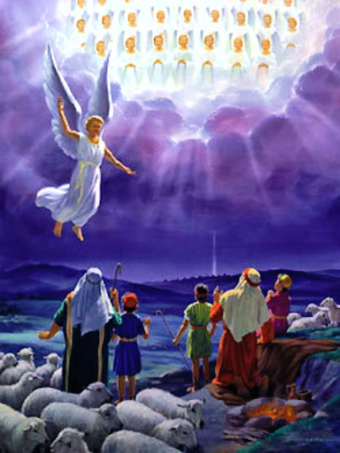
And suddenly there was with the angel a multitude of the heavenly host praising God and saying:
“Glory to God in the highest,
And on earth peace, goodwill toward men!”
(Luke 2:13-14, NKJV)

We often sing or say or write this angelic announcement of the Incarnation in our Christmas songs and greetings as if the angels declared the birth of the Messiah brought new conditions to the earth–peace and good will.

We think of “peace” as meaning nations not at war with one another and “good will” as people being kind to one another. Yet we know that on earth nations are at war with one another and human beings showing kindness to other human beings is often lacking.

Continue reading

Qualified – Hebrews 5:1-10

“After he was perfected, he became the source of eternal salvation for all who obey him….” (Hebrews 5:9, CSB).

The Hebrews writer gives us yet another Old Testament perspective of how Jesus is the fulfillment of God’s plan for human redemption. This verse is the conclusion of a broader argument about Jesus’ role as the everlasting High Priest to emphasize His unique qualifications as the both fully human and fully divine Savior.

The Hebrews writer explains that a High Priest was chosen from the Israelite people to make sacrifices for their sins. Because he was human, he had to offer sacrifices for his own sin as well as the sins of the people. In Leviticus 16 God implemented a Day of Atonement in which the High Priest performed a sacrifice for the atonement of the sin for the Israelites. The ceremony, which was conducted annually, began with a sacrifice for the atonement of the sins for the High Priest.

Continue reading

Being Christian or Being Religious – John 5:1-30

“’Get up,’ Jesus told him, ‘pick up your mat and walk.’ Instantly the man got well, picked up his mat, and started to walk. Now that day was the Sabbath, and so the Jews said to the man who had been healed, ‘This is the Sabbath. The law prohibits you from picking up your mat’” (John 5:8-10, CSB).

In the story of Jesus healing the disabled man at the Pool of Bethesda on the Sabbath, consider the absurdity of what the Jewish leaders are contending. They argued that because the man picked up his mat and walked away with it on the Sabbath after being healed by Jesus, he broke Sabbath law.

Whaaat? The man had been disabled for 38 years!

Because of their religious convictions, they concluded that Jesus shouldn’t be healing people on the Sabbath because it caused them and Jesus to break Sabbath law.

This certainly begs the question: “Does God take a break from redeeming people?”

Continue reading

Drift, Part 1: Spiritual Workout – Hebrews 2:1-3

boat-adrift“For this reason we must pay much closer attention to what we have heard, so that we do not drift away from it… how will we escape if we neglect so great a salvation?” (‭Hebrews‬ ‭2‬:‭1,3; NASB).

The greatest affliction of the Christian life, in my opinion, is drift! Drift occurs when we neglect our Christianity, our relationship with Christ, our salvation!

The reason I know this is because I, too, suffer from drift. I don’t always apply to my life what I’ve been taught in church since I was a child. I don’t always read and study my Bible regularly. I get busy and neglect my prayer life. And consequently, I neglect my salvation. Then I start to drift.

Continue reading

Believing or Belonging? – Acts 11:26

“The disciples were first called Christians at Antioch.” (Acts 11:26, HCSB)The term “Christian” occurs only three times in the New Testament.

Besides this verse, in Acts 26:28 King Herod Agrippa asked if the Apostle Paul was trying to persuade him to become a Christian and in 1 Peter 4:16 the Apostle Peter referred to suffering for being a Christian.

The word for Christian in the Greek is Christianos and comes from christos, meaning “anointed one” with a modifier borrowed from Latin to denote adhering to, or even belonging to, as in slave ownership.

Continue reading