Amateur Theologians – John 9

This meditation was originally posted on November 10, 2013.
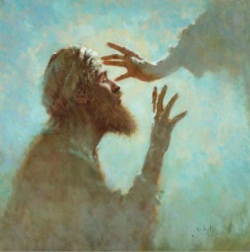
“He answered, “Whether or not he’s a sinner, I don’t know. One thing I do know: I was blind, and now I can see!”…. “This is an amazing thing!” the man told them. “You don’t know where he is from, and yet he opened my eyes. We know that God doesn’t listen to sinners, but if anyone is God-fearing and does his will, he listens to him. Throughout history no one has ever heard of someone opening the eyes of a person born blind. If this man were not from God, he wouldn’t be able to do anything.” (John 9:25,30-33, CSB).

As Jesus and His disciples are walking along one day they came across a man who was blind from birth and was also a beggar.

The disciples asked Jesus to explain the reason for the man’s unfortunate condition and circumstances: His disciples asked him, “Rabbi, who sinned, this man or his parents, that he was born blind?” (vs 2).

Jesus explicitly answered the second question but enigmatically answered first question: “Neither this man nor his parents sinned,” Jesus answered. “This came about so that God’s works might be displayed in him” (vs. 3).

Continue reading

Who’s Your Daddy? – John 8:30-59

Jesus said to them, “If God were your Father, you would love me, because I came from God and I am here. For I didn’t come on my own, but he sent me. Why don’t you understand what I say? Because you cannot listen to my word. You are of your father the devil, and you want to carry out your father’s desires.” (John 8:42-44, CSB)

Star Wars fans know well the iconic scene when Lord of the Dark Side, Darth Vader, reveals to Jedi warrior, Rebel hero, and disciple of the Force, Luke Skywalker, that he is Luke’s father. And, it then becomes a classic case of good vs. evil and what you think is good becomes evil.

There seems to be a similar theme in this discussion between Jesus and the Jewish religious leaders: what people think is the agent for “good” is actually the agent for “evil.”

The genealogy of Jesus is often questioned in the Gospel of John. Under a constant barrage of threats and accusations about His background hurled at Jesus by the Jewish religious leaders, He consistently maintained that He was sent from God the Father.

In fact, Jesus being one with God and being sent by God the Father–His Messiahship– is a recurring theme in John.

But, in this case Jesus turns the table on the Jewish leaders and throws shade on them about their genealogy!

Continue reading

When God Cries Out – John 7:37-39

“On the last and most important day of the festival, Jesus stood up and cried out, ‘If anyone is thirsty, let him come to me and drink. The one who believes in me, as the Scripture has said, will have streams of living water flow from deep within him.’ He said this about the Spirit. Those who believed in Jesus were going to receive the Spirit, for the Spirit had not yet been given because Jesus had not yet been glorified.” (John 7:37-39, CSB).

God is passionate about your salvation….

In John 7 Jesus went down to Jerusalem for the Feast of Tabernacles. About halfway through the week-long celebration He went up to the Temple and began to teach.

The Feast of Tabernacles, also known as the Feast of Booths and Sukkot, is the seventh and last feast that the Lord commanded Israel to observe. It is one of the three feasts each year that Jews were to observe by appearing before the Lord (see Deuteronomy 16:16). As one of the pilgrim feasts when Jewish males were commanded to go to Jerusalem, the Feast of Tabernacles was also the time when they brought their tithes and offerings to the Temple.

With the influx of people coming to Jerusalem at this time, we can only imagine what the scene must have been like. Thousands of people coming together to remember and celebrate God’s deliverance and His provision, all living in temporary shelters or booths as part of the requirements of the feast.

Continue reading

Signs – John 6:22-59

“Jesus answered, ‘Truly I tell you, you are looking for me, not because you saw the signs, but because you ate the loaves and were filled. Don’t work for the food that perishes but for the food that lasts for eternal life, which the Son of Man will give you, because God the Father has set his seal of approval on him.’ ‘What can we do to perform the works of God?’ they asked. Jesus replied, ‘This is the work of God—that you believe in the one he has sent.’ “What sign, then, are you going to do so that we may see and believe you?’ they asked” (John 6:26-30, CSB).

The signs or miracles Jesus performed weren’t so much to get people to believe in Him as to validate His Messiahship. Jesus was more interested in granting people eternal life than in performing miracles to heal or feed them.

Jesus wanted more from our belief than just believing in the miracles He performed.

Belief in His Messiahship was the belief Jesus wanted His disciples to have. Jesus described it as a life-sustaining belief: “Truly I tell you, unless you eat the flesh of the Son of Man and drink his blood, you do not have life in yourselves. The one who eats my flesh and drinks my blood has eternal life, and I will raise him up on the last day, because my flesh is true food and my blood is true drink” (vs. 53-55).

Continue reading

Being Christian or Being Religious – John 5:1-30

“’Get up,’ Jesus told him, ‘pick up your mat and walk.’ Instantly the man got well, picked up his mat, and started to walk. Now that day was the Sabbath, and so the Jews said to the man who had been healed, ‘This is the Sabbath. The law prohibits you from picking up your mat’” (John 5:8-10, CSB).

In the story of Jesus healing the disabled man at the Pool of Bethesda on the Sabbath, consider the absurdity of what the Jewish leaders are contending. They argued that because the man picked up his mat and walked away with it on the Sabbath after being healed by Jesus, he broke Sabbath law.

Whaaat? The man had been disabled for 38 years!

Because of their religious convictions, they concluded that Jesus shouldn’t be healing people on the Sabbath because it caused them and Jesus to break Sabbath law.

This certainly begs the question: “Does God take a break from redeeming people?”

Continue reading

Location, Location, Location – John 4:1-26

Jesus told her, ‘Believe me, woman, an hour is coming when you will worship the Father neither on this mountain nor in Jerusalem…. But an hour is coming, and is now here, when the true worshipers will worship the Father in Spirit and in truth. Yes, the Father wants such people to worship him. God is spirit, and those who worship him must worship in Spirit and in truth'” (John 4:21-24, CSB).

Mount Gerizim was the Old Testament location where God was to pronounce blessing on the Jewish people upon entering the promised land: “When the Lord your God brings you into the land you are entering to possess, you are to proclaim the blessing at Mount Gerizim and the curse at Mount Ebal…. When you possess it and settle in it, be careful to follow all the statutes and ordinances I set before you today” (Deuteronomy 11:29, CSB). This ceremony was solemnly performed after the Israelites began to take possession of the promised land (see Joshua 8:30-35).

During Jesus’ time Samaritanism was alienated from Judaism. This alienation had evolved over many centuries starting with the division of Israel into northern and southern kingdoms and the bad influence of evil kings in the northern kingdom. The conquest of Israel (northern kingdom) by Assyria and the resulting importation of foreign colonists greatly modified the Jewish religion in that region.

Continue reading

The What and Why of Salvation – John 3

“The one who believes in the Son has eternal life, but the one who rejects the Son will not see life; instead, the wrath of God remains on him” (John 3:36, CSB).

John 3 contains two Messiah-affirming stories of Jesus: (1) the secret meeting between Nicodemus the Pharisee and Jesus from which originates those iconic and rudimentary Christian propositions: “You must be born again” and John 3:16: “For God so loved the world….” and, (2) the defection of some of John the Baptist’s disciples to Jesus’ ministry, which John the Baptist acknowledges with a seeming air of expectancy, “He must increase but I must decrease” (vs. 30).

Then, the final six verses of Chapter 3 provide a theological recap of the case John is making through these two stories for the Messiahship of Jesus.

John declares that there is some metaphysical angst that accompanies unbelief in Christ’s divinity–the potential for eliciting the wrath of God. We often express this tension in the gospel message in terms like this: “If you believe in Jesus you go to heaven when you die, but if you don’t believe in Him you go to hell when you die.”

Continue reading

Good Intentions Are Not Good Enough – John 2

While he was in Jerusalem during the Passover Festival, many believed in his name when they saw the signs he was doing. Jesus, however, would not entrust himself to them, since he knew them all and because he did not need anyone to testify about man; for he himself knew what was in man. (John 2:23-25, CSB).

John 2 describes the launching of Jesus’ public ministry through two gospel stories that are very familiar to us – the first miracle of Jesus and the first cleansing of the temple in Jerusalem.

In the first miracle story Jesus was attending the wedding of a family friend when it became apparent that the celebration was low on wine. Jesus’ mother asked Jesus to take care of the wine problem and in a sort of obtuse remark, Jesus responded to His mother that His time hadn’t come (probably meaning the time for Him to be identified as the crucified Messiah had not yet arrived).

Yet, the time to begin His public ministry had arrived and he performed an inaugurating miracle by turning large vats of water–specifically, over 100 gallons–into fine wine! This act didn’t go unnoticed by both the maitre d’ of the ceremony nor by His disciples: “Jesus did this, the first of his signs, in Cana of Galilee. He revealed his glory, and his disciples believed in him” (vs. 11).

Continue reading

What Are You Looking For? – John 1:29-50

“When Jesus turned and noticed them following him, he asked them, ‘What are you looking for?’ They said to him, ‘Rabbi’ (which means ‘Teacher’), ‘where are you staying?’ ‘Come and you’ll see,’ he replied. So they went and saw where he was staying, and they stayed with him that day. (John 1:38-39, CSB).

Jesus’ first two disciples were actually disciples of John the Baptist before becoming Jesus’ followers. One of them was Andrew and the other was not named but perhaps was John, the author of this gospel.

Nevertheless, the two left John the Baptist to become followers of Jesus.

John the Baptist didn’t seem to be grieved by the two abandoning him and following after Jesus. In fact, John actually encouraged his disciples to follow Jesus: “The next day, John was standing with two of his disciples. When he saw Jesus passing by, he said, ‘Look, the Lamb of God!’ The two disciples heard him say this and followed Jesus” (vs. 1:35-37, CSB).

Then the dominoes started to fall.

Continue reading

Little Town of Bethlehem: A Christmas Story Prequel – Micah 5

“Bethlehem Ephrathah, you are small among the clans of Judah; one will come from you to be ruler over Israel for me. His origin is from antiquity, from ancient times” (Micah 5:2, CSB).

Micah 5 describes a set of events that present a tragic yet hopeful prequel to the Christmas story.


Therefore, Israel will be abandoned until the time
when she who is in labor has given birth;
then the rest of the ruler’s brothers will return
to the people of Israel.
He will stand and shepherd them
in the strength of the Lord,
in the majestic name of the Lord his God.
They will live securely,
for then his greatness will extend
to the ends of the earth
(vs. 3-4).

The prophet Micah identified himself by his hometown, called Moresheth Gath, located near the border of Philistia and Judah about twenty-five miles southwest of Jerusalem. Micah prophesied during the time surrounding the tragic fall of Israel to the Assyrian Empire in 722 BC, an event he predicted in Chapter 1.

The book of Micah provides one of the most unambiguous prophecies of Christ’s birth in all the Old Testament. Some seven hundred years before Christ’s birth Micah reveals that Bethlehem is the birthplace of Messiah!

Continue reading