One Thing, No Two, God Cannot Do – Psalm 89:33-35

“But I will never stop loving him nor fail to keep my promise to him. No, I will not break my covenant; I will not take back a single word I said. I have sworn an oath to David, and in my holiness I cannot lie.” (Psalm 89:33-35, NLT)

In this Psalm, the Psalmist restates God’s covenant with David as ruler over His people.

Continue reading

Touched By God – Exodus 30:17-21

“Then the Lord said to Moses, Make a bronze washbasin with a bronze stand. Place it between the Tabernacle and the altar, and fill it with water. Aaron and his sons will wash their hands and feet there. They must wash with water whenever they go into the Tabernacle to appear before the Lord and when they approach the altar to burn up their special gifts to the Lord—or they will die! They must always wash their hands and feet, or they will die. This is a permanent law for Aaron and his descendants, to be observed from generation to generation” (Exodus 30:17-21, NLT).

God commanded Moses to have a washbasin and a stand constructed so the priests could wash their hands and feet before entering the holy place of the Tabernacle complex.

Because God is holy–He is distinct from His creation–then what is used for His service cannot be used for any other purpose.

Continue reading

A Beautiful Life – Exodus 28:2

“Make sacred garments for Aaron that are glorious and for beautiful” (Exodus 28:2, NLT).

God commanded Moses to have the Israelites sew ornamental garments for the high priest to wear during the time he served in the tabernacle.

These garments were designed to be visually beautiful and appealing because the garments represented the glory of God, which is God’s Beauty.

Continue reading

God’s Moral Otherness – Exodus 3:5-6

“Do not come any closer, the Lord warned. Take off your sandals, for you are standing on holy ground. I am the God of your father—the God of Abraham, the God of Isaac, and the God of Jacob. When Moses heard this, he covered his face because he was afraid to look at God.” (Exodus 3:5-6, NLT)
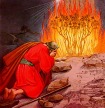
Moses was born a Hebrew but was raised by Pharoah’s daughter as her own child. As an adult Moses was aware of his heritage and he killed an Egyptian to rescue a Hebrew slave and had to flee from Egypt. Moses escaped to the southern Sinai peninsula in an area occupied by nomadic shepherds and he became a shepherd also.

About forty years later God revealed Himself to Moses in a burning bush and commissioned Moses to return to Egypt to lead the Israelites out of slavery. When Moses saw the burning bush, he was amazed not that the bush was burning, but that it wasn’t consumed by the fire. So he came closer to inspect the bush and when he did, God spoke the words in these verses to Moses.

God informed Moses that the soil around the bush through which He was speaking was holy ground because it contained His presence while the soil on the bottom of Moses’ sandals was common or unclean.

The common or unclean cannot touch the holy without being transformed into being holy or else being destroyed. From this point on, holiness becomes the primary descriptor of God in the Old Testament.

Holy means “set apart” and God made it clear that He was absolutely “other” than his creation.

Moral perfection is also a central idea of the term “holy.”

The one true God is the only One Who truly stands apart from this world and is worthy of being called “holy” in this general sense.

God stands apart from His creation and He is perfectly consistent and moral in his character.

So, here, at the burning bush, God revealed to Moses his otherness. Later at Mt. Sinai when God gave the law to Moses He revealed his moral character.

God’s holiness means God’s moral otherness.

What’s significant about God’s holiness is that God calls us to be like Him. God calls us to holiness. God calls us to moral otherness. God calls us to live distinct from the world, but live righteously in the world.

And there’s a good reason why!

God wants us to be holy so He can enter into a relationship with us…because the common or unclean cannot touch what is holy.

Only what is holy can enter into God’s presence

The Holy One can only be approached by one who is holy!

To receive and live out God’s moral otherness, His holiness, in our lives, we must let our Holy God transform us by the power of the cleansing blood of Christ and the purifying indwelling of the Holy Spirit from unclean and common into people who are holy!

“So also Jesus suffered and died…to make his people holy by means of his own blood.” (Hebrews 13:12, NLT)

Examine the Fruit – Matthew 12:33,35

“A tree is identified by its fruit. If a tree is good, its fruit will be good. If a tree is bad, its fruit will be bad…A good person produces good things from the treasury of a good heart, and an evil person produces evil things from the treasury of an evil heart.”  (Matthew 12:33,35, NLT).

Goodness is a quality that is only attributable to God.

And God’s redemptive purpose is not to create good people, but to establish His goodness in the human heart.

So God’s plan for you is not just to clean you up, but to shape and form the character of your being for eternity.

God wants to do an inside job on you!

He knows that it is what is on the inside—your character, your heart, your soul—that determines what you will do with what is on the outside—your words and behavior.

According to Jesus, it is relatively simple to determine what is on the inside of a person.

You examine their fruit!

When you purchase fruit at the store, you pick it up and look it over before you place it in your shopping cart. It’s the same way with people.

You hear what they say and see how they behave: “Yes, just as you can identify a tree by its fruit, so you can identify people by their actions” (vs. 7:20).

What you say and do are indicative of what’s in your heart.

What do people hear and see coming from your heart? Do you  pass the fruit exam? Are you a tree that bears good fruit?

Let the words you speak and the way you live demonstrate that Jesus lives in your heart!

“So you see, we are shown to be right with God by what we do, not by faith alone” (James 2:24,NLT),

Adapted from The Kingdom Order: Living for the Future in the Present, by Steven C. Mills

Truth Professionals – 1 John 1:6-7

“If we say we have fellowship with him while we walk in darkness, we lie and do not practice the truth. But if we walk in the light, as he is in the light, we have fellowship with one another, and the blood of Jesus his Son cleanses us from all sin.” The Apostle John says in the preceding verse (vs. 5) that God is light. Therefore, those who walk in darkness are not walking with God, no matter what they say. John says that if you are walking in darkness then you are not practicing the truth. By contrast, those who walk in the light reflect God’s glory; they walk in the same way Jesus walked (vs. 2:6). The light in which they walk includes both correct doctrine (truth) and God’s moral law (holiness). If you “walk in the light” then you practice the truth and your behavior is consistent with your doctrine. When you live your life each day according to God’s redemptive love and moral law, then you are living the truth. You are like a practitioner of the truth, a truth professional. Just as doctors practice medicine and attorneys practice the law, Christians practice truth. As a practitioner of truth, when you “walk in the light” then your life is known to others: “You are the light of the world…let your light shine before others, so that they may see your good works and give glory to your Father who is in heaven” (Matthew 5:14-16). Be a truth professional and let the way you live your life and the way you say you live your life be one in the same and to the glory of God, and the blood of Jesus Christ will cleanse you from all sin.

God’s China Cabinets – 2 Timothy 2:20-21

“Now in a great house there are not only vessels of gold and silver but also of wood and clay, some for honorable use, some for dishonorable. Therefore, if anyone cleanses himself from what is dishonorable, he will be a vessel for honorable use, set apart as holy, useful to the master of the house, ready for every good work.” Many homes have a china cabinet that holds the “good” dishes and flatware. These dishes and eating utensils have been set apart and specially cleaned and shined so that they are ready to be used at meals prepared for holidays and special occasions. In the kitchen there are drawers and cabinets with assortments of plates, cups, pots, pans, and cooking utensils that are used for the regular preparation and serving of meals. The challenge Paul presents to Timothy is that of how he will be used of God. Timothy and all of us will be used of God, but will it be as vessels for honorable use or vessels for dishonorable use? We get to make that choice! If we choose honorable use, then we must cleanse or purify ourselves by laying hold of the provision of grace and redemption that has been given to us by God and flee evil and pursue godliness (vs. 22). Choose to be a vessel of honorable use just like those good dishes in the china cabinet, specially cleaned (holy) and ready for any special occasion (every good work)!