
Be a Blessing, Share the Gospel – Genesis 48:20

“So Jacob blessed the boys that day with this blessing: The people of Israel will use your names when they give a blessing” (Genesis 48:20, NLT)
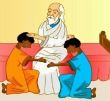
Before Jacob (Israel) died, he blessed Joseph and his two sons, Manasseh and Ephraim.

First, he adopted Joseph’s sons, which entitled them to part of the inheritance of the promised land. Then he gave Ephraim, the younger of Joseph’s son, the right-hand blessing, which was the right to inheritance entitled to the eldest son.

Centuries later when God delivered the Israelites from Egyptian slavery and they possessed the land of Canaan, the tribes of Ephraim and Manasseh each received a portion of the land distribution.

Ephraim eventually became the leading tribe in the northern kingdom of Israel and the Old Testament prophets sometimes referred to the entire northern kingdom as Ephraim.

Blessing was used in the Old Testament to describe the conditions of covenantal relationships.

God, who is the ultimate Grantor of blessing, uses people to channel or convey His blessings. Thus, Abraham’s call by God to be a blessing was a missionary calling meant to convey God’s blessings to all the nations of the earth (Genesis 12:2-3).

When Jacob blessed Ephraim and Manesseh (and his other sons in vs. 49:3-28), he was conveying God’s blessing to the nation of Israel.

The nation of Israel, which was the successor to the Abrahamic covenant, was intended to be the channel for God’s blessing to all nations.

Declaring the gospel is the New Testament expression of the Old Testament blessing.

When Jesus commissioned His followers to go and make disciples of all nations (Matthew 28:18-20), theirs was a missionary calling under the new covenant.

Just as God called Abraham to be a blessing to all nations, Jesus called His disciples to be a blessing to all nations by proclaiming the gospel.

So, be a blessing, share the gospel!

“For I am not ashamed of this Good News about Christ. It is the power of God at work, saving everyone who believes—the Jew first and also the Gentile.” (Romans 1:16, NLT)

The One Who Sees and Hears You- Genesis 16:11,13

“And the angel also said, You are now pregnant and will give birth to a son. You are to name him Ishmael (which means God hears), for the Lord has heard your cry of distress…Thereafter, Hagar used another name to refer to the Lord, who had spoken to her. She said, You are the God who sees me.” Sarah, Abraham’s wife, gave Hagar, her servant, to Abraham as a concubine so that she would have Abraham’s child as was the social custom for a barren wife. God had promised Abraham and Sarah they would have a son and and the number of their descendants would be as numerous as the stars (vs. 15:5). Because they were both elderly (Abraham was 99 and Sarah was ten years younger), they were skeptical that God’s promise could be fulfilled through them so they tried to work it out themselves. When Hagar became pregnant, she began to treat Sarah with contempt. In return Sarah treated Hagar harshly and Hagar ran away. Hagar was beside a spring of water when an angel of the Lord appeared to her and told her to return and submit to Sarah and promised that her son, whom she would name Ishmael, would also have more descendants than she could count (vs. 15:9). Hagar named the well Beer-lahai-roi, which means “well of the Living One who sees me.” The name of the well and the name, Ishmael, which means “God hears” were reminders to Abraham and Sarah that God sees affliction and hears the cries of those in need. Sarah and Abraham should have asked God for help (as did their son Isaac in Genesis 25:21) rather than taking the fulfillment of God’s promise into their own hands. What seems like impossible difficulties can be resolved through God’s intervention. God sees the difficulties and hears the cry of the afflicted and can miraculously resolve the problem. God is the One Who Sees and Hears you. He sees your difficulty and hears your cries for help and He will answer and intervene on your behalf.