
“And you were dead in the trespasses and sins in which you once walked, following the course of this world, following the prince of the power of the air, the spirit that is now at work in the sons of disobedience—among whom we all once lived in the passions of our flesh, carrying out the desires of the flesh and the mind, and were by nature children of wrath, like the rest of mankind. But God, being rich in mercy, because of the great love with which he loved us, even when we were dead in our trespasses, made us alive together with Christ—by grace you have been saved—and raised us up with him and seated us with him in the heavenly places in Christ Jesus, so that in the coming ages he might show the immeasurable riches of his grace in kindness toward us in Christ Jesus. For by grace you have been saved through faith. And this is not your own doing; it is the gift of God” (Ephesians 2:1-8, ESV).
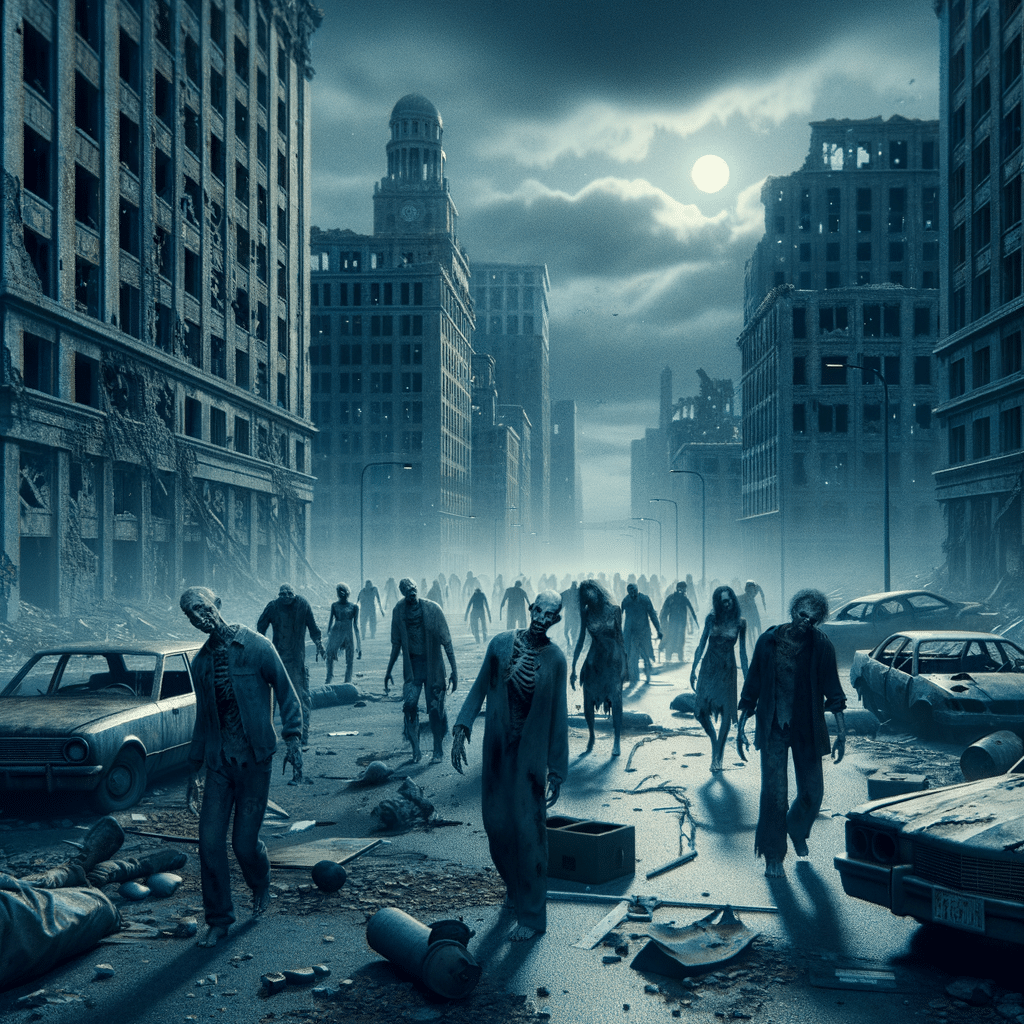
A zombie apocalypse is coming according to many current movies and televisions shows fixated on zombies. In the movies the zombie apocalypse is a fictional world where societal collapse occurs due to an overwhelming outbreak of undead, infectious human beings.
But maybe the zombie apocalypse is already here!
In these verses from the Apostle Paul’s letter to the Ephesians the zombie apocalypse may not be so fictional and it may have already arrived! Ephesians 2:1-2 indicate there is already an overwhelming outbreak of the walking dead causing societal collapse: “And you were dead in the trespasses and sins in which you once walked, following the course of this world, following the prince of the power of the air, the spirit that is now at work in the sons of disobedience” (vs. 1-2).
According to Paul, there is walking dead everywhere. He says it is the way of this world. So, we live in a fallen world that is overwhelmingly inhabited by people who are spiritually dead!
Because the zombie apocalypse seems to have started with Adam and Eve in the Garden of Eden!
The deliberate rejection of God’s rule in favor of human rule.described in Genesis 3 resulted in separation from God’s Spirit and access to eternal life and the consequential spiritual death of human beings: “Then the Lord God said, “Behold, the man has become like one of us in knowing good and evil. Now, lest he reach out his hand and take also of the tree of life and eat, and live forever—” therefore the Lord God sent him out from the garden of Eden to work the ground from which he was taken. He drove out the man, and at the east of the garden of Eden he placed the cherubim and a flaming sword that turned every way to guard the way to the tree of life” (Genesis 3:22-24, ESV).
Yes, according to the Bible, the zombie apocalypse has always been here since Adam and Eve were expelled from the Garden of Eden! And, according to the Bible God has formulated a way for us to survive the zombie apocalypse.
The priest turned prophet, Ezekiel, prophesied during the Babylonian exile. Around 597 BC many Israelites including Ezekiel were taken to Babylon after King Nebuchadnezzar conquered Jerusalem. Ezekiel prophesied among these exiles.
Ezekiel had a vision of the restoration of God’s chosen people–it was a vision of dead bones coming back to life: “Then he said to me, “Prophesy over these bones, and say to them, O dry bones, hear the word of the Lord. Thus says the Lord God to these bones: Behold, I will cause breath to enter you, and you shall live. And I will lay sinews upon you, and will cause flesh to come upon you, and cover you with skin, and put breath in you, and you shall live, and you shall know that I am the Lord.” (Ezekiel 37:4-6, ESV).
But in Ezekiel’s vision God does something more to these dry bones to bring them back to life to make them more than just walking dead: “And I will put my Spirit within you, and you shall live, and I will place you in your own land. Then you shall know that I am the Lord; I have spoken, and I will do it, declares the Lord” (Ezekiel 37:14, ESV).
God restores their spiritual life. By putting His Spirit in them He makes them whole or complete like the human beings He created in Genesis 1 and 2!
God takes the walking dead and gives them eternal life. Because God is “rich in mercy” and because of His “great love” and the “immeasurable riches of His grace in kindness” toward human beings, God takes spiritually dead people and makes them alive in Christ.
The life of God’s Spirit that was lost in Eden is now restored to those who have received the gift of salvation and eternal life through Jesus Christ.
They are the survivors of the zombie apocalypse!
If the Spirit of him who raised Jesus from the dead dwells in you, he who raised Christ Jesus from the dead will also give life to your mortal bodies through his Spirit who dwells in you. (Romans 8:11, ESV)


 Steve's Bible Meditations