
First published October 2, 2010 and edited for re-publication here.
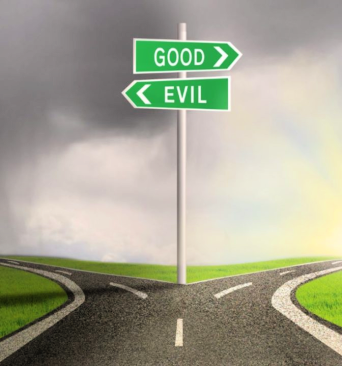
“But solid food is for the mature, whose senses are trained by practice to distinguish between good and evil” (Hebrews 5:14, CSB).
As I have grown older and lived through many social and cultural changes in our world, one of my biggest concerns for our younger generations is the blurring of the line between good and evil.
With all the information that confronts us every minute of every day in this digital age in which we live, it becomes more difficult for some to distinguish between what’s right and what’s wrong!
But, discernment between good and evil is a fundamental proposition of our humanity and morality. In the Bible, it’s a compelling part of the Creation story. And, it’s a basic element of humanity’s separation from God and the rationale for God’s cosmic plan for the redemption of humanity.
In fact, I believe that if you can’t/don’t recognize evil, you can’t/won’t recognize your need for redemption.
The Hebrews writer rebukes the Hebrew Christians for their immaturity in their faith in Christ. The writer claims the Hebrew Christians should have matured enough in the faith to instruct others about the Kingdom of God, but they seem not to have progressed to spiritual adulthood.
He says that spiritually they need milk instead of solid food. In other words, they act like spiritual babies who require someone to feed them milk instead of grown-up Christians who can feed themselves solid food.
The Hebrews writer identifies a Christian who is spiritually mature as one who has the ability to discern between good and evil–to know what is God’s will and what is not (cf. Genesis 3:5).
Just as children learn right and wrong as they grow up, the same is true for Christians. As they become spiritually mature, their conscience is refined and their spiritual awareness and sensitivity are enhanced.
And, this ability to discern good from evil, right from wrong, moral from immoral, God’s will from God’s prohibition might be the most important spiritual discipline you can develop, especially in the times in which we now live at the end of the ages.
Discernment is acquired by constant practice–by feeding oneself spiritually. What kind of practice might train you to distinguish good from evil? Certainly the spiritual disciplines of Bible study and prayer and fellowship with those with refined discernment can help you hone your spiritual skills.
So, it’s time for you and me to grow up–spiritually–into healthy, mature, discerning Christians so we can prepare those generations following us to confront the ages with the gospel.
For the time will come when people will not tolerate sound doctrine, but according to their own desires, will multiply teachers for themselves because they have an itch to hear what they want to hear. They will turn away from hearing the truth and will turn aside to myths. (2 Timothy 4:3-4, CSB)
 Steve's Bible Meditations